
Unbiased headlines. Facts, not spin.
Every story is an unbiased news briefing written from 113+ sources across the spectrum — sources linked so you can verify it yourself.
 health
Low Interest (4/10)
Event date: September 28, 2026
health
Low Interest (4/10)
Event date: September 28, 2026
Amazon Science Roundup: Conservation Maps Miss The Birds Most At Risk, A New Fire Fund Launches, And Ancient Tool-Makers Get A Second Look
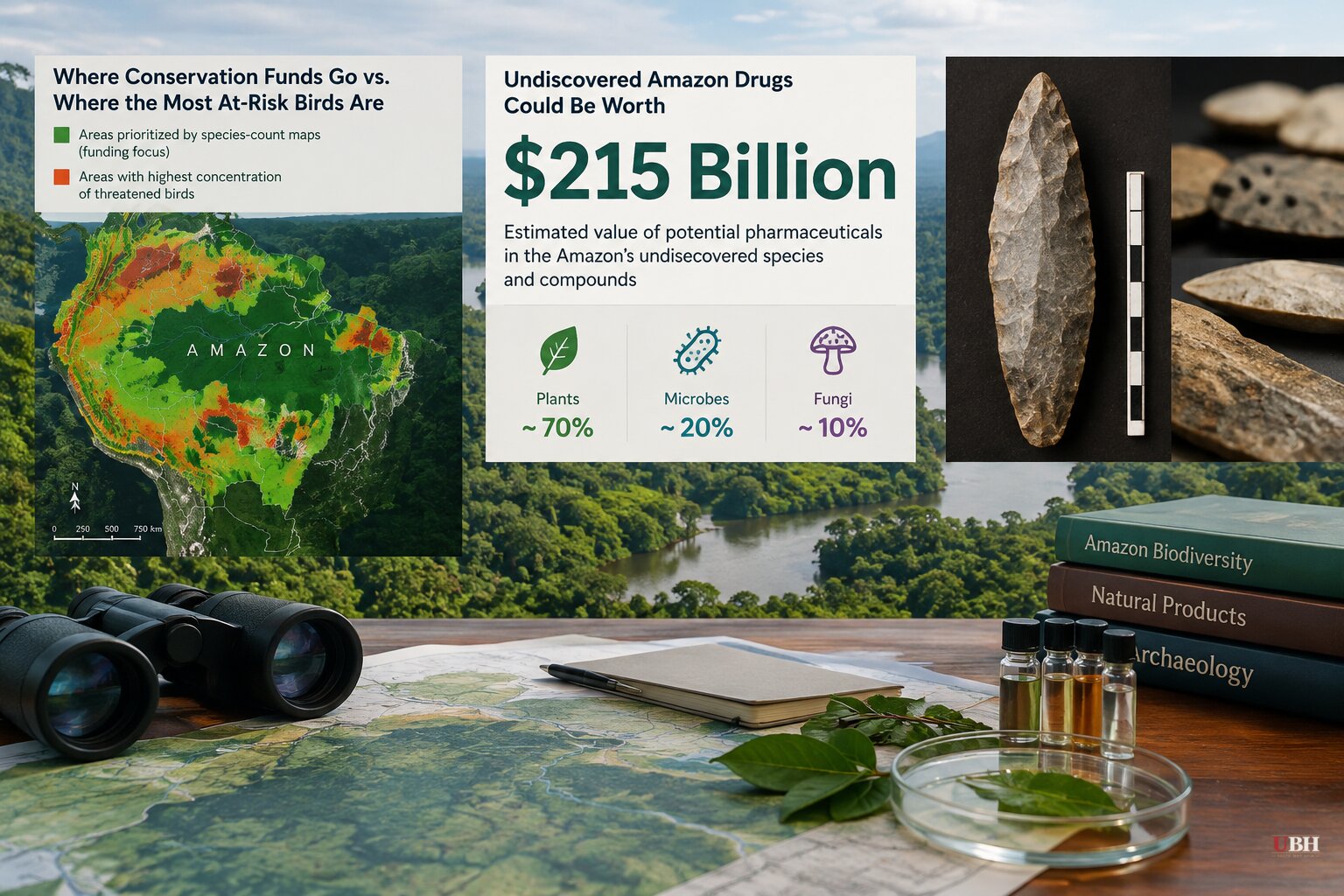
Conservation maps may be protecting the wrong forests
A study published in Nature Communications argues that the standard way conservationists decide which Amazon forests matter most, counting how many bird species live there, is missing the birds most likely to disappear.
The research, led by George Olah of the Australian National University and Greg Asner, director of Arizona State University's Center for Global Discovery and Conservation Science, used the Global Airborne Observatory to read the chemical fingerprint of forest canopies across Peru. The plane's imaging spectrometer measures nitrogen, phosphorus, calcium, water content and other leaf chemicals from the air, sorting Peru's forests into 36 classes and six broader functional groups, according to Earth.com.
Olah's team matched those forest types to bird data. Earth.com reports the analysis started with 1,893 forest-dependent species and narrowed to 1,331 with complete records; Tech Times, covering the same study, put the figure at "more than 1,492" forest-dependent species. Neither outlet reconciles the difference, and it isn't clear from either report whether they're citing the same stage of the dataset.
The headline finding, per Tech Times, is that slow-breeding birds in swamp forests carry the highest extinction risk, and that risk is written into the canopy's chemistry rather than into how many species a patch of forest holds. Asner told Earth.com the goal is to map "the diversity and composition of the canopy itself and how the ecosystem functions," not just where trees stand. Earth.com also notes an important limit: the study compares where species' ranges overlap with forest type, not how many birds actually live in a given patch, so it describes risk geography, not population counts.
Peru holds roughly 18% of the world's bird species and forest covers more than 60% of its land, according to Earth.com, which is why the country was the test case.
The $215 billion case for what's still standing
A separate analysis from the London-based group Zero Carbon Analytics, released in July and reported by ZME Science via Mongabay, estimates that tropical forests worldwide could hold a median $714 billion in undiscovered drug value from flowering plants, with a modeled range of $382 billion to $1.176 trillion. The Amazon accounts for roughly $215 billion of that, about 30% of the global total, the largest regional share ZCA identified.
That figure is a projection, not a discovered or verified asset. Roughly three in four cancer drugs approved between 1940 and 2014 were derived from or inspired by natural compounds, and an estimated 99% of the chemical compounds plants produce have never been screened, ZCA co-author Joanne Bentley-McKune told Mongabay. Deforestation since 2001 has already erased an estimated $86 billion of that global potential, according to ZCA, with some Amazon endemic species possibly gone before they were ever cataloged.
Bráulio Ferreira de Souza Dias, director of conservation and sustainable use of biodiversity at Brazil's Ministry of Environment, told Mongabay that Brazil holds the title of most biodiverse country on Earth but that no more than 10% of its biodiversity is known to science, with a new plant species described roughly every two days. He pointed to a practical obstacle: most of Brazil's federal science funding flows to São Paulo and Rio de Janeiro, with less than 3% reaching the Amazon region itself, and the unexplored interior between rivers, the interflow, remains largely uncharted because reaching it requires the roads that threaten it.
A private fund bets on targeted action, not blanket bans
Against that backdrop, Renaissance Philanthropy and Conservation X Labs launched the South America Fire Fund during Climate Week in New York, announced September 25, with anchor funding from the Gordon and Betty Moore Foundation and the David and Lucile Packard Foundation, according to PR Newswire. It's a three-year, privately funded effort targeting the Amazon, the Pantanal wetland and the Chiquitania dry forest, and it is not a government program.
"We're facing the possibility that we might lose the Amazon altogether, and once we lose the Amazon, we don't get it back, the next couple of years are really going to matter," said Kumar Garg, president of Renaissance Philanthropy.
Alex Dehgan, CEO of Conservation X Labs and the fund's director, framed the fires as a matter of human choice rather than natural disaster: "Nearly every fire in the basin is lit by a person, which means nearly every fire was a decision somebody made." The fund's stated approach is to target the specific actors and incentives behind land-clearing fires rather than impose across-the-board burn bans, which PR Newswire's release says have already fallen short.
This approach is defensible. Critics of a purely voluntary, incentive-based approach could reasonably argue that without binding government enforcement against the cattle and soy operations driving the bulk of Amazon clearing, philanthropic pilot projects won't scale fast enough to matter. None of the sources here document how the new fund plans to resolve that tension, and the fund itself is only weeks old, so its effectiveness is untested.
Also in science: what 500 spear points say about risk
Unrelated to the Amazon research, a study in the Journal of Archaeological Method and Theory, authored by Jesse W. Tune of the University of Mississippi and D. Shane Miller of the University of Alabama, examined 489 Ice Age projectile points from Tennessee's river valley, per the Times of India. Clovis hunters, who arrived roughly 13,200 years ago, resharpened their points more heavily than the later Cumberland people who followed, per records in the Paleoindian Database of the Americas. The researchers argue that pattern reflects how newcomers to unfamiliar territory managed the risk of running out of usable stone, versus groups who already knew where to find more.
Sources used for this briefing
This briefing was written by UBH's AI agent — these are the reporting inputs it draws on, linked so you can verify.


