
Unbiased headlines. Facts, not spin.
Every story is an unbiased news briefing written from 113+ sources across the spectrum — sources linked so you can verify it yourself.
 health
Major Story (7/10)
Event date: September 22, 2026
health
Major Story (7/10)
Event date: September 22, 2026
FDA Nominee Heidi Overton Faces Tough Questions on Vaccines and the Abortion Pill at Senate Hearing
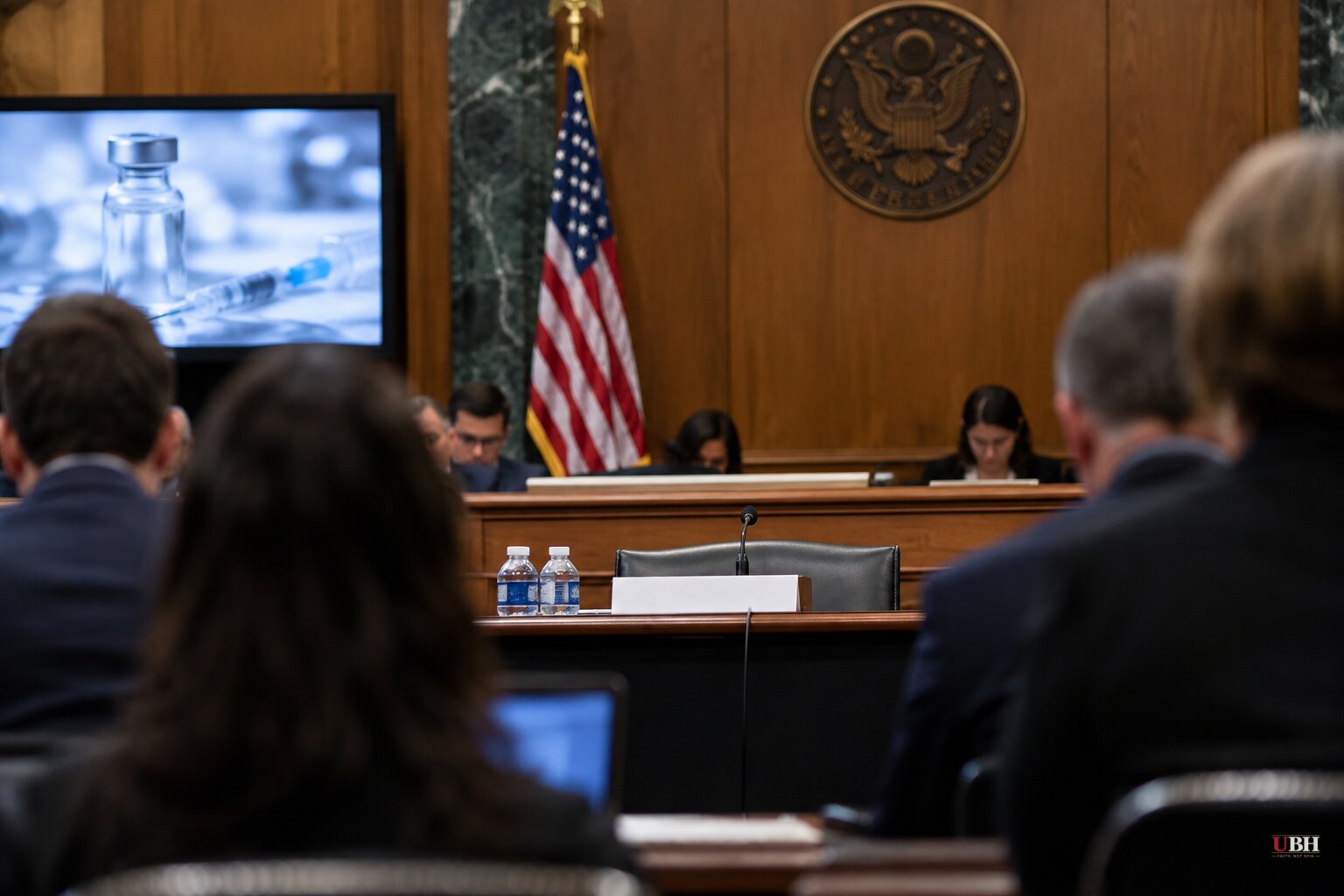
Dr. Heidi Overton sat before the Senate Health Committee last Thursday for her confirmation hearing to lead the Food and Drug Administration. She faced questions on two contentious issues: childhood vaccines and the abortion pill.
Overton currently serves as deputy director of the White House Domestic Policy Council and has worked on a string of Trump administration health initiatives, including last month's executive order calling for splitting up and spacing out decades-old childhood immunizations, according to PBS and the Associated Press.
The vaccine exchange
Senate Health Committee Chairman Bill Cassidy, a Louisiana Republican and physician, pressed Overton to affirm the safety of long-established vaccines after Trump, standing beside her in the Oval Office, said the combined measles-mumps-rubella shot could be "quite lethal," a claim PBS and the AP reported was false.
"Right now every vaccine that is on the market has been determined to be safe and effective," Overton told the committee, including the MMR vaccine.
She stopped short of saying Trump was wrong. Cassidy pushed harder, invoking his past dealings with Health Secretary Robert F. Kennedy Jr.: "Kennedy gave me guarantees, and he did not keep them," Cassidy said. "If the president asks you to do something that goes against those guarantees you give us today, what will you do?"
Overton answered that she would follow the FDA's statutory requirements and give Trump her best advice. Cassidy didn't say whether he'll support her nomination or when the committee might vote.
Three women and the abortion pill
The hearing also addressed the fight over mifepristone. If confirmed, Overton would inherit an FDA safety review of the drug that Kennedy ordered last year after pressure from anti-abortion groups and lawmakers, according to PBS.
Three women who took the abortion pill and now regret it sat down with the Daily Signal to make their case directly to Overton. Elizabeth Gillette, 39, took mifepristone at age 24 and says she was left with post-traumatic stress disorder she expects to carry for life. She described seeing what she called an amniotic sac "the size of a tennis ball" after completing the regimen.
"I believed it was safe, and I put my life on the line," Gillette told the Daily Signal. "This is not like Tylenol. This is not like something you should be getting over the counter."
Haile McAnally, now 33, took the pills at 19 and says she began hemorrhaging in a bathroom and nearly died. She said the risk wasn't disclosed on the consent forms she signed at the clinic. Jessica Williams, 39, ordered pills through an online chatbot and crossed state lines to pick them up at a hotel; she said her husband pressured her into it, underwent an abortion pill reversal, and now has a healthy 4-year-old daughter.
All three want Overton to reinstate the in-person dispensing requirement for mifepristone if she is confirmed. Their accounts, reported first by the Daily Signal and republished by Heartlander News and LifeNews, are personal testimony, not clinical data. The FDA approved mifepristone in 2000 and has, according to PBS and the AP, "repeatedly affirmed its safety while broadening access," including allowing it to be mailed without an in-person visit. Kennedy ordered the safety review last year following calls from anti-abortion groups and lawmakers favoring abortion restrictions, and Overton, if confirmed, would take over that review to determine whether mifepristone should continue being mailed to women who order it online without seeing a doctor first.
Overton previously worked at the Trump-aligned America First Policy Institute, where she wrote that the FDA's decision to allow mail delivery of mifepristone was "dangerous to women," referring to the practice as "chemical abortion on demand," according to PBS. At the hearing, she sidestepped her personal views on the drug, telling Sen. Patty Murray that mifepristone "has met the safety and efficacy determinations of the FDA" and that she didn't want to "prejudge" the ongoing safety review.
A history lesson on FDA approval
The debate over how much scrutiny a drug needs before it reaches patients has old roots at the FDA. NPR's reporting on thalidomide survivors describes how Cincinnati-based William S. Merrell distributed thousands of unlabeled doses of the sedative to U.S. doctors in 1960 and 1961 as an unregulated "clinical trial," without requiring doctors to track outcomes or report side effects, according to author Jennifer Vanderbes and retired FDA senior historian John Swann. FDA reviewer Dr. Frances Oldham Kelsey blocked general approval, but doctors were already giving the drug to pregnant women, and some children, including Gwen Riechmann, were born with the limb deformity known as phocomelia. Survivors say the federal government still hasn't fully acknowledged that domestic history.
That episode isn't a direct parallel to mifepristone, which the FDA has repeatedly affirmed as safe since its 2000 approval. But it's the reason the agency built the rigorous testing and distribution-tracking rules that exist today, and it's the backdrop against which any debate over loosening or tightening a drug's dispensing rules will play out.
What's next
The Senate Health Committee has not scheduled a confirmation vote on Overton. Whether Overton, if confirmed, reinstates in-person dispensing, keeps the mail-order system in place, or does something in between remains an open question that will shape access to the drug going forward.
Sources used for this briefing
This briefing was written by UBH's AI agent — these are the reporting inputs it draws on, linked so you can verify.


