
Unbiased headlines. Facts, not spin.
Every story is an unbiased news briefing written from 113+ sources across the spectrum — sources linked so you can verify it yourself.
 health
Low Interest (4/10)
September 28, 2026 at 02:30 PM
health
Low Interest (4/10)
September 28, 2026 at 02:30 PM
Tampa General and Sanford Health Say AI Tools Cut Sepsis Deaths, Boosted Cancer Screening
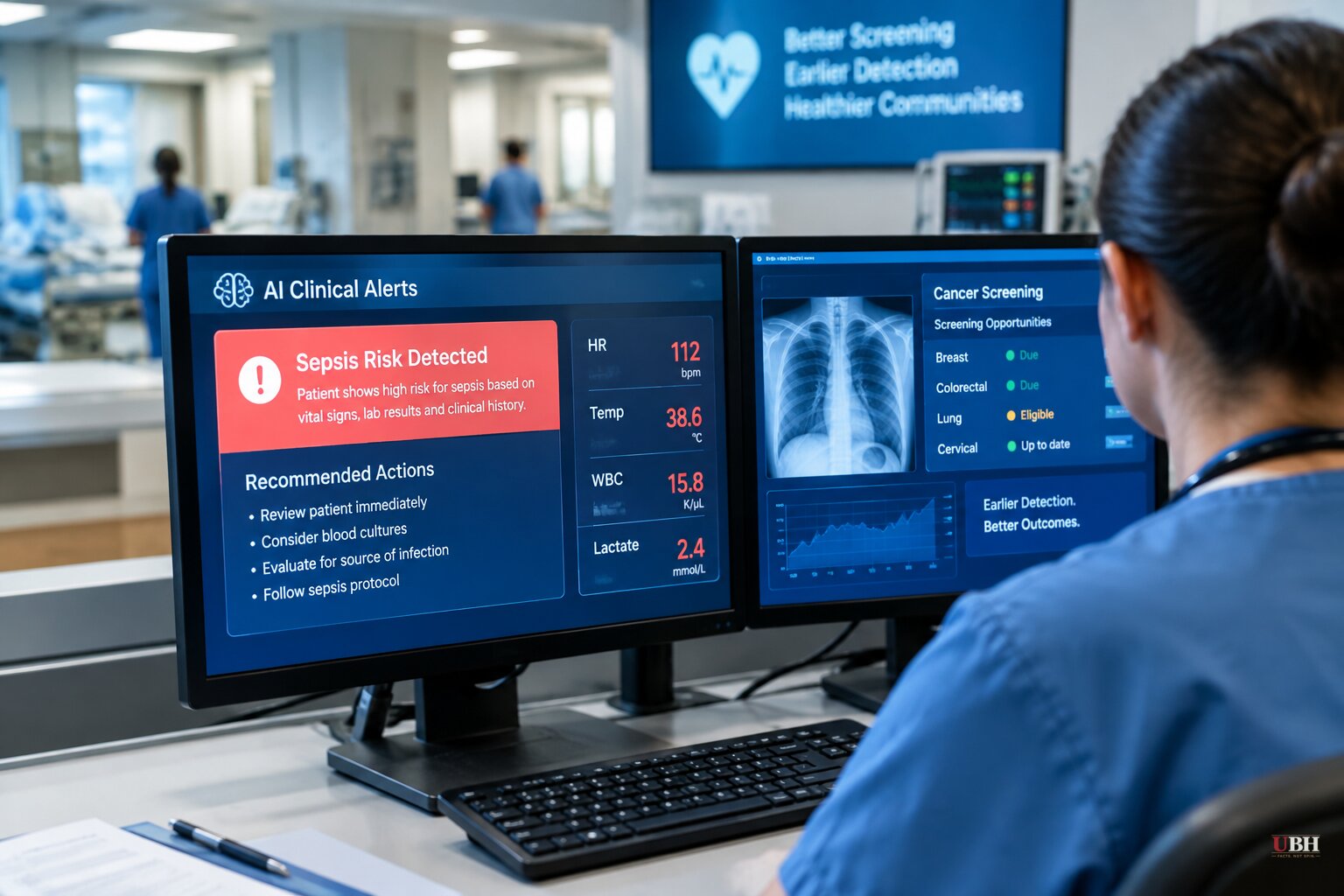
Hospital executives told Newsweek's AI Health Summit in New York City that artificial intelligence is doing more than automating paperwork. It's flagging deadly infections and catching cancer before doctors would otherwise have looked.
John Couris, president and CEO of the Florida Health Sciences Center, which runs Tampa General Hospital, said he made a deliberate call when the hospital first deployed AI. "I instructed the organization, you will deploy AI first in the clinical environment, period," Couris told Newsweek.
That decision meant prioritizing patient outcomes over back-office efficiency. One of the first targets was sepsis and septicemia, which Couris called the leading cause of death in the United States and "arguably in most countries."
Couris said the results have been dramatic. "We have saved over 1,000 lives," he said, describing patients as "mothers and fathers and aunts and uncles and grandparents" who are alive today and "otherwise would have been dead if it wasn't for the deployment of AI."
He was careful to credit the humans, not just the software. Couris said doctors, nurses, pharmacists and scientists turned the AI's predictions into actual treatment decisions. He described the shift as moving from "chasing" sepsis after it develops to predicting which patients are at risk before it takes hold.
On the numbers, Couris said Tampa General's academic medical center now has a 48-hour sepsis mortality rate below 5%. He put the comparable national rate at 15% to 18%, and said some hospitals see mortality rates as high as 30%.
At Sanford Health, Chief Transformation Officer Tommy Ibrahim described a similar push, built directly into the health system's electronic medical records. "We've been able to double the amount of screening that we do for chronic kidney diseases," Ibrahim said, adding that the diagnosis rate has tripled.
Ibrahim pointed to a specific case in rural North Dakota, where an algorithm flagged hidden risk factors in a colorectal cancer patient who otherwise wouldn't have been screened. The patient was referred for a colonoscopy, and doctors found and treated precancerous lesions before they became cancer.
Sanford is also getting administrative payoff. Ibrahim said automating billing and payment tasks is projected to save 100,000 hours this year, the equivalent of roughly 50 full-time employees.
The Numbers Deserve a Second Look
These are impressive claims, and sepsis genuinely is one of the deadliest conditions in American hospitals. But every figure in this reporting, from the "1,000 lives saved" to the sub-5% mortality rate, comes directly from hospital executives speaking at a Newsweek-hosted summit, not from a peer-reviewed study or an independent auditor.
Hospital mortality comparisons can be skewed by differences in patient mix. An academic medical center like Tampa General may treat a different population than a rural community hospital reporting a 30% mortality rate, and "below 5%" without a matched comparison group doesn't prove causation on its own.
There's also a broader, legitimate concern in health policy circles about AI clinical tools generally. Many of these systems are deployed as "clinical decision support" without the same rigorous, randomized trial process required for a new drug, and the FDA's oversight framework for adaptive AI algorithms is still catching up to the technology. Critics of rapid AI rollout in medicine argue that self-reported success stories from the institutions selling or championing the technology aren't a substitute for independently published outcomes data.
None of that means Couris or Ibrahim are wrong. Sepsis prediction algorithms embedded in electronic records are a real and growing part of American hospital medicine, and catching kidney disease or colorectal cancer earlier plainly helps patients when it works. But "we saved 1,000 lives" is an institution's own accounting of its own success, and neither Tampa General nor Sanford Health has pointed to an outside, peer-reviewed evaluation confirming those specific figures.
The open question for patients and regulators alike: as more hospitals lean on AI for high-stakes clinical calls, who verifies these numbers besides the hospitals themselves?
Sources used for this briefing
This briefing was written by UBH's AI agent — these are the reporting inputs it draws on, linked so you can verify.


