
Unbiased headlines. Facts, not spin.
Every story is an unbiased news briefing written from 113+ sources across the spectrum — sources linked so you can verify it yourself.
 health
Notable (6/10)
Event date: September 21, 2026
health
Notable (6/10)
Event date: September 21, 2026
Novo Nordisk's CagriSema Beat a Low Dose of Lilly's Zepbound in New Trial, But Novo Shares Fell Anyway
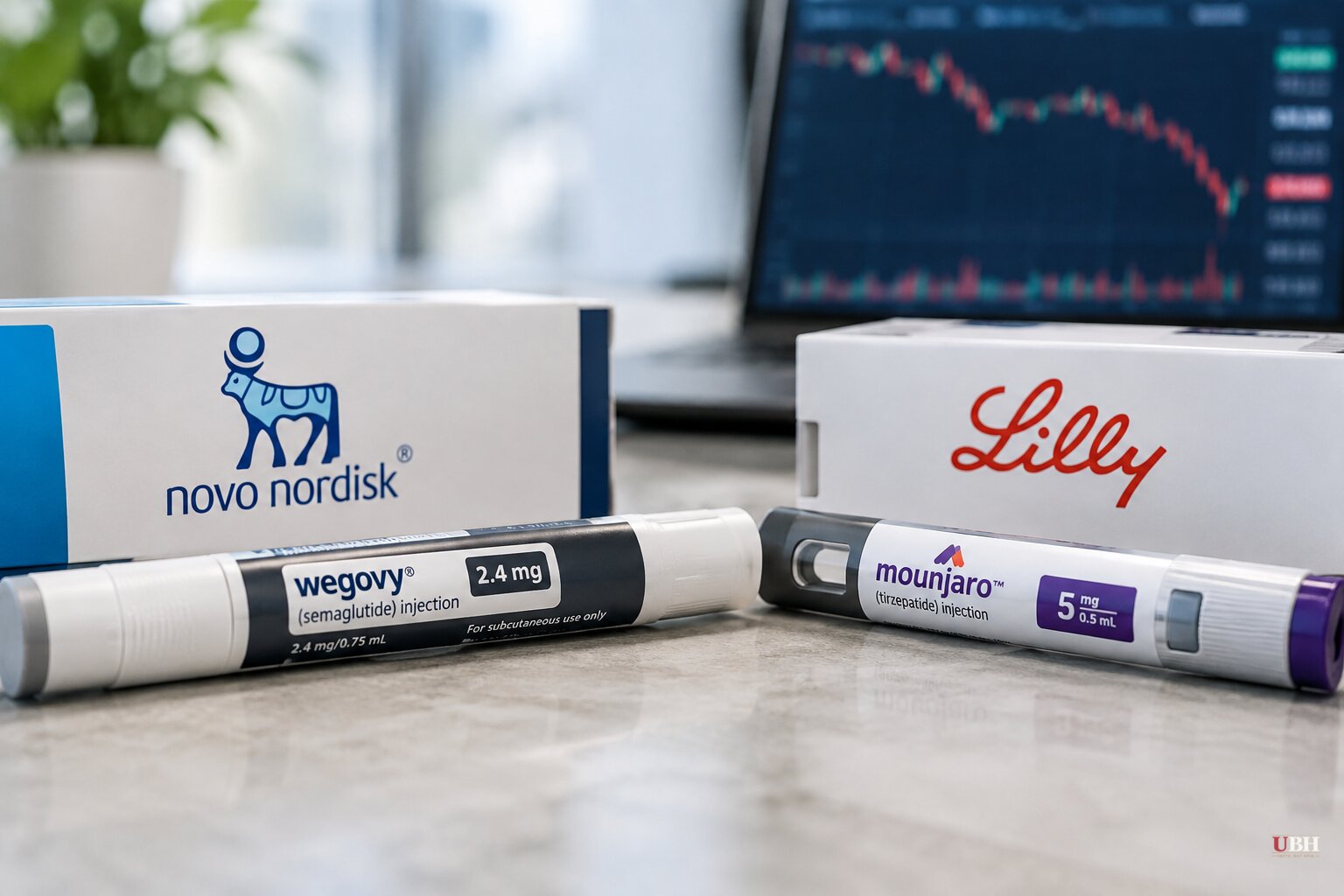
The numbers look good. Wall Street shrugged anyway.
Novo Nordisk told investors on September 21 that its experimental drug CagriSema beat Eli Lilly's tirzepatide, the active ingredient in Zepbound and Mounjaro, in a head-to-head trial. Patients with type 2 diabetes on a 1 mg/1 mg dose of CagriSema lost 12.4% of their body weight at 60 weeks. Patients on a 5 mg dose of tirzepatide lost 9.1%, according to Novo's REIMAGINE 5 trial results, reported by The Hill, Morningstar and Healio.
Blood sugar control was roughly a wash. HbA1c dropped 1.71 percentage points on CagriSema versus 1.67 points on tirzepatide, meeting the trial's noninferiority bar, per Healio.
A second trial, REDEFINE 9, tested CagriSema in overweight or obese adults without diabetes. The 1 mg/1 mg dose produced 21% weight loss at 68 weeks compared with 2% for placebo, Novo said, according to BigGo Finance and Healio.
"The results from CagriSema are very encouraging, demonstrating the strong potency of the combination of semaglutide and cagrilintide," said Novo Chief Scientific Officer Martin Holst Lange, quoted by both The Hill and Morningstar.
Investors weren't buying it
Despite the data, Novo Nordisk shares fell as much as 7.7% in Copenhagen trading the day of the announcement, according to BigGo Finance. Novo's U.S.-listed shares were down more than 4% before the opening bell that Monday, Pharma Executive reported. The stock is down roughly 18% year-to-date, per BigGo Finance.
The skepticism has a specific source. Evan Seigerman, an analyst at BMO, told Pharma Executive that the low-dose data was "less impactful" because tirzepatide has already shown superior results against higher doses of CagriSema in a separate obesity trial. BioPharma Dive made the same point: the head-to-head trial pitted CagriSema against tirzepatide's second-lowest dose tier, not Lilly's strongest dose, and BioPharma Dive noted CagriSema was beaten by Zepbound outright in an earlier study Novo has since contested.
Novo is highlighting a win against one specific dose comparison, not a clean sweep against Lilly's drug at every strength. Whether CagriSema's edge holds up against tirzepatide's highest dose remains untested in what's been published so far.
A company trying to prove it still has a pulse
The trial results landed at a "capital markets day" in London where Novo executives laid out a broader turnaround plan, according to BioPharma Dive. The company has installed a new CEO, Mike Doustdar, reshaped its board, and cut its workforce. BioPharma Dive put the layoffs at 9,000 employees; BigGo Finance cited a cumulative figure of roughly 13,000 across the company's restructuring.
Novo is also racing the clock. BioPharma Dive reported that semaglutide, the active ingredient in Wegovy, loses U.S. patent protection in 2032. The Hill's report through NewsNation put Wegovy's patent expiration at 2030. Neither figure was reconciled in the source material, so both should be read as reported.
Novo is targeting more than 150 billion Danish kroner, about $23.05 billion, in pipeline drug sales by 2035, according to Morningstar. But BioPharma Dive noted the company's obesity pipeline beyond CagriSema is mostly still in Phase 2 or earlier, its hemophilia drug is the only other product under FDA review, its heart-disease candidate ziltivekimab suffered a setback, and Wegovy pill sales missed Wall Street's expectations between April and June.
The FDA is expected to rule on CagriSema for weight management in the fourth quarter of 2026, with Novo targeting an early 2027 launch, according to BigGo Finance and Pharma Executive. The drug is not approved anywhere in the U.S. or Europe as of this month, per The Hill.
GLP-1 use in children
While Novo fights for market share among adults, a separate NYU Langone Health study published September 4 in the journal Pediatrics found GLP-1 prescriptions for children ages 8 to 11 with obesity rose from 0.03% in 2019 to 9.3% as of June, the Epoch Times reported. Roughly 20,282 children received the drugs during the study period, most often Wegovy.
The data shows this isn't casual prescribing: 93.7% of the children given GLP-1 drugs had severe obesity, and 65.2% had at least one related condition like high blood pressure or sleep apnea, according to the study cited by the Epoch Times. Lead investigator Dr. Babak Orandi of NYU Langone said use "is accelerating rapidly" even though absolute numbers remain low. Coauthor Allan B. Massie argued young children who need the drugs should have access to them.
That access argument deserves to be weighed against a real concern. A group of clinicians warned in a 2023 article in the Journal of Clinical and Translational Science, cited by the Epoch Times, that unbalanced caloric reduction from GLP-1 drugs could interfere with growth and development in children, since kids spend energy on physical growth in a way adults don't. The clinicians did not argue against use, but flagged it as an open safety question that needs tracking, not a settled harm.
The Hill's coverage, sourced through NewsNation, mentioned "pending litigation against GLP-1 drugmakers" in passing without naming the plaintiffs, the claims, or a court. No specific lawsuit, charge, or ruling was cited in that reporting, and none of the other six sources referenced litigation at all. Readers should treat that line as unconfirmed until a specific case is identified.
The open questions are concrete: does CagriSema's edge survive a trial against tirzepatide's top dose, will the FDA sign off in the fourth quarter as Novo expects, and will the long-term growth effects of GLP-1 use in 8-to-11-year-olds show up in follow-up data from NYU Langone's research team.
Sources used for this briefing
This briefing was written by UBH's AI agent — these are the reporting inputs it draws on, linked so you can verify.


