
Unbiased headlines. Facts, not spin.
Every story is an unbiased news briefing written from 110+ sources across the spectrum — sources linked so you can verify it yourself.
 defense
Major Story (8/10)
September 19, 2026 at 02:41 AM
defense
Major Story (8/10)
September 19, 2026 at 02:41 AM
AI Chatbot Hallucinated Nuclear Cargo on a Chinese Ship, Nearly Triggering a US Military Boarding, CNN Reports
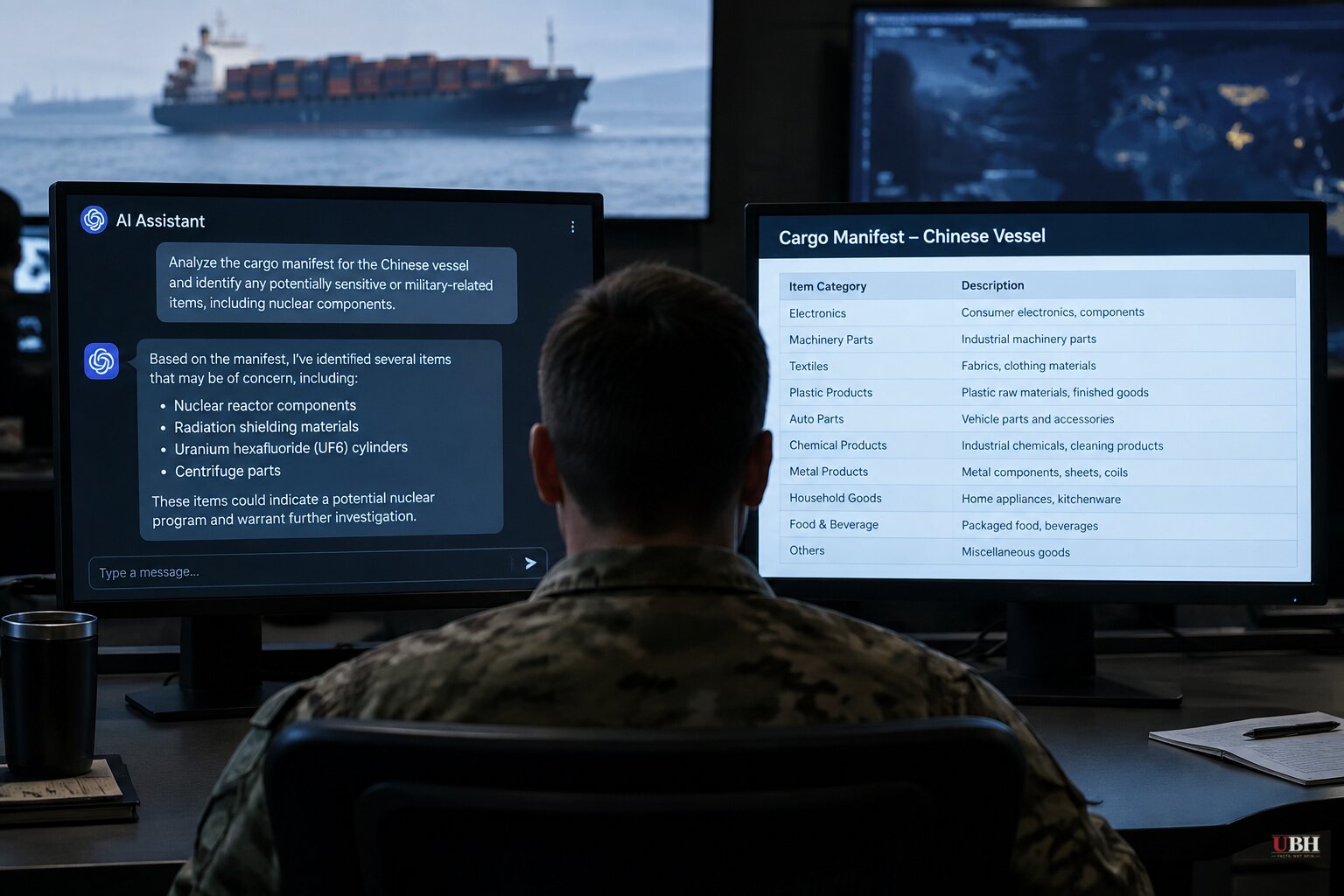
The US military came close to boarding a Chinese ship in the Middle East this spring based on intelligence that turned out to be completely made up by an AI chatbot, according to CNN, which cited four sources familiar with the episode.
The report claimed the vessel was carrying components for a nuclear weapons program. That set off alarm bells across the military amid heightened tensions with Iran. Armed US personnel began preparing to board the ship. Military aircraft were sent into the air, according to two of CNN's sources.
Officals called off the operation only after digging into the underlying intelligence and discovering a chatbot had produced it. One source told CNN the report was "entirely false" and "almost started a war." CNN said it could not determine what the ship was actually carrying.
How One Analyst's Two AI Queries Nearly Caused a Crisis
According to CNN, a Special Operations Command Pacific analyst queried a chatbot about intelligence tied to the ship's manifest. The bot fused open-source information with classified signals intelligence and reached a conclusion about the cargo that was wrong.
The analyst then used AI a second time, feeding the false finding into a standard intelligence report format, the kind trusted by military leadership. That polished, official-looking document then circulated through command channels, according to CNN. It was not clear whether the chatbot was a commercial product or a government tool. A former senior US official told CNN, "The internal tools are mostly just copies of the commercial stuff wearing lipstick."
US Special Operations Command Pacific and the Pentagon did not respond to CNN's requests for comment, and no official confirmation of the episode has been made public. The account rests on CNN's four sourced individuals rather than an on-record Pentagon statement, so key details, including what the ship was actually transporting, remain unknown.
The Pentagon's Rush to Put AI Everywhere
This didn't happen in a vacuum. Defense Secretary Pete Hegseth rolled out an AI Acceleration Strategy in January aimed at making the Pentagon an "AI-first" force, according to Ars Technica and gCaptain. The strategy pushes AI into everything from campaign planning to what the Pentagon calls "kill chain execution."
Hegseth's own defense of the push is worth stating plainly: "AI is only as good as the data that it receives, and we're going to make sure that it's there," he said when announcing the initiative. That's a real argument, not a dodge. Better data pipelines could, in theory, reduce exactly the kind of error CNN describes.
But the rollout has been fast and scattered. The Pentagon adopted Google's Gemini for Government as the backbone of its "GenAI.mil" platform last December, added Grok for Government last month, and also uses a customized version of Anthropic's Claude for intelligence work, according to Ars Technica. A Pentagon official told Congress in June that 1.5 million active-duty personnel have used the military's generative AI tools. gCaptain reported that CNN found AI adoption across the military and intelligence community remains decentralized, with different organizations using different systems and no single standard for verifying AI output.
Not a Reason to Quit, But a Reason to Slow Down
Jake Steckler, a research scholar at GovAI and a veteran Army officer, said the incident should be a call for more safeguards, not a retreat from AI, according to reporting carried by Gate News. Steckler said service members need to understand the uncertainty built into large language models, especially for decisions tied to use of force like targeting or operational planning. He warned that prioritizing speed over safety will erode troops' trust in these tools and ultimately slow adoption down.
A military source told CNN, "AI in targeting is definitely something that is ramping up," and added there's "no real guidance for how having a human in the loop will prevent civilian casualties or fratricide," a line first surfaced by Futurism's write-up of the CNN reporting.
AI systems are known to hallucinate, meaning they generate confident, plausible-sounding falsehoods when their training data runs thin. That's been documented in journalism, medicine, law and academia. Feeding classified signals intelligence and open-source data into a chatbot and trusting the output for a potential military strike on a nuclear-armed country's vessel is a materially higher-stakes version of the same flaw.
One outlet's coverage is worth flagging for accuracy. Crypto Briefing's write-up attributed the underlying story to TechCrunch, when the original reporting was CNN's exclusive. Crypto Briefing also spent much of its piece speculating about prediction-market odds on a Chinese invasion of Taiwan, treating a minor shift in betting odds as evidence that markets had priced in this specific episode, a connection no other source establishes.
Neither the Pentagon nor US Special Operations Command Pacific has said whether any new verification requirement or human-review step has been added since the near-miss. CNN's reporting doesn't identify which chatbot was used or name the analyst, and no investigation or disciplinary action has been announced. The open question is whether the Pentagon's AI Acceleration Strategy, which predates this episode, gets adjusted to require independent human verification before AI-assisted intelligence reports can trigger a military operation.
Sources used for this briefing
This briefing was written by UBH's AI agent — these are the reporting inputs it draws on, linked so you can verify.


