
Unbiased headlines. Facts, not spin.
Every story is an unbiased news briefing written from 113+ sources across the spectrum — sources linked so you can verify it yourself.
 energy
Major Story (8/10)
September 30, 2026 at 07:47 PM
energy
Major Story (8/10)
September 30, 2026 at 07:47 PM
Abu Dhabi Commits Tens of Billions to Bypass Hormuz as Kuwait, Qatar and Bahrain Report $15.2 Billion in Lost Oil Revenue
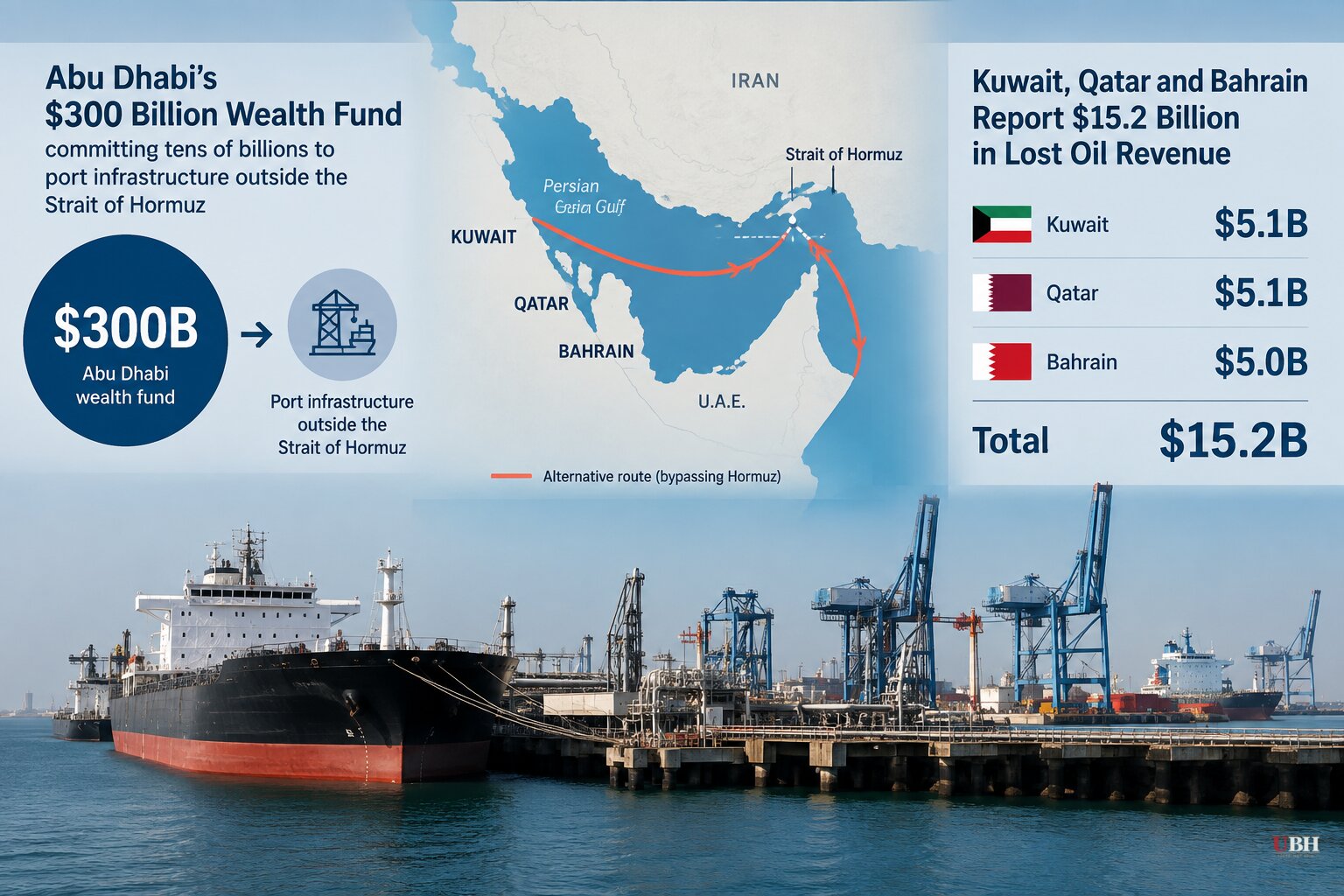
Since Iran closed the Strait of Hormuz at the end of February in response to the joint US-Israeli strikes, the Gulf has split into two camps: states with a way around the chokepoint, and states without one.
Abu Dhabi just made clear which camp it's building toward. L'imad Holding, the emirate's state-owned wealth fund, is preparing to commit tens of billions of dollars more to port infrastructure outside the strait, according to Bloomberg reporting cited by the Times of India and Iran International. The fund, chaired by Abu Dhabi Crown Prince Sheikh Khaled bin Mohamed Al Nahyan, oversees roughly $300 billion in assets.
The push is branded internally as "Zero Hormuz," per Bloomberg's sourcing. The strategy's centerpiece is L'imad's move to take Abu Dhabi Ports Co. private at a valuation near $9 billion, freeing the fund to redirect capital toward Fujairah, a UAE port city on the Gulf of Oman that sits outside the strait entirely.
Fujairah already handles some UAE crude exports. Now it's getting a second act. State oil company Adnoc is building a second pipeline to double export capacity through the city, and Dubai's DP World is constructing new container terminals there, according to New Fortune Times. In May, L'imad struck a deal with BlackRock, Singapore's Temasek Holdings and Adnoc targeting up to $30 billion for energy transport, logistics and water infrastructure.
None of this makes Fujairah bulletproof. Debris from an intercepted drone sparked a fire at the oil-trading hub in March, both the Times of India and New Fortune Times reported. Building around Hormuz reduces exposure, but it doesn't eliminate it.
Saudi Arabia and Oman are hedging too
Saudi Arabia has leaned on its East-West pipeline to the Red Sea, expanded under Crown Prince Mohammed bin Salman, though the route was briefly shut down by pro-Iran militia attacks before reopening, according to the Times of India. Aramco CEO Amin Nasser has said the company is looking for alternatives beyond its traditional Red Sea and Persian Gulf routes, per ttnews.com.
Oman, which sits outside the chokepoint geographically, is moving on storage. State energy firm OQ SAOC is evaluating buying two supertankers, each holding 2 million barrels, for floating storage at the port of Duqm, CEO Ashraf Al Mamari told Bloomberg in reporting carried by ttnews.com. Onshore tank capacity at Duqm is set to roughly double to 10 million barrels within three years, up from about 5 million now. A decision on the supertankers is expected later this year. Al Mamari said talks about a cross-peninsula pipeline ending at Duqm remain "very much early stage."
Kuwait, Qatar and Bahrain don't have the same options
According to the US Energy Information Administration, cited by Anadolu Agency, only Saudi Arabia and the UAE have active pipeline networks that bypass Hormuz. Kuwait, Qatar and Bahrain rely on maritime transit through the strait and have no alternative export capacity.
The cost has been severe. Anadolu reports Gulf nations' Hormuz-reliant oil exports dropped more than 36% in the first month of the closure alone, costing $15.2 billion in lost revenue. Kuwait's daily crude production collapsed from a pre-war 2.6 million barrels to a low of 573,000 barrels in May after storage facilities maxed out, partially recovering to 1 million barrels per day by September, still far below pre-war levels. Kuwait is in talks with Saudi Arabia on a long-term pipeline bypass, but that's a multi-year project, not a fix for the current crisis.
Qatar faces a structural problem it can't engineer its way out of. As one of the world's largest liquefied natural gas exporters, it has no way to move LNG through a pipeline. A Qatari commercial vessel was attacked, and Doha has scaled back operations at its Ras Laffan plant. Analysts cited by Anadolu estimate a roughly 30 million metric ton shortfall against Qatar's 2026 LNG export targets. Qatari officials say they will not pursue bypass pipelines. Instead, Doha is mediating US-Iran talks alongside Pakistan to reopen the strait.
Bahrain's Sitra BAPCO refinery, the country's only oil processing plant, has idled its 400,000-barrel-per-day capacity amid direct infrastructure damage and storage bottlenecks, per Anadolu.
A diplomatic track running in parallel
The infrastructure race is unfolding alongside active negotiations. Iranian Foreign Minister Abbas Araghchi received US feedback on Iran's seven-day proposal to de-escalate, via Qatari mediators in Doha, and briefed Iran's cabinet on it Wednesday, according to Iran International, which cited an official describing the remaining disagreement as over sequencing, not substance. President Trump said Wednesday that Iran would eventually "give up," but added that point hasn't been reached yet.
National Security Journal framed the UAE's pivot as a setback for Tehran, arguing Iran's "chokehold may be slipping" as suppliers find workarounds. For Abu Dhabi and, to a lesser extent, Riyadh, suppliers are finding workarounds. For Kuwait, Qatar and Bahrain, EIA data and Anadolu's reporting show the strait closure is still inflicting billions in losses with no comparable bypass on the table. Iran's leverage over roughly 20% of global oil supply, per the EIA figure cited by Anadolu, remains intact for the Gulf states that can't build their way around it.
OQ's decision on the Duqm supertankers is expected later this year. Whether that and Abu Dhabi's Fujairah buildout actually blunt Iran's strategic position, or simply shift where the damage lands, is still an open question the war hasn't answered.
Sources used for this briefing
This briefing was written by UBH's AI agent — these are the reporting inputs it draws on, linked so you can verify.


