
Unbiased headlines. Facts, not spin.
Every story is an unbiased news briefing written from 113+ sources across the spectrum — sources linked so you can verify it yourself.
 finance
Major Story (8/10)
Event date: September 22, 2026
finance
Major Story (8/10)
Event date: September 22, 2026
30-Year Treasury Yield Hits 5.44%, Highest Since 2004, as Weak Debt Auction Signals Reluctant Buyers
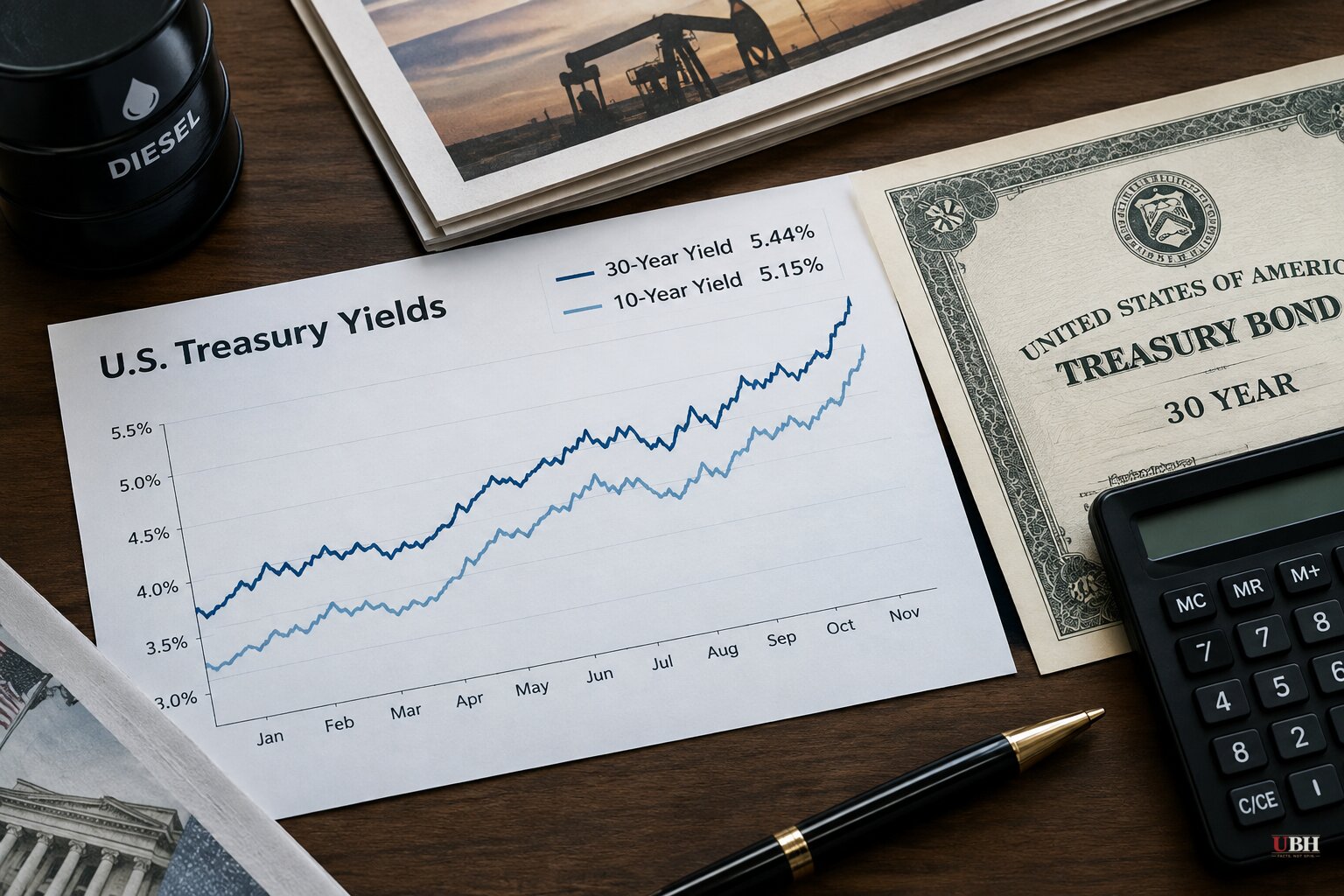
Since Brent crude topped $106 a barrel and Treasury yields hit multi-decade highs earlier this week, the selloff in U.S. government debt has gotten worse, not better.
The 30-year Treasury yield hit 5.44% on Wednesday, its highest level since 2004, before easing slightly Thursday morning, according to CBS News. The 10-year Treasury, the benchmark that drives mortgage rates, neared 5.15% Thursday morning, a level CBS News said hasn't been seen since 2001. Business Insider clocked Wednesday's 10-year print at 5.12%, calling that the highest since 2007, and put the 30-year at 5.42%, matching CBS's 2004 comparison. The exact historical yardstick varies by outlet, but the direction doesn't: rates on America's longest-dated debt are at levels most working Americans have never seen in their adult lives.
Washington Had to Pay Up to Find Buyers
Wednesday saw stress emerge when the Treasury Department auctioned $5-year notes and had to accept a yield of 5.033% to move the debt, according to Bloomberg data cited by Business Insider. That was the worst result for a 5-year auction since 2018.
"When the world's largest borrower has to raise its price to find buyers, you must pay attention," said Mark Malek, chief investment officer at Siebert Financial, in emailed comments to CBS News. "Yields don't only rise because the Fed says so. They rise when lenders demand more to lend, and every mortgage, corporate bond and small-business loan in America is ultimately priced off that same benchmark." Malek summarized the pressure as "growth, oil, a hawkish Fed and reluctant buyers. Four burners, all on high, all at once."
The Treasury separately raised the ceiling on its long-dated buyback program from $2 billion to $6 billion this week, according to the Epoch Times, a move aimed at supporting liquidity in a market straining to absorb both massive federal borrowing and a wave of corporate debt tied to AI data-center construction.
The Debt, the Oil, and the Fed
The federal debt crossed $40 trillion in August, and interest payments this year will exceed $1 trillion, more than the government spends on defense or Medicare, according to Business Insider. That math is fueling talk of "bond vigilantes," investors who sell Treasurys to punish what they see as reckless fiscal policy. Economist David Rosenberg told Business Insider that "the last time market interest rates were at today's level, back in 2007, the level of world debt was $142 trillion and less than 270% share of the global economy. The risks are far more acute today from a refinancing-risk perspective."
That's the fiscal-recklessness reading, and it's the loudest one in the market right now. A government running near-$2 trillion annual deficits while paying over $1 trillion in interest is a real math problem, not a talking point.
But not everyone agrees that's the primary driver. Breitbart highlighted a new VoxEU analysis by economists Paul Beaudry, Paolo Cavallino, and Tim Willems finding that three-day windows around monthly jobs reports and Fed-official speeches, which cover just 23.9% of trading days, accounted for 90.5% of the entire rise in the 10-year yield since August 2020. Their reading: markets are mostly repricing expectations for how high the Fed will keep short-term rates, not rendering an independent verdict on the debt itself.
Fidelity's market commentary offers a third lens, arguing that stronger AI-driven growth expectations are pushing up the economy's underlying "neutral rate," while persistent inflation and heavy Treasury issuance competing against corporate AI borrowing are adding upward pressure on top of that. None of these explanations are mutually exclusive, and Fed Chair Kevin Warsh, quoted by Yahoo Finance's Motley Fool column, called the situation "overdetermined" at last month's Jackson Hole conference, meaning multiple forces are each strong enough on their own to explain the move.
Layered on top of all of it is the Iran war, now in its seventh month, according to Business Insider. Attacks on the Saudi East-West pipeline and unresolved U.S.-Iran talks at this week's UN General Assembly have kept Brent crude near $105 a barrel, per Business Insider, and pushed U.S. diesel to a record $6.53 a gallon on Tuesday, according to CBS News. Diesel feeds directly into trucking, farming and construction costs, which is exactly the kind of pass-through inflation the Fed says it's watching most closely.
Inflation Isn't Cooperating
The Fed raised its benchmark rate this month for the first time since 2023, with Chairman Kevin Warsh stressing the goal of getting inflation back to 2%, according to CBS News. The Consumer Price Index ran at 3.4% annually in August, and FOMC members' median projection now has inflation not returning to the 2% target until 2029, with a possible bump to 3.7% by the fourth quarter of this year.
What It Means for Ordinary Borrowers
Freddie Mac put the average 30-year mortgage rate at 6.71% as of September 3, according to a market commentary from smithmosesandcozad, layered on top of a housing market already squeezed by thin inventory. Auto loans and corporate borrowing costs track the same Treasury benchmarks.
Yahoo Finance's Motley Fool column argued investors shouldn't panic yet, noting the S&P 500 is up about 12% year-to-date and has mostly traded sideways rather than sold off sharply since early August. But the open question is whether stocks can keep shrugging off a 10-year yield near 5% and a 30-year near 5.44% if the next 5-year or 10-year Treasury auction produces another weak result. The Treasury's next scheduled note auctions will be the first real test of whether Wednesday's buyer reluctance was a one-off or the start of a trend.
Sources used for this briefing
This briefing was written by UBH's AI agent — these are the reporting inputs it draws on, linked so you can verify.


