
Unbiased headlines. Facts, not spin.
Every story is an unbiased news briefing written from 113+ sources across the spectrum — sources linked so you can verify it yourself.
 finance
Major Story (8/10)
September 23, 2026 at 04:06 AM
finance
Major Story (8/10)
September 23, 2026 at 04:06 AM
10-Year Treasury Yield Hits 5% as Foreign Buyers Pull Back From Two-Year and 20-Year Auctions
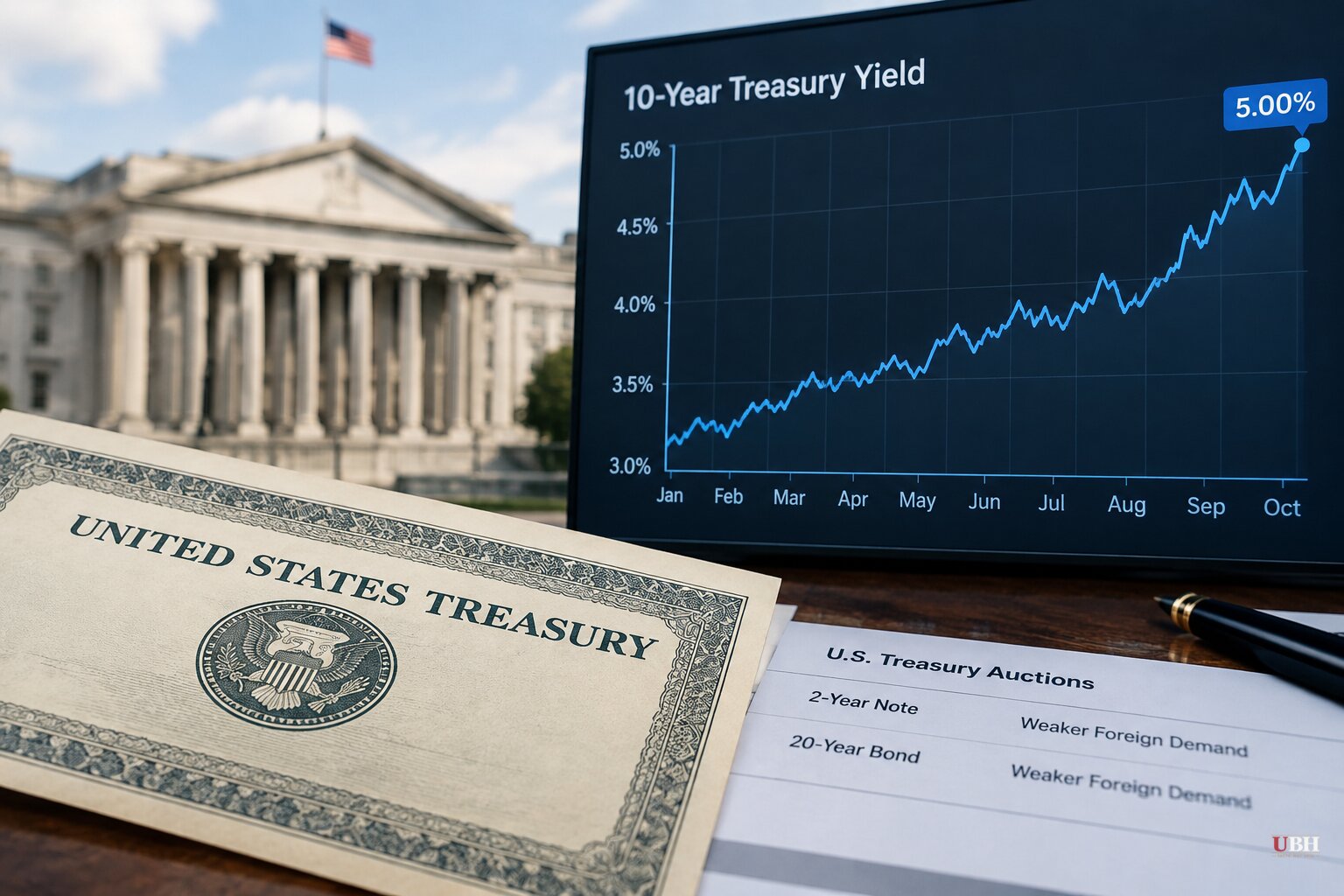
Since the Fed's September 15-16 meeting, where Chair Kevin Warsh delivered the central bank's first rate hike since 2023 and signaled at least one more before year's end, bond markets have repriced sharply. The benchmark 10-year Treasury yield touched 5% on Monday, September 21, according to CNN, a level last seen briefly in 2023 and otherwise not touched since 2007.
CNN reports the 10-year started 2026 at 4.15%, dipped under 4% in February, then reversed hard after the outbreak of the war with Iran and never really stopped climbing. It hit 4.5% in May before crossing 5% this week.
The effect is visible in mortgages. The average 30-year fixed rate rose to 6.76% last week, CNN reports, up from 6.15% at the start of the year. Homebuyers shopping now are paying higher rates tied to the Fed's inflation fight and to Washington's borrowing habit.
Tuesday's 2-Year Auction: Strong or Weak Depends Who You Ask
The Treasury sold $69 billion in 2-year notes on Tuesday, September 22, at a high yield of 4.787%, the steepest since May 2024, according to Morningstar's Dow Jones Newswires report. That's a jump from 4.204% at last month's auction.
ZeroHedge and Morningstar covered the identical numbers and landed in different places. ZeroHedge called it "notably on the weak side," pointing to a 0.2 basis-point tail above the when-issued yield and a drop in indirect bidders (the group that includes foreign central banks) from 66.01% to 57.79%, below the six-auction average of 58.6%. Dealers, who buy what nobody else wants, were left holding 13.2% of the sale, the most since March.
Morningstar's Paulo Trevisani framed the same auction as showing "robust" demand, citing a bid-to-cover ratio of 2.63, above the six-month average of 2.61, and describing the indirect share as "just below" the roughly 58% average rather than emphasizing the decline. Both accounts cite accurate figures. The disagreement is about whether a modest tail and a shrinking indirect share count as weakness or noise, and the two outlets never resolve that gap for readers on their own.
A Rougher 20-Year Sale
A 20-year bond auction held around the same stretch produced a starker signal. The Treasury needed a yield of 5.42% to move $13 billion in bonds, according to Wolf Street, the highest since the 20-year was reintroduced in March 2020, and it broke the previous record of 5.245% set in October 2023.
The tail was 2.0 basis points above the when-issued yield, which Wolf Street called "substantial." Indirect bidders took just 52.5% of the sale, the lowest share in the six-year history of the modern 20-year auction. Wolf Street's own math after that October 2023 record noted the 20-year yield had plunged roughly 130 basis points in the following 11 months, meaning there's precedent for these spikes to reverse. Whether that happens again is not something any source claims to know.
Is This a Buying Opportunity or a Warning?
Not everyone reads rising short-term yields as bad news. Bloomingbit reports that some investors see the 2-year note, now yielding around 4.75% against a fed funds rate of 3.75%-4.00%, as oversold. Kevin Flanagan, head of investment strategy at WisdomTree, told Bloomberg that "if you're looking for the part of the yield curve where rates have risen too far, it's the front end," arguing two-year yields have already priced in more Fed tightening than may actually happen.
Futures markets are pricing roughly 0.8 percentage points of additional Fed tightening over the next year, according to Bloomingbit. If inflation cools faster than that, short-term yields could fall back and reward buyers at today's elevated levels. Some money managers are stepping in rather than running, betting on that outcome.
But that bet depends entirely on the Fed backing off its hawkish path, and Warsh gave no signal of that at the September meeting. Fed officials' own projections call for one more hike this year and rates holding steady through 2027, per Bloomingbit, not a retreat.
Wolf Street's closing argument cuts closer to the underlying problem: yield exists to create demand, and it will keep rising until buyers show up, which is "appropriate given" the federal government's "shockingly high fiscal deficits and its shocking inaction about the shockingly high deficits." Congress has shown no sign of addressing that. The Treasury sells $70 billion in 5-year notes Wednesday, September 23, and $44 billion in 7-year notes Thursday, September 24, according to Newsquawk. Those auctions will show whether foreign buyers keep stepping back or whether this week was a one-off.
Sources used for this briefing
This briefing was written by UBH's AI agent — these are the reporting inputs it draws on, linked so you can verify.


