
Unbiased headlines. Facts, not spin.
Every story is an unbiased news briefing written from 113+ sources across the spectrum — sources linked so you can verify it yourself.
 finance
Notable (6/10)
September 23, 2026 at 01:29 AM
finance
Notable (6/10)
September 23, 2026 at 01:29 AM
CFTC Tells Prediction Markets to Rein In Bets on What Public Figures Say
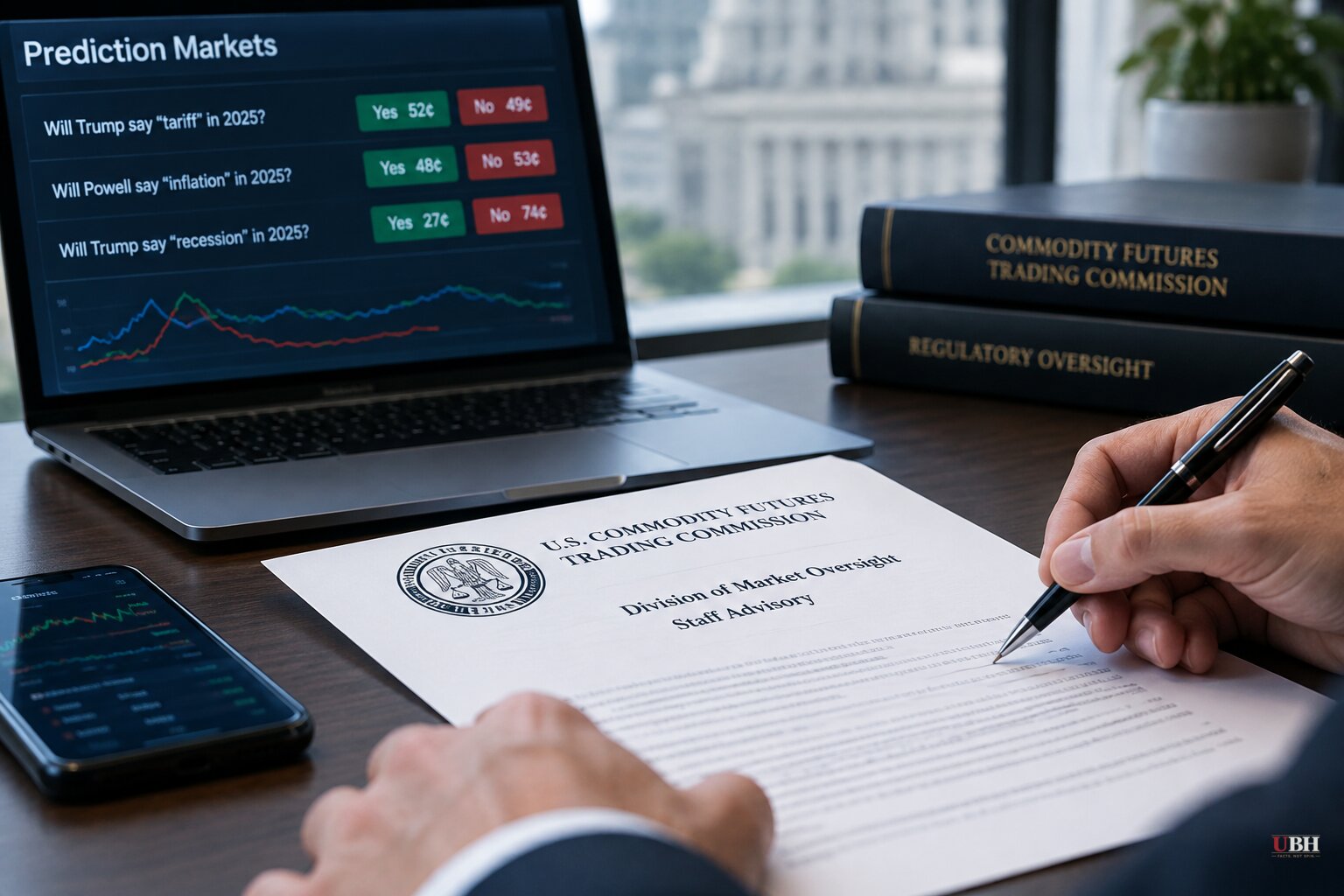
Since the CFTC settled its insider-trading case against Donald Trump's former teleprompter operator Gabriel Perez in August, forcing him to pay more than $172,000 and accept a three-year trading ban, the agency has been building toward something bigger. A staff advisory from the CFTC's Division of Market Oversight landed Tuesday, warning that so-called mention markets carry a heightened risk of manipulation and can only be listed in "limited circumstances."
Mention markets let traders bet yes-or-no on whether a public figure will say a specific word, show up somewhere, or interact with someone else. Think: will Jerome Powell say "inflation" at a Fed presser, or will Trump mention a specific country at the UN. Kalshi currently runs a market on exactly that question ahead of Trump's UN remarks, according to both KuCoin and Crypto News.
The advisory's language is blunt. These contracts don't have "independently generated, externally verifiable outcomes that are outside the control of any single person," the CFTC staff wrote. Instead, the outcome depends on "the discrete conduct of a named person, and that conduct may be neither independently generated nor externally verifiable." In other words, the person being bet on, or people close to him, can move the market just by knowing it exists.
Four Tests, Not a Ban
The CFTC isn't outlawing mention markets outright. Per Cointelegraph, citing CNBC's review of the letter, the agency laid out four factors exchanges should weigh before listing them: whether adequate surveillance exists to catch manipulation, whether the settlement condition is independently verifiable, whether outside pressure could push the subject to say or not say something, and what professional or legal obligations constrain the subject's conduct.
Glitchwire's reporting adds that the CFTC wants "independent obligations constraining the controlling individual" and a "complete, contract-specific analysis" before any new mention product goes live. That's a compliance burden, not a shutdown order. It's staff guidance, meaning it doesn't carry the force of a formal regulation. Exchanges can still list these markets. They just need paperwork showing they thought hard about manipulation risk first.
CFTC Chair Mike Selig backed the move publicly, posting on X that "regulatory clarity drives sound markets" and thanking staff for reminding exchanges of their "obligation to list only contracts not readily susceptible to manipulation," according to Cointelegraph.
Why Now: Perez and Santos
The advisory didn't come out of nowhere. Perez allegedly read Trump's prepared remarks roughly an hour before delivery and traded on Kalshi based on what he knew was coming, according to Glitchwire. He settled in August, surrendering $107,539 in profits and paying a $65,000 civil penalty, without admitting wrongdoing.
Then there's George Santos. The former congressman drew a lifetime trading ban from Kalshi after the platform accused him of betting on his own State of the Union appearance, KuCoin reported. That's a platform-level ban, not a CFTC enforcement action or criminal charge. No charges have been filed against Santos over this.
Sports leagues have piled on too. Bloomingbit reports the NFL asked the CFTC in July to ban word-mention bets tied to game broadcasts, arguing a single broadcaster or player could manipulate the outcome just by choosing his words. Major League Baseball made a similar ask about press conferences and postgame interviews. Those are the leagues' stated concerns, not proven instances of manipulation, but the underlying worry is straightforward: if an announcer knows people are betting on whether he says "clutch," he controls the payout.
The Case for Mention Markets
Kalshi and Polymarket aren't apologizing for the product. Both platforms said they oppose insider trading, run their own monitoring, and refer suspicious activity to federal regulators, according to Bloomingbit. Kalshi's own surveillance team is what flagged the Perez trades in the first place, per Glitchwire's reporting. Markets that police themselves and hand over evidence aren't the same as markets that look the other way.
There's also a genuine speech and innovation argument here. Mention markets are wildly popular. Kalshi rolled out mention parlays in November 2025, and by the Super Bowl in February 2026, individual sports broadcasts were generating multi-million-dollar trading volumes on what announcers might say, according to Glitchwire. People clearly want to bet on this stuff, and banning it outright would kill a legitimate consumer product over a manipulation risk that, so far, has produced exactly one confirmed enforcement case.
The counterargument, the one the NFL and MLB are making, is that the risk isn't hypothetical anymore. Perez didn't get caught because the system is airtight. He got caught because Kalshi's surveillance team happened to flag it. How many similar cases go undetected is an open question the CFTC itself can't answer, which is precisely why the agency is asking exchanges to build in more verifiability and oversight before listing new contracts, rather than waiting for the next Perez.
What's Unresolved
The advisory doesn't touch the separate legal fight over whether states can regulate Kalshi's sports-adjacent contracts at all. New Jersey petitioned the Supreme Court on September 2 asking the justices to decide whether Kalshi can keep self-certifying sports wagers with the CFTC while ignoring state gaming law, according to the Epoch Times. New Jersey Attorney General Jennifer Davenport argues that companies like Kalshi claim to offer legal sports betting nationwide but refuse to follow any state's gambling laws. That case, the Tuesday advisory, and the CFTC's June proposal to restrict war-and-terrorism betting add up to a regulator moving on three fronts at once against an industry it can't quite decide whether to embrace or contain.
Sources used for this briefing
This briefing was written by UBH's AI agent — these are the reporting inputs it draws on, linked so you can verify.


