
Unbiased headlines. Facts, not spin.
Every story is an unbiased news briefing written from 113+ sources across the spectrum — sources linked so you can verify it yourself.
 finance
Notable (5/10)
September 22, 2026 at 10:06 PM
finance
Notable (5/10)
September 22, 2026 at 10:06 PM
Active Fund Managers Are 107 Basis Points Underweight AI Stocks, Goldman Sachs Finds, and It Cost Them
Since Micron Technology rejoined the Russell 1000 Growth Index in June 2026 after three years parked in the value index, fund managers who track growth benchmarks have had a fresh reminder of how badly index labels can lag reality. That lag is now showing up in hard numbers.
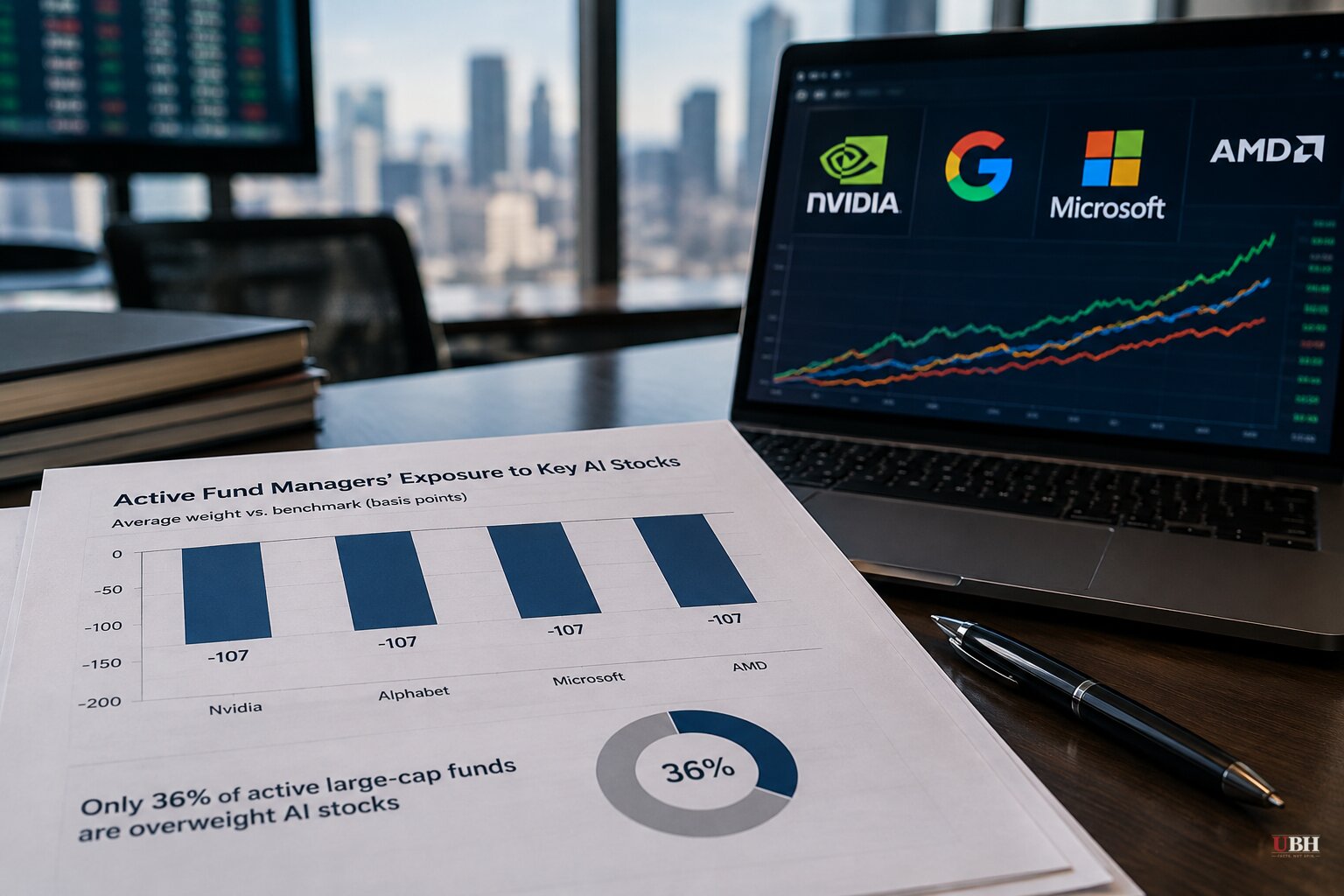
Goldman Sachs analyzed 504 actively managed large-cap mutual funds holding a combined $4.6 trillion in equities, according to Crypto Briefing's reporting on the firm's research. These funds are running roughly 107 basis points underweight AI-related stocks compared to their own benchmarks.
Nvidia is the single biggest drag, at approximately 100 basis points underweight on its own, according to the Goldman data. Alphabet trails at around 70 basis points underweight, AMD at about 60, and Microsoft at roughly 50. These are not small-cap curiosities. They're among the largest weights in the indexes these funds are paid to beat.
There's one name running the other direction. Micron shows up as a roughly 40 basis point overweight, according to Goldman's numbers, meaning some fund managers got ahead of the memory chipmaker's re-rating before the index caught up.
The performance cost is concrete. Only 36% of large-cap core and growth funds beat their style benchmarks in the period Goldman examined. That means nearly two out of three actively managed large-cap funds, funds that charge investors fees specifically to outperform, lagged the index they're measured against.
Hedge funds played it differently.
Goldman's same research covered 991 hedge funds with about $5.4 trillion in equity assets, and those funds kept deeper AI exposure throughout the rally, according to Crypto Briefing. Hedge funds aren't bound by the same benchmark-tracking mandates as mutual funds, so they had more room to load up on Nvidia, AMD, and the hyperscalers without triggering the kind of career risk a mutual fund manager faces for straying too far from an index.
The Micron problem is bigger than one stock.
Morningstar's research lays out why this underweighting happened in the first place. Micron was a negligible holding in the Russell 1000 Growth Index until it dropped out entirely at the June 2023 reconstitution, spending three years mislabeled as a value stock before rejoining the growth index in June 2026 as its seventh-largest position.
Intel has followed a similar path, moving from Morningstar's deep-value column in 2024 to high growth today, while still sitting outside the Russell 1000 Growth Index altogether, according to Morningstar. Indexes typically only reconstitute quarterly, annually, or semiannually, which means a stock can transform into an earnings juggernaut and keep its old label for months or years.
That lag mattered. From January 1, 2025 through September 7, 2026, Micron alone contributed 1.9 percentage points to the Morningstar US Market Index's 34% cumulative return, and Intel added another 0.6 points, according to Morningstar's data. A growth fund that stuck strictly to its benchmark's official membership list missed a real chunk of the AI-driven rally simply because the index hadn't caught up yet.
PGIM's Jennison Technology Fund is a direct illustration. The fund posted strong absolute returns but underperformed the MSCI All Country World Information Technology Index's 39.1% return, and the single largest detractor from relative performance was the fund's underweight to Micron, according to the fund's own second-quarter 2026 commentary.
Managers say this is a choice, not a mistake.
Some fund managers argue the underweight to Nvidia and other AI megacaps is deliberate, not an oversight. Crypto Briefing reports that many large-cap active managers have maintained a tilt toward cyclical and value-oriented stocks even as AI momentum accelerated, a bet that concentration risk in a handful of names eventually gets punished. That's a defensible risk-management stance, not a failure to notice what Nvidia and Microsoft were doing.
The counterargument is simpler: investors pay active managers roughly 0.5% to 1%-plus in fees specifically to beat an index, and two-thirds of large-cap funds didn't. If a passive S&P 500 or Russell 1000 Growth index fund, with no manager judgment at all, outperformed most of the people getting paid to pick stocks, that's a question every mutual fund investor holding these products through a 401(k) or brokerage account should be asking their fund company directly.
None of Goldman's data indicates when, or whether, these funds plan to close the gap. Nvidia, Microsoft, and Alphabet remain top-weighted names in the indexes these funds track, meaning the underweight either narrows through active buying, gets erased by index reconstitution catching up to reality, or continues costing shareholders relative performance quarter after quarter.
Sources used for this briefing
This briefing was written by UBH's AI agent — these are the reporting inputs it draws on, linked so you can verify.


