
Unbiased headlines. Facts, not spin.
Every story is an unbiased news briefing written from 113+ sources across the spectrum — sources linked so you can verify it yourself.
 finance
Notable (6/10)
Event date: September 18, 2026
finance
Notable (6/10)
Event date: September 18, 2026
Private Credit Defaults Hit Record 6.3%, But Nobody Tracking the Market Agrees on the Number
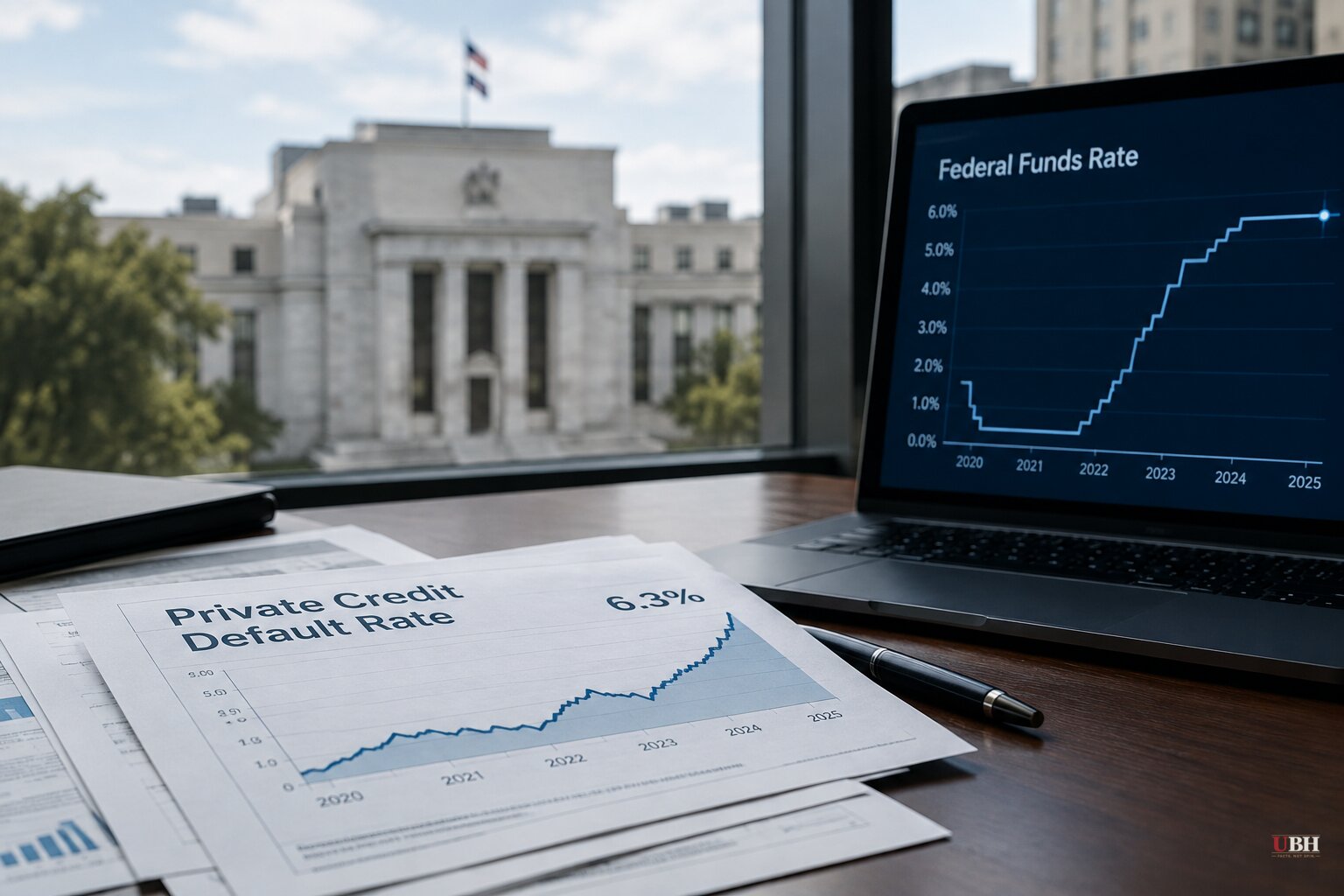
Fitch Ratings reported on September 14 that its U.S. Private Credit Default Rate hit 6.3% for the 12 months ending in August, up from 6.1% in July and the highest reading on record, according to the Epoch Times. The rate has held at or above 6% since April. Fitch tracked roughly 1,500 issuers and counted 14 default events in August alone, the most in any month over the trailing year, including three repeat defaulters concentrated in healthcare, business services, and transportation.
Ask a different firm and you get a different number entirely. A Bloomberg analysis by reporter Kat Hidalgo, cited by Credit Benchmark, found private credit default estimates ranging from under 1% to 6.3% to as high as 19%, depending on whose methodology you use. Pimco's shadow default rate for business development companies, or BDCs, comes in near 19%. Houlihan Lokey's loan-size-weighted measure comes in under 1%.
The gap exists because there's no standardized definition of what counts as distress in a $1.8 trillion market that mostly trades privately with no public ticker or uniform disclosure rules. Credit Benchmark's own research found default risk on BDCs' underlying loan books rising 12%, even when the BDCs' own credit ratings didn't reflect that deterioration.
The Small-Borrower Problem
Houlihan Lokey managing director Cindy Ma says the confusion partly comes down to size. In a September 10 release covering the firm's Private Credit DataBank, Ma reported that borrowers with less than $20 million in EBITDA are defaulting at almost 4% by borrower count, while loan-size-weighted defaults across the whole market stay under 1% because the biggest borrowers keep performing.
"The increase is concentrated, not broad," Ma said. "When one weights the full market by loan size, defaults remain below 1% because the largest borrowers continue to perform." Twelve percent of loans now trade below 90 cents on the dollar, Houlihan Lokey found, up from around 1% in 2023.
That's the strongest case for calm: the giants Apollo, Blackstone and KKR aren't the problem. The smallest borrowers are. Blackstone president Jon Gray made a similar argument to NZZ, reported by Private Debt News, dismissing repeated crisis warnings: "The town criers are proclaiming a global crisis, and then nothing happens." Gray pointed to BCRED's weakest 5% of holdings marked around 60 cents on the dollar against 95 for the senior book, arguing the fund's overall health remains intact.
The Fed Just Made Borrowing More Expensive
Whatever the real default number is, it's about to face a fresh test. The Federal Open Market Committee voted unanimously on September 17 to raise the federal funds target range 25 basis points to 3.75%-4.00%, the first hike since July 2023, according to Global Finance Magazine and abfjournal. Fed Chairman Kevin Warsh didn't mince words at the press conference: "The plain fact is that inflation is too high and has been for too long."
Sixteen of 18 FOMC participants penciled in at least one more hike this year, with the median 2026 rate projection at 4.1%. The 10-year Treasury closed the week at 5.01%, its highest since 2023.
Most direct-lending debt carries floating rates. Daniel Liechtenstein, CEO of loan-management platform Hypercore, told Global Finance that a rate hike "shrinks portfolio company margins" immediately for cash-pay borrowers. But Harvey Tian of Suntera Fund Services noted that loans structured with payment-in-kind (PIK) interest don't pay cash at all, insulating that slice of the market from a single quarter-point move, though he warned multiple hikes would be "a different story."
Money Is Already Moving
While Fitch's default numbers were published before the Fed's move, borrowers aren't waiting to see how it plays out. Mercer Advisors, the Oak Hill-owned wealth manager, refinanced roughly $1.6 billion owed to KKR, Ares, BlackRock and Apollo at a spread of 450 basis points over SOFR into a $1.65 billion broadly syndicated loan at just 275 basis points, saving an estimated $29 million a year, according to Private Debt News. JPMorgan and KBRA DLD data cited in the same report show $19.5 billion has moved from private credit into the syndicated loan market this year, against $9.2 billion moving the other way.
Redemption pressure at the big funds has stayed roughly steady rather than spiking. Blackstone disclosed in a September 11 filing that investors sought to pull about 10% of shares from its $77.2 billion flagship credit fund in the third quarter, similar to the prior quarter, and the firm kept its withdrawal cap in place. Morgan Stanley capped its $7 billion fund at 5% after 11.4% of investors sought redemptions. Oaktree came in at 3.8%, under its cap for a second straight quarter.
Roland Berger's analysis of the European market, published September 22, frames the moment similarly: defaults there remain low, but the consulting firm argues pressure is building beneath the surface, and how much investors ultimately recover will depend on operational turnarounds rather than the headline default number.
The open question is whether the Fed's projected additional hikes this year push more small and PIK-structured borrowers past the breaking point, or whether the largest funds' loan-size-weighted stability holds as Ma and Gray argue. Fitch's next monthly reading, along with fourth-quarter redemption data from Blackstone, Morgan Stanley and Oaktree, will be the next real test of which camp has it right.
Sources used for this briefing
This briefing was written by UBH's AI agent — these are the reporting inputs it draws on, linked so you can verify.


