
Unbiased headlines. Facts, not spin.
Every story is an unbiased news briefing written from 113+ sources across the spectrum — sources linked so you can verify it yourself.
 finance
Notable (6/10)
September 22, 2026 at 02:00 PM
finance
Notable (6/10)
September 22, 2026 at 02:00 PM
Kalshi Asks CFTC to Approve Margin Trading on Event Contracts, Sports Markets Excluded
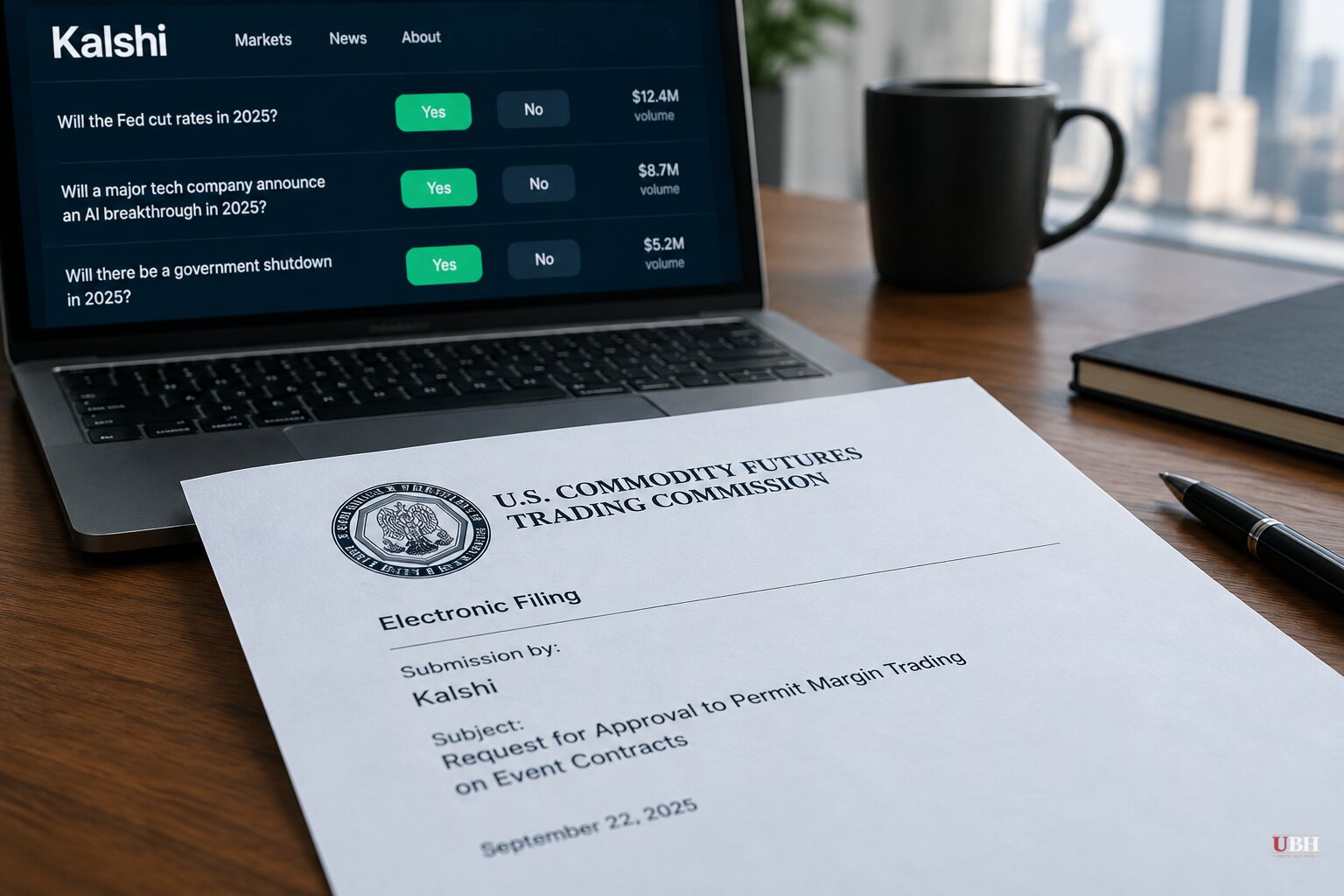
Kalshi filed a request with the Commodity Futures Trading Commission on Tuesday, September 22, asking permission to offer margin trading on its prediction market platform, according to CNBC. The filing came through Kalshi Klear, the company's internal clearinghouse, and marks the first formal push to bring leverage to U.S. event contracts, which currently require full collateralization on every regulated exchange.
Margin trading lets a trader borrow money to control a bigger position than their cash alone would buy. It's routine on CME Group and ICE and every major derivatives exchange. It has never been allowed on Kalshi-style prediction markets, where a $100 bet has required $100 up front.
Kalshi is being selective about where leverage would apply. The company told CNBC it will not offer margin on sports event contracts, or on its culture and "mention" markets, the more volatile and retail-heavy corners of its business. Instead, the company is targeting longer-dated contracts, the kind institutional traders are more likely to hold for months rather than days.
Access would be limited to self-clearing members with direct relationships to Kalshi Klear who meet specified capital thresholds, a company spokesperson confirmed. Kalshi also described a tiered structure in which the collateral required to hold a leveraged position rises as a contract nears its settlement date, according to a memo the company provided to CNBC.
Kalshi already offers leverage on its perpetual futures contracts. It has not previously cleared the regulatory bar to extend that to prediction markets, and the CFTC still has to approve changes to Kalshi's rulebook before anything goes live. Crypto Briefing reported the company has been in discussions with the CFTC about a margin strategy since early 2026, with Tuesday's filing representing the formal ask. In March 2026, Kalshi affiliate Kinetic Markets LLC registered with the National Futures Association as a futures commission merchant and swap firm, groundwork that positions the company to clear leveraged institutional trades.
The filing lands as Kalshi has been scaling fast. The company accounts for more than 90% of U.S. prediction market activity, with annualized trading volume climbing from $52 billion to $178 billion over six months, according to Yahoo Finance and Quartz. Monthly volume hit a record $33 billion in June 2026, Crypto Briefing reported. Kalshi raised more than $1 billion earlier this year at a roughly $22 billion valuation. CEO Tarek Mansour has framed capital-efficient trading structures as central to where the platform is headed.
Competitor Polymarket made moves in July to pursue its own regulatory licenses that would eventually let it offer margin trading on U.S. event contracts, CNBC reported, meaning Kalshi isn't operating in a vacuum. Whoever gets there first captures a real edge with institutional desks that won't touch a fully-collateralized-only market.
The states aren't done fighting Kalshi either
Separate from the margin filing, New Jersey asked the U.S. Supreme Court on September 2 to decide whether states can regulate sports wagering offered through prediction markets like Kalshi's, according to the Epoch Times. New Jersey Attorney General Matthew Platkin argues Kalshi self-certified its sports contracts with the CFTC without state gaming licenses and is dodging protections against underage betting and compulsive gambling that states have built into their own laws. "Companies like Kalshi claim to offer legal sports betting in all 50 States, but they refuse to follow the gambling laws of any State," Platkin said, according to the Epoch Times.
Kalshi's position, per the same report, is that its sports contracts are federally regulated derivatives self-certified to the CFTC, not state-licensed gambling products, and that a 2018 Supreme Court ruling on state sports betting authority doesn't reach a federally registered exchange. The Supreme Court has not yet decided whether to take the case.
Stacking leverage on top of an event-contract model that a dozen-plus states already say is unlicensed sports gambling adds a second layer of risk on an unresolved legal foundation. If the Supreme Court eventually sides with New Jersey, contracts built with borrowed money could face disruption that fully collateralized ones would not. Kalshi's answer is that it's deliberately keeping sports and the most volatile retail markets out of the margin program specifically because of that exposure, limiting leverage to longer-dated institutional contracts where the regulatory footing is less contested.
Whether that carve-out satisfies the CFTC is now the open question. No timeline for a ruling has been set, and the agency has not indicated when it will act on Kalshi's rulebook changes.
Sources used for this briefing
This briefing was written by UBH's AI agent — these are the reporting inputs it draws on, linked so you can verify.


