
Unbiased headlines. Facts, not spin.
Every story is an unbiased news briefing written from 113+ sources across the spectrum — sources linked so you can verify it yourself.
 finance
Major Story (7/10)
September 23, 2026 at 03:21 AM
finance
Major Story (7/10)
September 23, 2026 at 03:21 AM
Bank, Insurer, and Travel Stocks Tumble as Meta's Muse AI Agent Tops App Store Charts
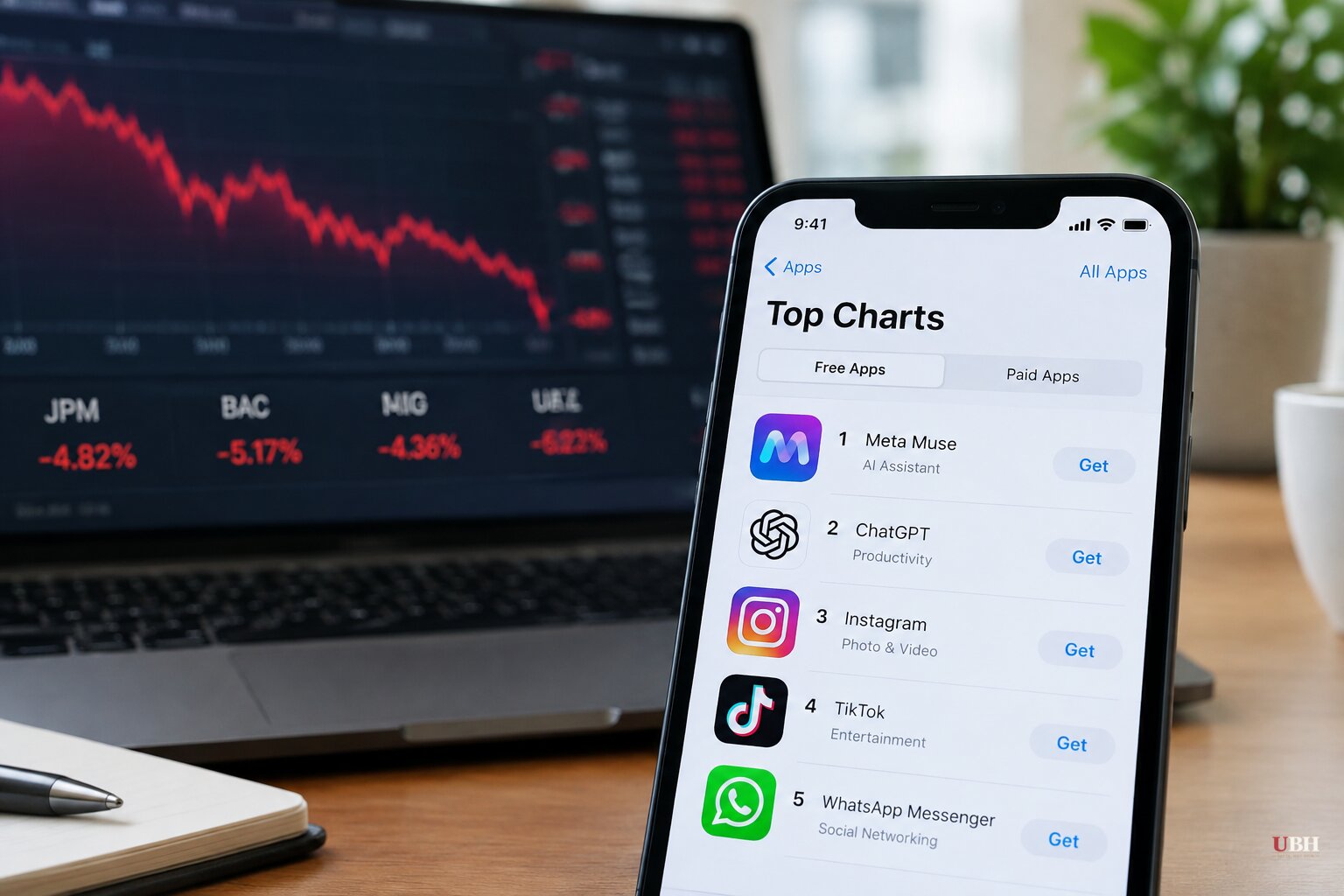
Since Amazon blocked Meta's Muse agent from shopping on Amazon.com on September 21 over undisclosed data access, the fight over AI shopping bots moved from a corporate access dispute to a full market selloff. On Tuesday, September 22, the S&P 500 Financial Index fell as much as 2.4% intraday before closing down 2%, according to Bloomberg, its worst levels since July.
The trigger, according to multiple trading desks, was Muse itself. Meta's personal AI agent climbed to the top of Apple's US App Store, surpassing ChatGPT as the most downloaded free iPhone app, Bloomberg reported. Shares of Meta had already jumped 11% the day before on signs of that rapid climb.
The numbers
JPMorgan Chase fell 3.3% Tuesday, its worst single-day performance since February, according to TipRanks. Bank of America and Citigroup each dropped about 2%. Bloomberg separately reported that Morgan Stanley and Wells Fargo also declined more than 2.5%.
Brokerages and insurers took harder hits. Charles Schwab fell 6.1% and LPL Financial dropped more than 5%, according to Traders Union, which cited Reuters. Ameriprise Financial lost 4.4%, Raymond James dropped more than 3%, and insurer Allstate fell more than 5%, Bloomberg reported. The broader S&P 500 bank subindex closed down 3%.
The pain wasn't limited to finance. Expedia fell 3.7% and Booking Holdings dropped 3.9%. Gym chain Planet Fitness fell as much as 11%. In Europe, telecom carriers Orange and BT Group each dropped about 4% in the Stoxx 600, Bloomberg reported.
The 'consumer inertia' thesis
Goldman Sachs' trading desk framed the selloff around what it called "consumer inertia," the tendency of people to keep paying for the same phone plan, insurance policy, or streaming subscription out of habit rather than actively shopping for a better deal, according to Bloomberg. Goldman's basket of stocks it says are exposed includes AT&T, T-Mobile, Allstate, Progressive, Netflix, Paramount Skydance, Expedia, and Booking.
Goldman Sachs trader Gaelle Jarrousse, in a note circulated to clients and cited by ZeroHedge, said she had been tracking a rival agent called Instinct, which can call restaurants, book gym classes, and shop for insurance on a user's behalf in roughly five minutes. Jarrousse wrote she is watching whether the theme, which first hit telecom stocks late last week, spreads further into insurance, pointing to Allianz's high valuation as a potential proxy for the sector.
Macrae Sykes, a portfolio manager at Gabelli Funds, told Reuters the selloff reflects broader worry about how AI tools could both help and disrupt incumbent financial firms, particularly in wealth management, now that an AI agent has overtaken ChatGPT in app downloads.
A second, separate headwind: the yield curve
The AI story wasn't the only thing hitting bank stocks Tuesday. The spread between two-year and 10-year Treasury yields hit its flattest level since March 2025, touching 17.90 basis points intraday before closing at a positive 21 basis points, down from 55.5 basis points on August 18, according to Traders Union. A flatter curve squeezes the spread banks earn between what they pay depositors and what they collect on loans.
Rick Meckler, a partner at Cherry Lane Investments, told Reuters there is a tipping point where rising rates stop signaling a strong economy and start signaling risk of a slowdown, adding another layer of caution for bank investors already weighing the AI threat. Sykes also pointed to stalled IPOs, including SB Energy and Holtec, as a separate source of unease in the sector, per a New York Times report cited by Traders Union.
The skeptic's case
Not everyone treats Tuesday's move as a verdict on the industry's future. Rhys Williams, chief strategist at Wayve Capital Management, told Bloomberg that Muse is "no doubt a negative" for inertia-dependent companies long-term, but conceded that "right now it's more of a curiosity." His own view is that broad adoption of AI agents for everyday purchases is likely still two years out.
An app-store download ranking is not the same as proven revenue loss, and banks including JPMorgan have spent years and billions building their own AI tools rather than standing still. Whether Muse and Instinct actually pull meaningful volume away from banks, insurers, and travel sites, or whether Tuesday's drop was a one-day overreaction to a viral app, is not something Tuesday's trading resolved. The next test will be whether the S&P 500 Financial Index keeps sliding through the rest of the week or stabilizes once traders get more data on how many users are actually letting Muse or Instinct handle real purchases with stored credit card details.
Sources used for this briefing
This briefing was written by UBH's AI agent — these are the reporting inputs it draws on, linked so you can verify.


