
Unbiased headlines. Facts, not spin.
Unbiased Headlines is an independently owned news organization. We bring you the facts, not opinions, written fresh from 110+ named sources. Sources linked so you can verify it yourself.
 politics
Major Story (8/10)
Event date: October 19, 2026 ·
Weeks Before Midterms, Courts Have Mostly Blocked Trump's Federal Moves on Voting as Both Parties Chase Turnout
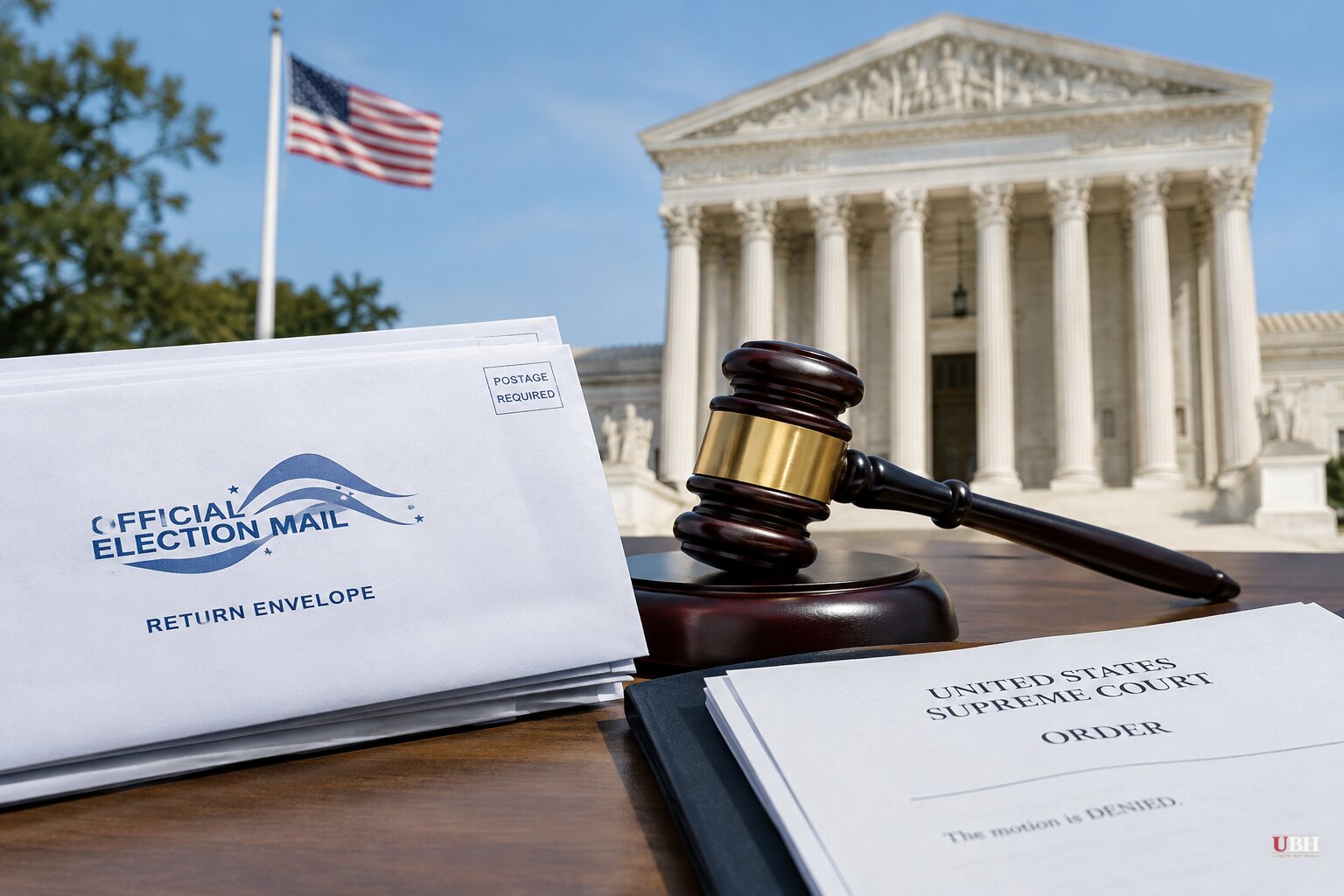
Since Trump's July primetime address on voting integrity, the fight over the rules for the November midterms has played out mostly in courtrooms, and the administration has mostly lost. NPR described the midterm election as less than two weeks away as of Oct. 21.
What the courts have blocked
In that July address, Trump said "hundreds of thousands of noncitizens and dead people are listed and active on the voter rolls," and that the country holds elections "with no voter ID, no proof of citizenship and tens of millions of ballots flowing aimlessly through the mail."
The administration has since tried to act on that. It sought to have the Postal Service screen who can receive mail ballots. It also demanded that states purge thousands of people from voter rolls. The Supreme Court has blocked the Postal Service plan. UCLA law professor Rick Hasen, who runs the Election Law Blog, says several of these efforts have been "decisively defeated." He notes the noncitizen-purge push is still active in California.
The legal obstacle is structural. The Constitution leaves election administration to the states, not Washington. Hasen says the federal government sued 31 states and Washington, D.C., to obtain unredacted voter lists, and that it was zero for 26 in those lawsuits at the time of NPR's interview.
The noncitizen numbers
Homeland Security Secretary Markwayne Mullin claimed Nevada had nearly 16,000 noncitizens on its voter rolls. Nevada officials pared that to 185 names when they pressed for details, then to zero after investigating, according to a political scientist's analysis published in The Conversation. Hasen likewise said the list of roughly 16,000 people was whittled to 185 and then to zero, because the people identified either were not registered to vote or were eligible to register.
That analysis says studies by public officials and think tanks show voting by noncitizens occurs at minuscule levels. Hasen noted that the federal SAVE database is not very reliable or up to date, and that many people share the same names, which makes mistakes possible without identifiers like Social Security or driver's license numbers. Federal agents are still combing state rolls and federal databases for noncitizen voters, according to The New York Times. Mullin has also asked the Justice Department to examine whether a commonly used voting machine can be trusted.
A no-ID, no-proof-of-citizenship system is a fair thing to question. Voter ID is a mainstream position, and most Americans show ID for ordinary transactions. The problem for the administration is that the one concrete number in dispute collapsed under state scrutiny.
Why critics see a setup
Sen. Mark Warner of Virginia, the top Democrat on the Senate Intelligence Committee, said he is increasingly worried Trump may cite foreign interference as grounds to seize voting machines. Election officials and Democrats told The New York Times they fear the claims are groundwork for contesting results that don't favor Republicans.
Lawrence Norden of the Brennan Center for Justice offered a less alarmed read. "There's been a lot of posturing," he said, adding that "mostly election officials are tuning this out. They have elections to run." Even so, some state and local officials say they are preparing to defend their elections against what used to be a reliable ally, the federal government.
Public trust is already thin. Polling cited in The Conversation finds 65% of Republicans, 64% of Democrats and 57% of independents are very or somewhat confident the 2026 count will be reliable. Its author, a political scientist, argues that stoking fraud fears is a high-risk turnout strategy for Republicans.
On the trail
Trump spent Oct. 19 in Park City, Kansas, outside Wichita, rallying for Sen. Roger Marshall. He named Reps. Ilhan Omar, Rashida Tlaib and Alexandria Ocasio-Cortez and said, "A vote for any Democrat this year is a vote to let that small and dangerous group of extremists hold all of us hostage in America." He promised to "defeat the communists, the jihadists, and the corrupt anti-American lunatics once and for all."
In Michigan, Republican Senate candidate Mike Rogers told Sean Hannity's town hall that Democrat Abdul El-Sayed has a "pattern of deception" and is a "manufactured candidate." Rogers said his volunteers are approaching 6 million doors knocked.
El-Sayed said in an ABC News interview that an ally that "takes your money and pushes you into wars you shouldn't be fighting is not an ally," adding, "I think it's time for us to realize that Israel is not actually our friend."
Trouble inside the White House
CNN reports, citing administration officials, advisers and allies, that aides are bracing for personnel shakeups if Republicans lose heavily. Trump ousted Kimberly Guilfoyle as ambassador to Greece and fired new press secretary Katie Zacharia after five days, CNN reported.
"It's more brutal than any other situation in modern times in the White House," one Trump ally told CNN. "You can't trust anybody here."
Mullin's request that the Justice Department examine the voting machine remains one federal election move still in play as the midterms approach.
Sources used for this briefing
6 links from 6 independent newsrooms (syndicated copies of the same report count once)
These are the sources it draws on, linked so you can verify.


