
Unbiased headlines. Facts, not spin.
Unbiased Headlines is an independently owned news organization. We bring you the facts, not opinions, written fresh from 110+ named sources. Sources linked so you can verify it yourself.
 politics
Notable (6/10)
Event date: October 19, 2026 ·
China's Communist Party Opens Fifth Plenum Monday, Oct. 26, With Party Discipline on the Agenda
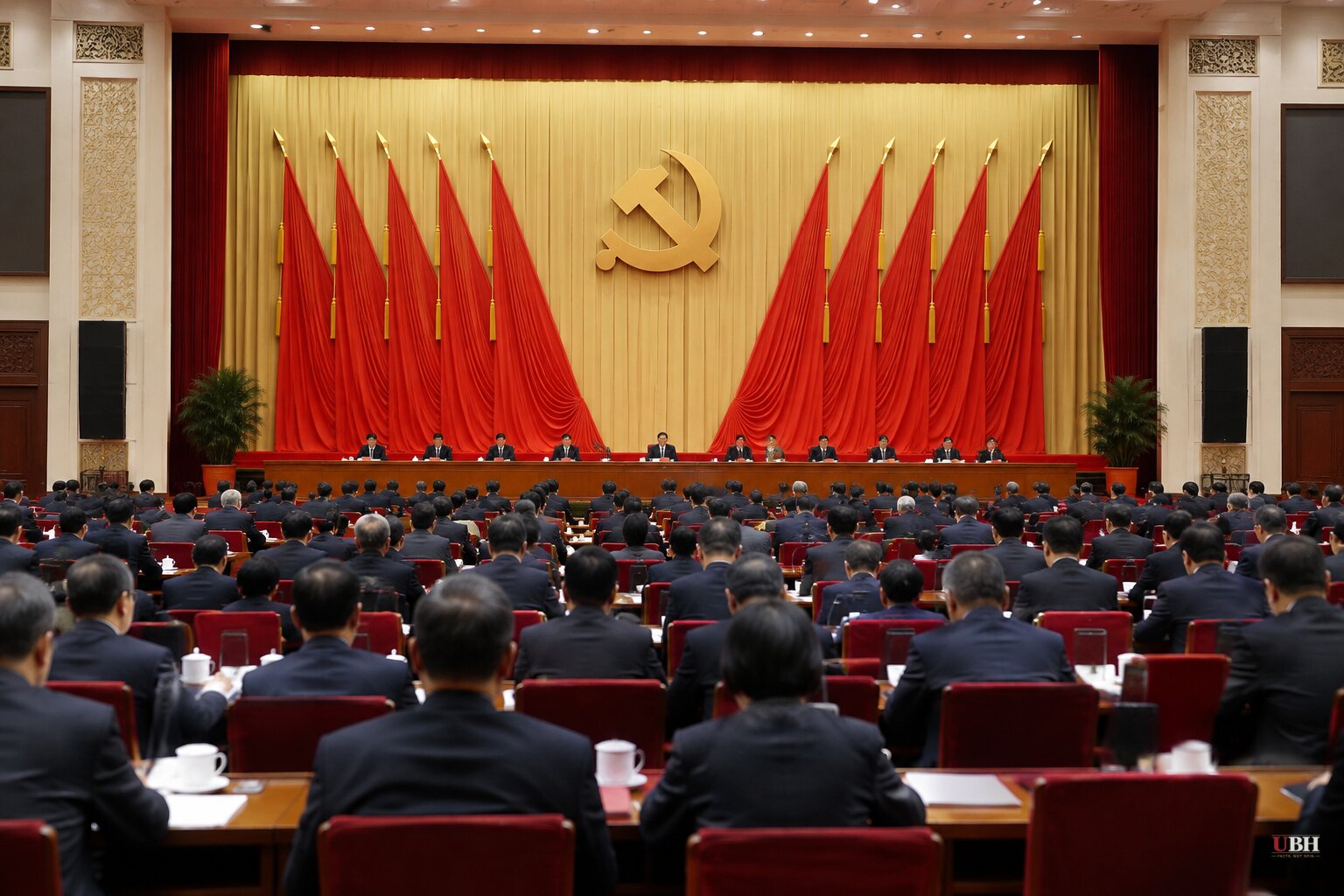
China's Communist Party will convene its Central Committee, roughly 300 of its top officials, in closed-door session in Beijing from Monday, Oct. 26, through Thursday, Oct. 29. It is the fifth plenum of the cohort chosen in 2022.
The party has said the agenda is "issues concerning the sustained advancement of full and rigorous party self-governance." Analysts expect it to be the last major party gathering before the 21st Party Congress in October 2027.
What Xi has already signaled
Xi Jinping laid out his priorities in an article in the party journal Qiushi days before the meeting. He wants the leadership's decisions enforced with uncontested authority. He wants the power of cadres placed in "an institutional cage." And he wants the anti-graft campaign sustained indefinitely, with more "penetrating power."
Xi also went after "two-faced" officials who pay lip service to the leadership while privately resisting its decisions. In a Jan. 12 speech to the party's discipline commission, he said some cadres "constantly proclaim political loyalty" but "comply outwardly while defying inwardly and doing as they please."
The campaign is not new. Xi introduced it in 2014, two years after taking power. Millions of people in China's bureaucracy have been investigated to varying degrees, and hundreds of senior officials and top generals have been purged, including some of Xi's one-time allies.
The SCMP reported that Xi chaired an early Politburo meeting today, Oct. 23, to signal the anti-corruption push ahead of the plenum. The paper also reported that the discipline watchdog warned on Oct. 17 that corrupt officials have "nowhere to hide."
The purge keeps reaching higher
The recent casualty list is long. Former Shenzhen mayor Qin Weizhong was placed under investigation Sept. 21 by the Central Commission for Discipline Inspection, just ahead of Apec meetings in the city. Huang Qifan, a long-time Chongqing figure who had survived scandals in that city for years, fell in mid-October, according to the SCMP.
In the military, Zhang Youxia and Liu Zhenli were stripped of their top military positions on Aug. 29. Both have been under investigation since January for alleged discipline failures. The Epoch Times reported they were later expelled from the party and the army. Zhang was a vice chairman of the Central Military Commission, and Liu was its member and the military's former chief of staff.
On Oct. 2, the SCMP reported, China set up new military academy colleges for AI, drones and discipline, which it described as part of the anti-corruption push in the armed forces.
Critics and the party's answer
Critics argue the purges, especially those at the top of the armed forces, are destabilizing and undermine combat readiness. The party says the opposite. It calls the campaign necessary and regenerative, and says the military must "bathe in flames and be forged anew."
Ruby Osman, a senior policy adviser on China at the Tony Blair Institute, offered a different reading. "The growing focus on discipline is not because behaviour is getting worse, but because the stakes are getting higher," she said. Many of Xi's closest associates are likely to retire in 2027, and she argued that campaigns help ensure "a new generation with fewer personal ties share his political standards."
Osman does not expect major personnel moves or a succession signal at this meeting. "This plenum is probably less about deciding individual promotions, more about signalling the system-wide changes Xi wants ahead of a competitive 2027 Party Congress," she said.
Can discipline deliver results?
The Asia Society Policy Institute's Center for China Analysis says Xi's dominance "should not be mistaken for omnipotence." Its analysts argue that commanding the Zhongnanhai leadership compound is easier than steering 101 million party members across a vast country.
A separate analysis by Neil Thomas, Lobsang Tsering and Shengyu Wang describes contradictory effects. Local officials face rising demands and shifting goals, must produce constant paperwork to prove they complied, and often have thin budgets. Under those conditions, a visible showpiece project can pay off better than slow work on structural problems.
That tracks with an article in the same Qiushi issue by Wang Xipeng of the Chinese Academy of Social Sciences. Wang flags task assignments too vague to enforce, inspections that lean on written logs over on-site checks, and poor sharing of inspection findings between departments. He also warns that grassroots officials may choose inaction because "the more they do, the more mistakes they make."
Analyst Fred Gao reads those pieces as a sign the plenum may address how decisions get implemented, and possibly ways to tolerate errors, rather than only tighten control.
Loyalty at the top
Xi has effectively skipped a plenum in 2023, according to the Asia Society, and is now assigning the Fifth Plenum party-governance business usually associated with a Sixth Plenum. The fourth plenum in 2025 already adopted recommendations for the 15th Five-Year Plan, so this one is not about the economic blueprint.
U.S.-based commentators Wang He and Li Linyi told The Epoch Times that the purge raises questions about Xi's grip on the military and on succession. Wang named Cai Qi, who runs the party's General Office and oversees the Central Guard Bureau, and Public Security Minister Wang Xiaohong as the two figures most important to Xi's hold on power. Both have ties to Xi from his years in Fujian. "If these two people remain in place, Xi Jinping will still hold power firmly," Wang He said.
Li noted that both men approach or pass age 70 by the next congress. He said keeping control of the military may be harder still, since many serving officers remain connected to the men who were purged.
Those are analysts' assessments, not announced facts. The party has not said who, if anyone, will be added to or removed from the leadership at the plenum.
The plenum is expected to end Thursday, Oct. 29, with the party's official readout of its decisions. The 21st Party Congress is slated for October 2027, exactly a year from now.
Sources used for this briefing
5 links from 5 independent newsrooms (syndicated copies of the same report count once)
These are the sources it draws on, linked so you can verify.


