
Unbiased headlines. Facts, not spin.
Unbiased Headlines is an independently owned news organization. We bring you the facts, not opinions, written fresh from 110+ named sources. Sources linked so you can verify it yourself.
 politics
Major Story (7/10)
Event date: October 17, 2026 ·
French Protest Turnout Lower Than Last Week as Police Use Tear Gas in Lyon and Clermont-Ferrand
Since the Oct. 17 protests that ended in looting, burned cars and about 3,000 damaged or looted shops, France has spent a week boarding up storefronts and massing police. Saturday, Oct. 24, was the test of whether that worked.
Through the afternoon, the answer looked like a qualified yes. Crowds were smaller than a week earlier, and authorities were trying to prevent another weekend of looting, burned cars and attacks on public buildings.
Smaller crowds, tear gas in two cities
Nuñez said 35,000 people had demonstrated nationwide by 1 p.m., compared with 60,000 at the same hour on Oct. 17. More than half a million people took to the streets that day.
In Paris, authorities confined the union-led march to the city's southeastern edge, away from the center. An Associated Press journalist saw tens of thousands of people marching from Porte d'Italie early in the afternoon, but the crowd appeared smaller than a week earlier. Trade unions led the procession, followed by protesters in raincoats carrying flags and handmade placards. Some banners read "We are fed up."
Toulouse drew 26,500 people, according to local authorities.
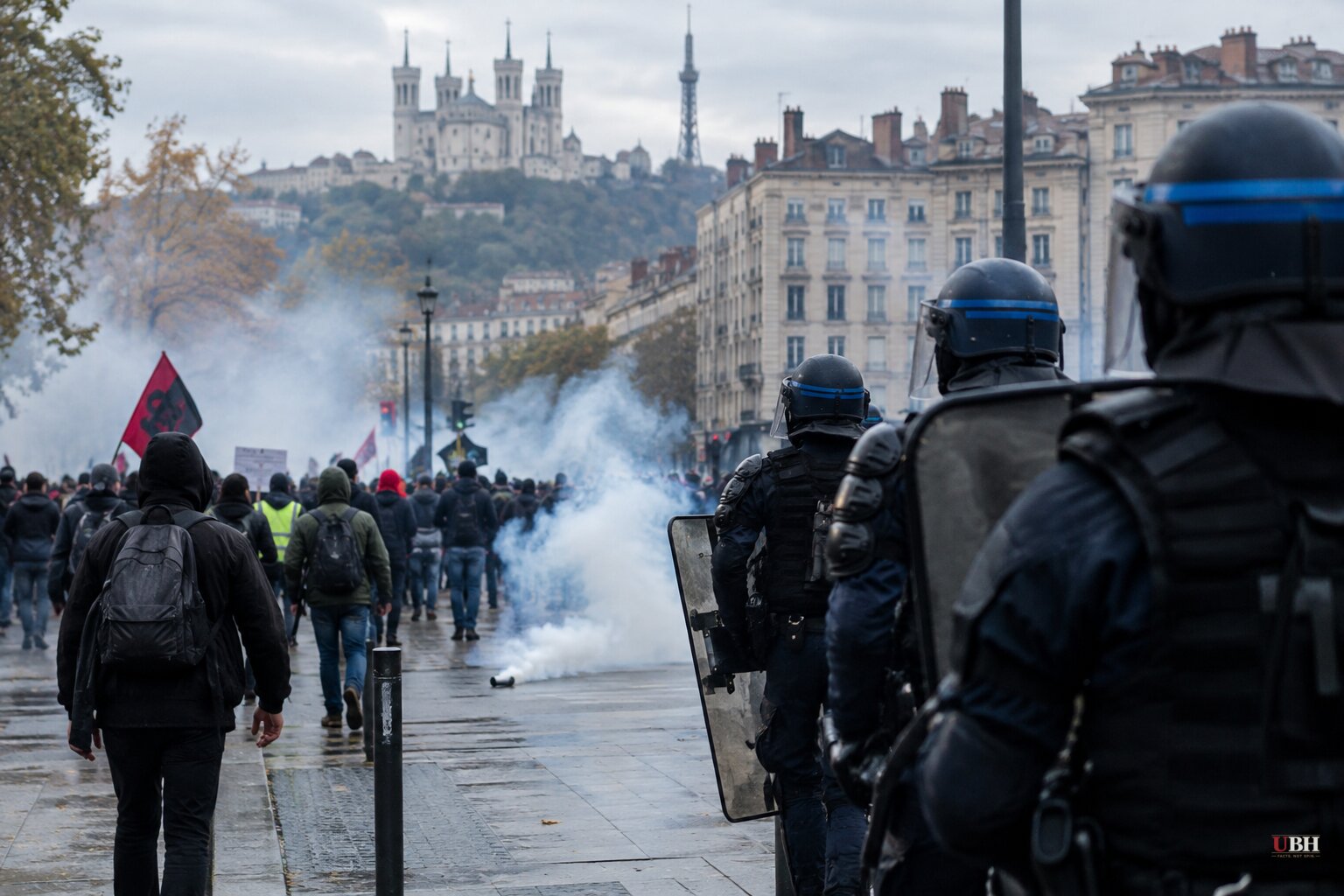
Police used tear gas in Lyon on Saturday morning, where the rally had been banned. In Clermont-Ferrand, officers used tear gas and stun grenades to push back demonstrators trying to reach the city center, French media reported.
Nuñez had said up to 70,000 officers would be deployed nationwide, backed by helicopters, armored vehicles and water cannons. That is about 10,000 more than on Oct. 17.
A capital in lockdown mode
The Louvre, Musée d'Orsay, Picasso Museum and Grand Palais were all closed for the day. The Grand Palais shutdown cut off access to a major Cézanne exhibition. The Paris Opera closed both the Palais Garnier and the Opera Bastille, citing the safety of staff and visitors.
Art Basel Paris opened Friday, but only for the day, and organizers cancelled the weekend program because of the threat of unrest. More than 20 metro stations were reported closed.
Gendarmes stood beneath the Arc de Triomphe. Military officers and an intervention vehicle were positioned outside the National Assembly. Near Saint-Lazare station, contractor Akram Ahmed, 34, was boarding up an optician's shop. "I got the call last night," he said. "The owner seemed desperate. He said I was saving his life."
Last weekend's damage was not limited to the capital. In Limoges, a suspected arson attack nearly destroyed the city's 19th-century town hall. Nuñez acknowledged on Monday that police had lost control in some cities, and he offered to resign. President Emmanuel Macron refused.
Bans draw fire from unions
Local authorities banned rallies in Lyon, Nice and Montpellier. Marches went ahead in Paris and Marseille.
Trade unions have called the bans violations of freedom of expression, which is protected by the constitution. Macron has said the measures are needed to protect city centers, businesses and public buildings.
Paris police prefect Patrice Faure first urged shopkeepers to hire security guards. He later clarified that protecting businesses and their owners remained the government's responsibility.
Money and Macron's last months
The movement began last month over staff shortages at one high school southeast of Paris. It has since pulled in students demanding better-funded schools and workers seeking higher wages and pensions.
The cost-of-living complaint has numbers behind it. France's national statistics agency, INSEE, reports energy prices in September were 21.3% higher than a year earlier, helping drive overall inflation to 3.1%.
Camille Chesnier, 27, said she had been unable to find work despite having an engineering degree and a master's degree. "There are enormous numbers of people in the same situation as me but who aren't privileged and who find themselves living on the streets and in squats and, frankly, it's very tough," she said.
Student groups want 250,000 more places in higher education and an end to selection through Parcoursup, the national admissions system. Their joint 10-point plan also calls for more teachers and repairs to schools and universities.
Macron met high school representatives on Friday. They said he had promised to overhaul university admissions, but called for protests to continue until concrete measures are announced.
Macron is in the final months of his presidency, with his popularity at its lowest since he took office in 2017. Voters choose his successor in May.
In Orléans, thousands joined a separate, peaceful march against the far right as Marine Le Pen's National Rally held a two-day congress in the city. The far-right party has accused the government of failing to protect the public and urged people to channel their anger into votes.
What comes next
The U.S. Embassy has advised Americans in Paris for the NFL game on Sunday, Oct. 25, to exercise caution.
Student leaders have given no sign of standing down. Whether Macron's admissions promise turns into a concrete announcement before the next round of marches is the open question.
Sources used for this briefing
8 links from 8 independent newsrooms (syndicated copies of the same report count once)
These are the sources it draws on, linked so you can verify.


