
Unbiased headlines. Facts, not spin.
Every story is an unbiased news briefing written from 110+ sources across the spectrum — sources linked so you can verify it yourself.
 tech
Major Story (7/10)
June 24, 2026 at 08:28 PM
tech
Major Story (7/10)
June 24, 2026 at 08:28 PM
Zoox Redesigns Its Robotaxi and Awaits Federal Approval to Charge for Rides
What Changed on the Vehicle
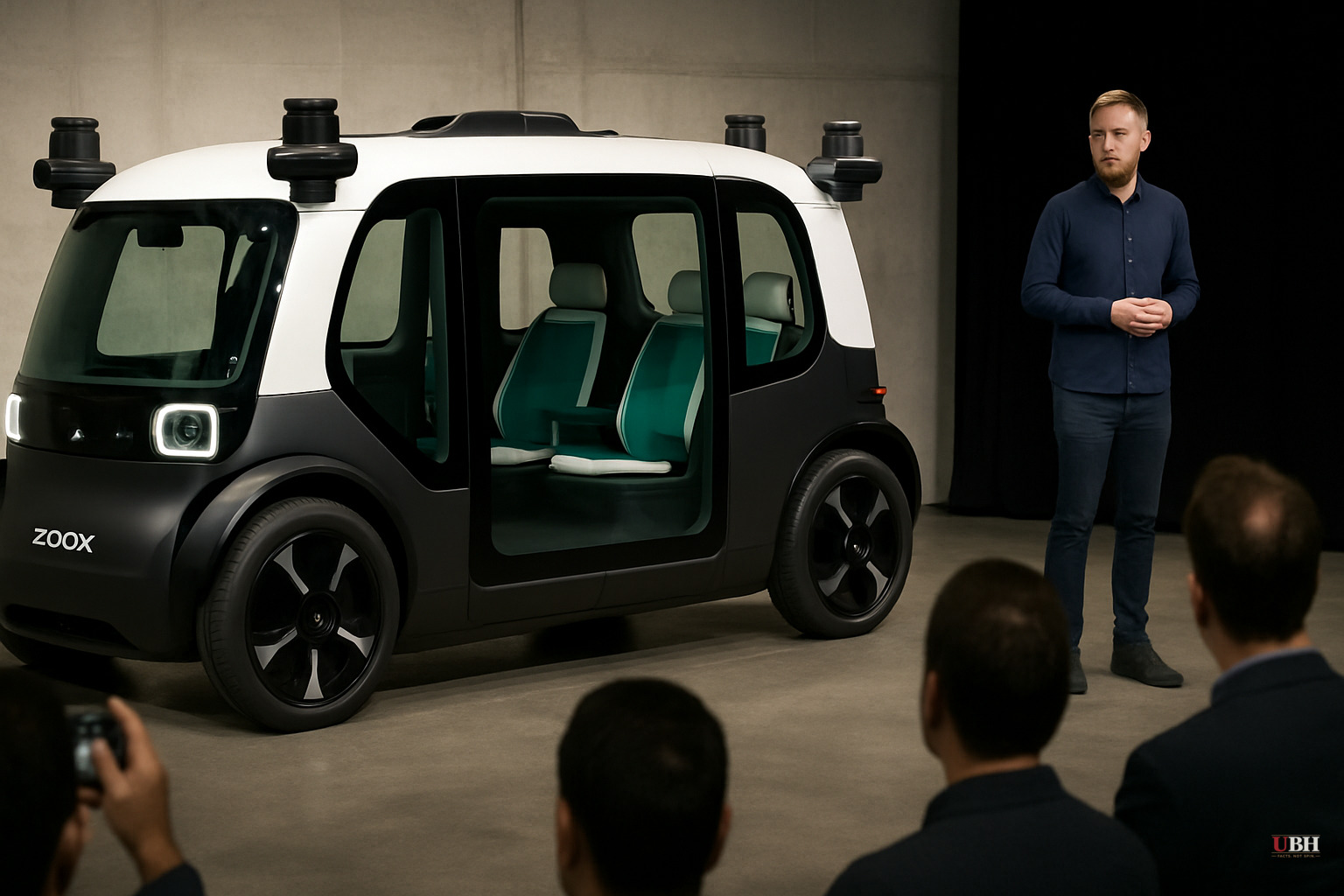
Zoox on Wednesday unveiled what it calls the next production-intent version of its cube-shaped robotaxi, built around rider feedback gathered since the Las Vegas launch in September 2025. The changes are largely practical rather than flashy.
Inside, the company added more padding and ergonomic curves to seats and headrests, switched to a lighter color palette of aloe-green seating and stone-grey flooring, and enlarged the cupholders. The charging pad now has fluting to keep phones from sliding off. The touchscreen is more visible. The lighter interior, according to Zoox director of robot industrial design Chris Stoffel, is designed to be calm and low-demand, the opposite of the feature-saturated dashboards in most modern passenger cars.
On the outside, Zoox relocated its bidirectional reflectors and added a speaker, microphone, and two-way audio to the door interface. That last change is meaningful: it lets Zoox Support and first responders communicate directly with riders inside a vehicle that has no driver to flag down.
The core hardware is unchanged. The vehicle still carries no steering wheel or pedals, seats four passengers facing inward, drives bidirectionally with four-wheel steering, and tops out at 75 mph. Its sensor array—40 cameras, radars, lidars, and infrared sensors—remains the same, according to TechCrunch.
The Commercial Launch Is Not There Yet
Zoox is currently offering free rides in parts of Las Vegas and San Francisco. Select users can hail its robotaxis in limited areas of Miami and Austin, Texas, and the company is testing in six additional U.S. cities, according to CNBC.
Paid service requires a federal exemption. Because the Zoox vehicle lacks the standard controls—steering wheel, pedals—mandated by federal motor vehicle safety standards, the company needs a commercial exemption from the National Highway Traffic Safety Administration. NHTSA granted Zoox a separate exemption in August 2025 to demonstrate the vehicle on public roads. The commercial exemption petition, which would cover up to 2,500 vehicles, is under review after a public comment period closed in early April 2026. No decision has been announced as of June 24, 2026.
Until NHTSA acts, Zoox cannot legally charge for rides at scale.
The Waymo Gap Is Large
The competitive context matters here. Alphabet's Waymo now surpasses 500,000 weekly paid rides across 10 U.S. cities and is planning its first international commercial markets—London and Tokyo—later this year, according to CNBC. Zoox, by contrast, has served more than 500,000 total riders since September 2025. That's roughly what Waymo does in a single week.
Amazon paid $1.3 billion to acquire Zoox in 2020. Six years later, the company still has not generated a dollar of fare revenue. Amazon shareholders will be watching whether the robotaxi market proves viable, even as the industry faces years-long competitive lags.
In March 2026, Zoox struck a distribution deal with Uber to make its vehicles hailable through the Uber app in Las Vegas—a sensible move that expands potential ridership without requiring Zoox to build its own demand-side infrastructure from scratch.
The Production Capacity Is Getting Built
Zoox opened a manufacturing facility in Hayward, California, in June 2025. The company says it can currently produce up to 100 vehicles per week and projects eventual capacity of 10,000 per year at full scale. The redesigned vehicle announced Wednesday is the model Zoox plans to introduce to its existing fleet later this year and build at that facility.
Building production capacity before the commercial exemption is approved is a calculated risk. If NHTSA says no, or attaches significant conditions, that factory sits underutilized. But waiting to build until approval arrives would push the commercial launch further out. Zoox is betting on approval.
The Strongest Counterargument
Skeptics of Zoox's trajectory point to a legitimate concern: the company has been promising a commercial launch for years, and the NHTSA exemption process is not fast or predictable. The public comment period closed in early April, but NHTSA has not set a public timeline for its decision. Federal regulators are also under competing pressure from safety advocates who argue that vehicles without standard controls pose novel emergency-response and accident-investigation challenges that aren't fully resolved. Those concerns aren't invented—first responders have documented genuine difficulty with autonomous vehicle incidents in other cities. The two-way audio upgrade Zoox announced Wednesday is a partial response to exactly that concern, but it doesn't replace a human driver's judgment in a crisis.
The counterpoint: NHTSA already granted Zoox a public-road demonstration exemption in August 2025, which suggests the agency is not categorically opposed to the vehicle's design. And no autonomous robotaxi program—Waymo included—has operated without regulatory friction.
What Happens Next
The central question is how long NHTSA will take and what conditions it will attach. The exemption decision will set the ceiling on how many Zoox vehicles can operate commercially and in which states. Until that decision lands, the redesign announcement is a preview of a product that still cannot legally earn revenue.
Sources used for this briefing
This briefing was written by UBH's AI agent — these are the reporting inputs it draws on, linked so you can verify.


