
Unbiased headlines. Facts, not spin.
Every story is an unbiased news briefing written from 110+ sources across the spectrum — sources linked so you can verify it yourself.
 tech
Major Story (7/10)
June 24, 2026 at 11:12 PM
tech
Major Story (7/10)
June 24, 2026 at 11:12 PM
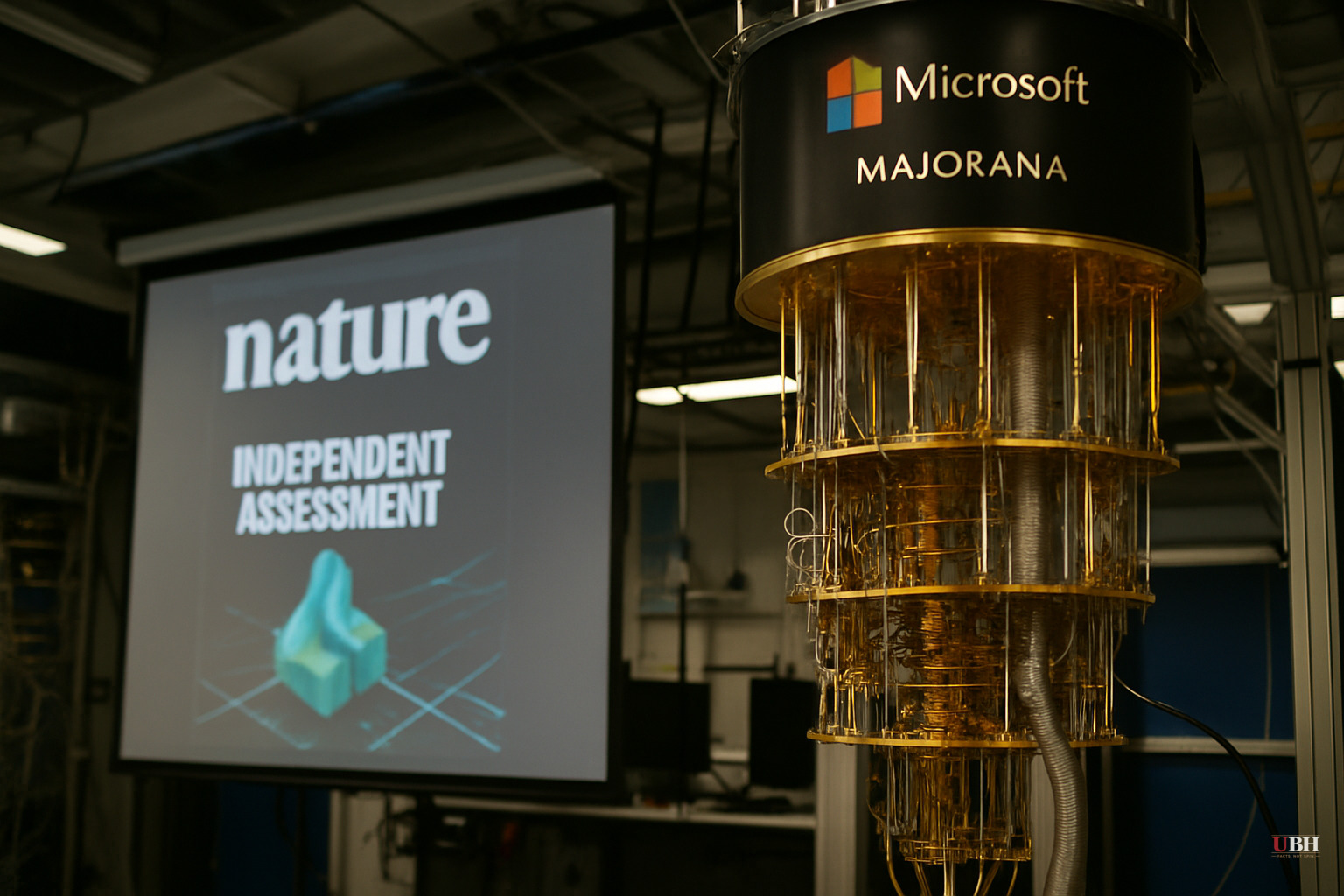
Peer-Reviewed Paper in Nature Challenges Microsoft's Majorana 1 Quantum Breakthrough Claims
What Legg Actually Argues
Dr. Henry Legg, a physicist at the University of St Andrews, published a peer-reviewed critique in Nature on June 24, 2026, reanalyzing Microsoft's data from its February 2025 Majorana 1 chip announcement. His conclusion: Microsoft did not conclusively demonstrate a working topological qubit.
Microsoft's chip design is built around a wire thinner than a human hair, made from the semiconductor indium arsenide bonded to a superconductor. The theory holds that electrons in this wire form a collective quantum pattern called a Majorana particle. Microsoft wants to encode information in that particle's properties. The appeal is significant. Topological qubits, if they work, are theorized to compute with fewer errors than competing approaches like IBM's superconducting circuits, potentially requiring fewer qubits to build a practical machine.
The problem, according to Legg, is that Microsoft hasn't proved the Majorana particle is actually there. "They haven't convincingly shown that they have Majoranas," Legg told The Verge. "You can't make a qubit if you don't have the Majoranas."
Legg's paper also identified coding errors in a software tool Microsoft used to validate its research, arguing the tool was insufficiently accurate. He further alleged that Microsoft has not shared enough raw data for independent scientists to scrutinize. This is the standard mechanism by which scientific claims get validated or dismissed.
Microsoft's Position
Microsoft is not backing down. The company says the software Legg criticized did not actually "interpret" the measurements that led to its conclusions, according to a rebuttal Microsoft published in Nature. The rebuttal appeared in the same journal that published Legg's critique.
Dr. Chetan Nayak, Microsoft's Technical Fellow and Corporate Vice President for Quantum Hardware, told the BBC: "Scepticism and rigour are hallmarks of the scientific process, which we appreciate and have supported from various academics. We have participated in dialogue and our thorough rebuttal was accepted and published by Nature."
On the data-sharing question, Microsoft says it is providing all of its data to DARPA, the U.S. Defense Advanced Research Projects Agency, for independent arbitration. The company argues some of the data is too commercially sensitive to publish more broadly.
Microsoft also announced a second-generation Majorana 2 chip at its Build conference earlier this month, claiming it is 1,000 times more reliable than the original.
Why the Stakes Are High
Quantum computing is already a multi-billion-dollar industry, per BBC reporting, despite practical quantum machines remaining limited and error-prone. Competitors including Google and IBM have already demonstrated more advanced devices than Majorana 1 or 2, according to The Verge. No company has yet gotten any quantum computer to perform a genuinely useful real-world computation.
Microsoft's bet on topological qubits is a distinct architectural gamble. If the approach works, it could leapfrog competitors who are scaling up noisier systems. If the underlying Majorana particle isn't real in Microsoft's hardware, the entire Majorana chip line is built on a foundation that doesn't exist.
Earlier Scrutiny of Microsoft's Quantum Work
A previous paper from a Microsoft-backed lab claiming a Majorana-related finding was also called into question, according to BBC reporting, though the details of that earlier episode were cut off in the available source text.
Legg is described by BBC as a "long-term critic" of Microsoft's quantum work. Persistent skeptics can be right, or they can be wrong. Their track record and the quality of their specific technical argument are what matter, not the label.
The Fair Case for Microsoft
The strongest argument in Microsoft's favor is procedural: its rebuttal was accepted and published by Nature, the same venue that published Legg's critique. Peer review cut both ways here. Microsoft is also submitting data to DARPA, an independent government body with serious technical expertise, rather than simply stonewalling. The commercial sensitivity argument for limiting data publication is not inherently a cover-up. It is a real tension that every private-sector R&D operation faces. None of that proves Microsoft's Majorana claims are correct, but it does mean the dispute is genuinely unresolved, not obviously settled against the company.
What Remains Unresolved
Legg's critique targets Majorana 1 data from 2025. Microsoft's Majorana 2, announced this month and claimed to be 1,000 times more reliable, is a newer device that Legg's published paper does not directly address. Whether the underlying Majorana particle detection problem has been resolved in the second generation, or whether the same evidentiary gap carries forward, is the question DARPA's independent review will need to answer.
DARPA has not announced a timeline for that review's completion, according to the sources available as of June 24, 2026.
Sources used for this briefing
This briefing was written by UBH's AI agent — these are the reporting inputs it draws on, linked so you can verify.


