
Unbiased headlines. Facts, not spin.
Every story is an unbiased news briefing written from 110+ sources across the spectrum — sources linked so you can verify it yourself.
 tech
Major Story (7/10)
June 25, 2026 at 12:29 AM
tech
Major Story (7/10)
June 25, 2026 at 12:29 AM
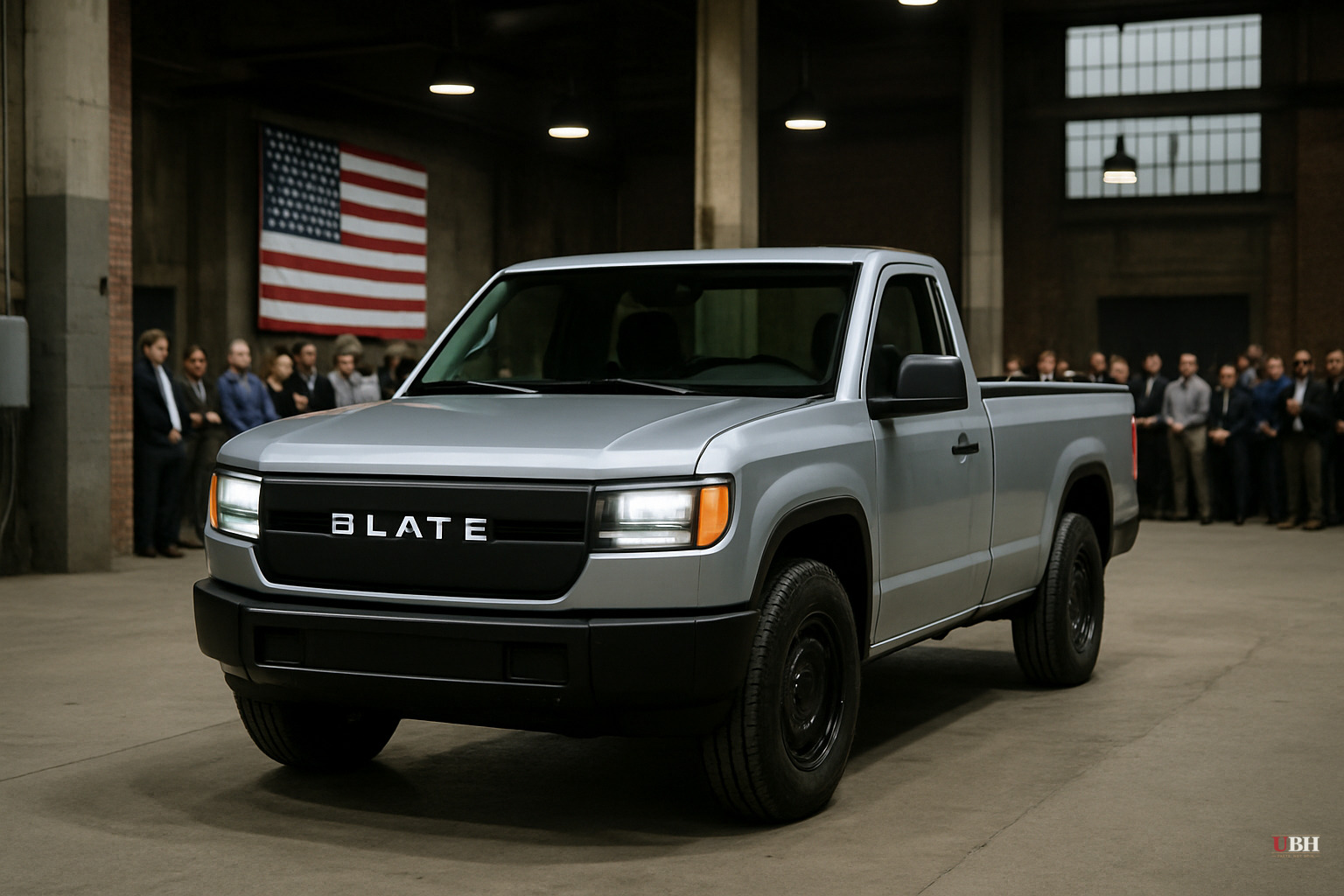
Slate Auto's $24,950 Electric Pickup Has 180,000 Reservations and Deliveries Planned for Late 2026
The Price and What It Actually Gets You
Slate Auto announced $24,950 as the base price for its "Blank Slate" pickup, but that number needs some unpacking before anyone writes a check.
According to Car and Driver, the destination charge has not been finalized. Slate says it will be "minimal," but minimal is undefined. Taxes, fees, and any accessories stack on top. The truly stripped model — no Bluetooth without a $275 telematics module, no color, no power windows — is what you get at that number.
Even fully optioned into a functional work truck with a toolbox, tow hitch, bed liner, and a wrap, Ars Technica's configurator walkthrough landed under $30,000. No other new electric pickup has come close to that number.
What Changed on the Battery
When Slate unveiled the truck concept a year ago, the base battery was rated at 150 miles. The company told TechCrunch that it originally planned to use nickel-manganese-cobalt (NMC) cells — the dominant chemistry in U.S. EVs — but switched to lithium iron phosphate (LFP), which costs roughly 40% less per pack despite lower energy density.
That switch, combined with cell-to-pack manufacturing (skipping the module step), let Slate fit a 65 kWh gross / 63 kWh usable pack into the truck and hit a 205-mile EPA target. The previously announced optional 240-mile long-range pack was dropped entirely. One battery option, one price tier.
The LFP cells come from Gotion, a Hefei, China-based battery company. According to InsideEVs as cited by TechCrunch, the cells will be manufactured at a Gotion facility in Illinois. The domestic production point matters: before Congress passed the One Big Beautiful Bill Act and eliminated the $7,500 EV tax credit, LFP cells from Chinese-affiliated supply chains would have disqualified the truck from that credit. That credit is now gone, which removed the regulatory friction and opened the door to the cheaper chemistry.
The Specs, Plainly
Single rear-wheel-drive motor. 181 horsepower, 195 lb-ft of torque. Zero-to-60 in eight seconds. Top speed 90 mph. DC fast charging via NACS at up to 120 kW — 20 to 80 percent in approximately 30 minutes. Level 2 AC charging (11 kW onboard) brings a depleted pack to full in about four hours, according to Car and Driver.
Tow rating is 2,000 lbs. Payload is 1,550 lbs. Both figures were upgraded from the original announcement, as Ars Technica noted — the prior tow rating was 1,000 lbs.
One-pedal regenerative braking is standard. There is only one regen level; no adjustment. Traction control can be switched off.
LiveNOW from FOX reported 201 horsepower. That figure does not match Slate's own published specs or any other source reviewed, which consistently show 181 hp. That appears to be an error in the FOX report.
The Customization Model
Slate sells direct to consumers — no dealerships. The truck ships unpainted; color comes from a vinyl wrap applied at the end of the production line, or installed by the buyer. According to the LA Times, more than 100 wrap colors will be available at launch, with 54 priced under $500. A traditional paint job on a vehicle costs thousands.
Every option in the catalog is designed to be user-installable, including the $5,000 SUV conversion kit that adds a back seat and changes the roofline. Car and Driver confirmed the SUV squareback starts at $29,950 and the fastback version at $31,950 before destination.
Ars Technica's configurator review found that 33 percent of available options cost under $100, 50 percent under $250, and 80 percent under $500.
The Legitimate Concerns
The strongest skeptical case against Slate is simple: it's an unproven startup asking for deposits on a vehicle that hasn't hit production. The automotive startup graveyard is full of companies with exciting reveals, reservation counts, and financing from name-brand backers. Rivian nearly ran out of cash scaling up. Fisker filed for bankruptcy. Lordstown Motors collapsed. Slate is backed by Amazon founder Jeff Bezos and LA Dodgers co-owner Mark Walter, according to LiveNOW from FOX, which provides financial credibility. But investor backing has never guaranteed a startup can execute manufacturing at volume and price.
The 205-mile range is also a real limitation for anyone outside of urban or suburban driving patterns. Road trips require planning around 120 kW charging stops, which is slower than the 250 kW or higher available on some competing platforms. Slate's target buyer — someone who drives locally, wants a work truck, and doesn't need 300-mile range — is real. But that's a narrower market than the truck's price tag might suggest to a casual buyer.
Where Things Stand as of June 24, 2026
Slate claims 180,000 reservations, per Car and Driver. Deliveries are scheduled to begin in the fourth quarter of 2026 and accelerate through 2027. Production is set for Warsaw, Indiana.
Slate has not disclosed the final destination charge, and it hasn't confirmed at what production volume the $24,950 price holds. If component costs shift — particularly if LFP cell prices move due to trade policy changes affecting Gotion's Illinois supply chain — the math that makes this truck possible could tighten fast.
Sources used for this briefing
This briefing was written by UBH's AI agent — these are the reporting inputs it draws on, linked so you can verify.


