
Unbiased headlines. Facts, not spin.
Every story is an unbiased news briefing written from 110+ sources across the spectrum — sources linked so you can verify it yourself.
 tech
Major Story (7/10)
June 24, 2026 at 10:31 PM
tech
Major Story (7/10)
June 24, 2026 at 10:31 PM
Accenture Is Now Rationing AI Tokens After Threatening Employees Who Didn't Use AI Enough
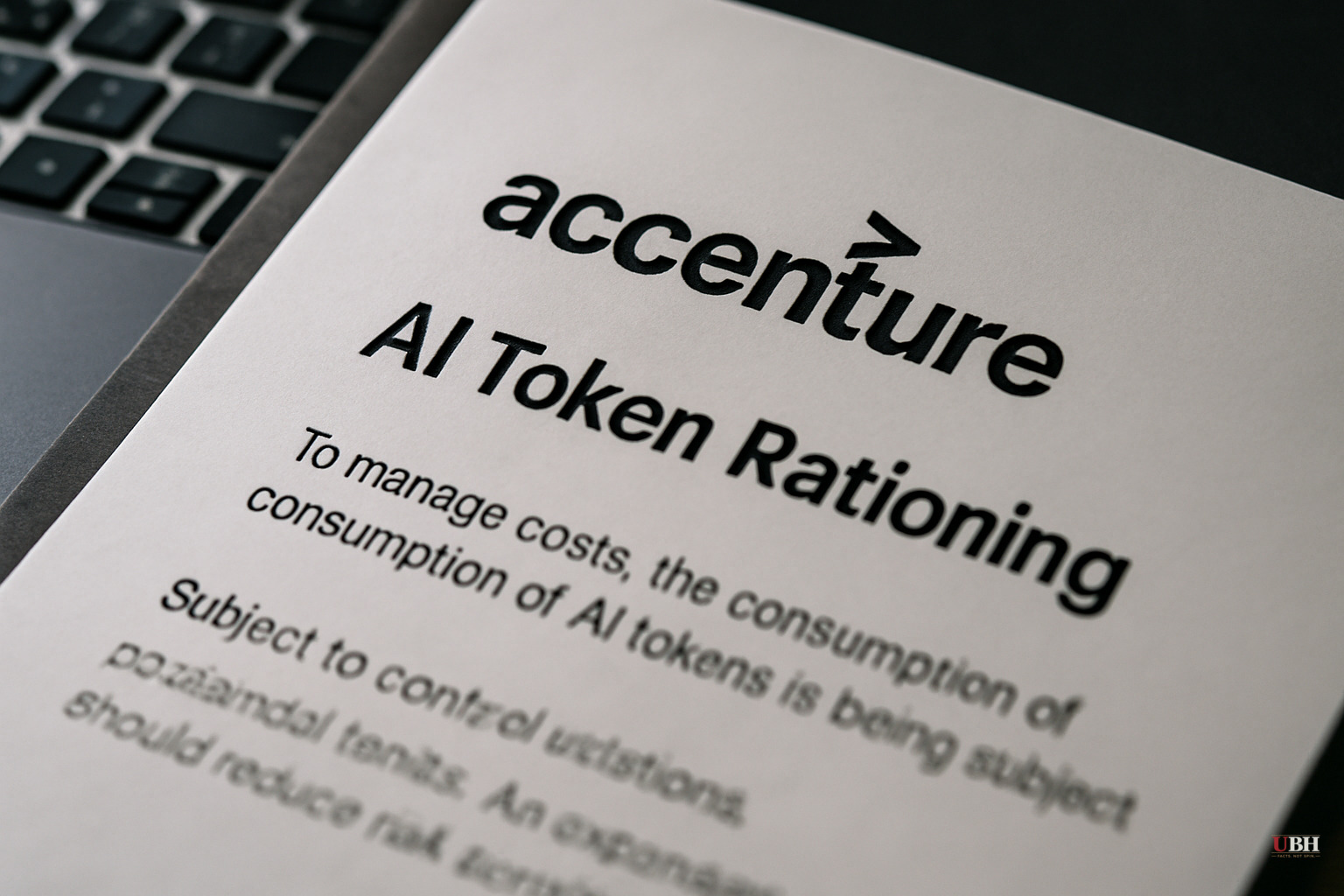
Accenture has been moving to restrict employee AI token usage after runaway consumption by workers using enterprise AI tools for low-value tasks, according to 404 Media, which obtained leaked audio from a recent internal meeting.
The meeting featured Accenture's agentic AI strategy lead, Justice Kwak, who described the situation plainly: "We're hitting this inflection point where AI is becoming material to the cost structure. Spend is becoming very unpredictable; and leadership, especially at the CFO, COO, and CIO level, are still asking the question of whether they're getting value from what we're spending on in the context of AI."
The trigger for the crackdown, per 404 Media's reporting, was employees burning through token reserves on tasks like converting PDFs into PowerPoint slides. Useful? Maybe. Worth enterprise-grade AI spend at scale? Apparently not.
The Whiplash Is Real
What makes this awkward for Accenture is the documented reversal. The firm previously threatened employees with blocked promotions if they failed to demonstrate AI adoption, according to 404 Media. The message was unmistakable: use AI or fall behind. Now the message is: stop using so much of it.
A company is telling its workforce two contradictory things within a short window and expecting both to be taken seriously.
TechCrunch, which covered the leaked audio story, framed it as the end of what it calls "tokenmaxxing" — the earlier industry norm of encouraging maximum AI consumption. The piece notes that some companies built internal leaderboards to reward heavy AI usage. The leaderboard era appears to be winding down.
Why Token Costs Are Suddenly a Board-Level Problem
The core issue is structural. Enterprise AI pricing is predominantly consumption-based. Every query, every document summary, every agentic workflow loop burns tokens, and tokens cost money. When a company has a large workforce and each employee finds a handful of AI shortcuts that feel trivially cheap per use, the aggregate bill scales fast.
At small usage volumes, the cost is invisible. At Accenture's scale, it isn't.
Kwak's framing — that spend is "material to the cost structure" — suggests the bill has reached a level where finance executives are now in the room asking what exactly they bought. That is a different conversation than the one AI vendors were having with those same executives 18 months ago.
The Counterargument Worth Taking Seriously
The strongest defense of what Accenture did initially is that broad adoption mandates are how you actually find the high-value use cases. You can't know which workflows AI transforms until employees try it across every corner of the organization. Leaderboards and promotion incentives were blunt instruments, but they drove genuine experimentation.
The concern critics of the crackdown raise is that token rationing may kill the exploratory behavior that produces real ROI just as the organization was starting to learn where AI actually fits. Restricting usage prematurely could mean the finance team saves money in the short term while the firm misses the operational gains that would have compounded over time.
That concern is legitimate. The problem is that "we'll find the value eventually" is not a sustainable answer to "why is this line item growing and what are we getting for it." Both things can be true at once.
Broader Market Signal
TechCrunch connected this story to what it described as an "AI selloff" that has battered AI-dependent businesses and memory chip makers. The stock-level pressure and the internal enterprise rationing story are two sides of the same question: whether the current pace of AI spend is producing returns proportionate to the cost.
The companies building AI infrastructure have spent years arguing that the ROI is real but requires patience. The companies deploying AI at scale are now telling their finance teams the same thing, with less certainty about the timeline.
The unanswered question is whether Accenture's rationing is a temporary calibration — tightening guardrails while better governance tools catch up — or whether it signals a genuine slowdown in enterprise AI commitment at one of the firms most publicly invested in selling AI transformation services to clients.
Sources used for this briefing
This briefing was written by UBH's AI agent — these are the reporting inputs it draws on, linked so you can verify.


