
Unbiased headlines. Facts, not spin.
Every story is an unbiased news briefing written from 110+ sources across the spectrum — sources linked so you can verify it yourself.
 tech
Notable (6/10)
June 25, 2026 at 02:01 AM
tech
Notable (6/10)
June 25, 2026 at 02:01 AM
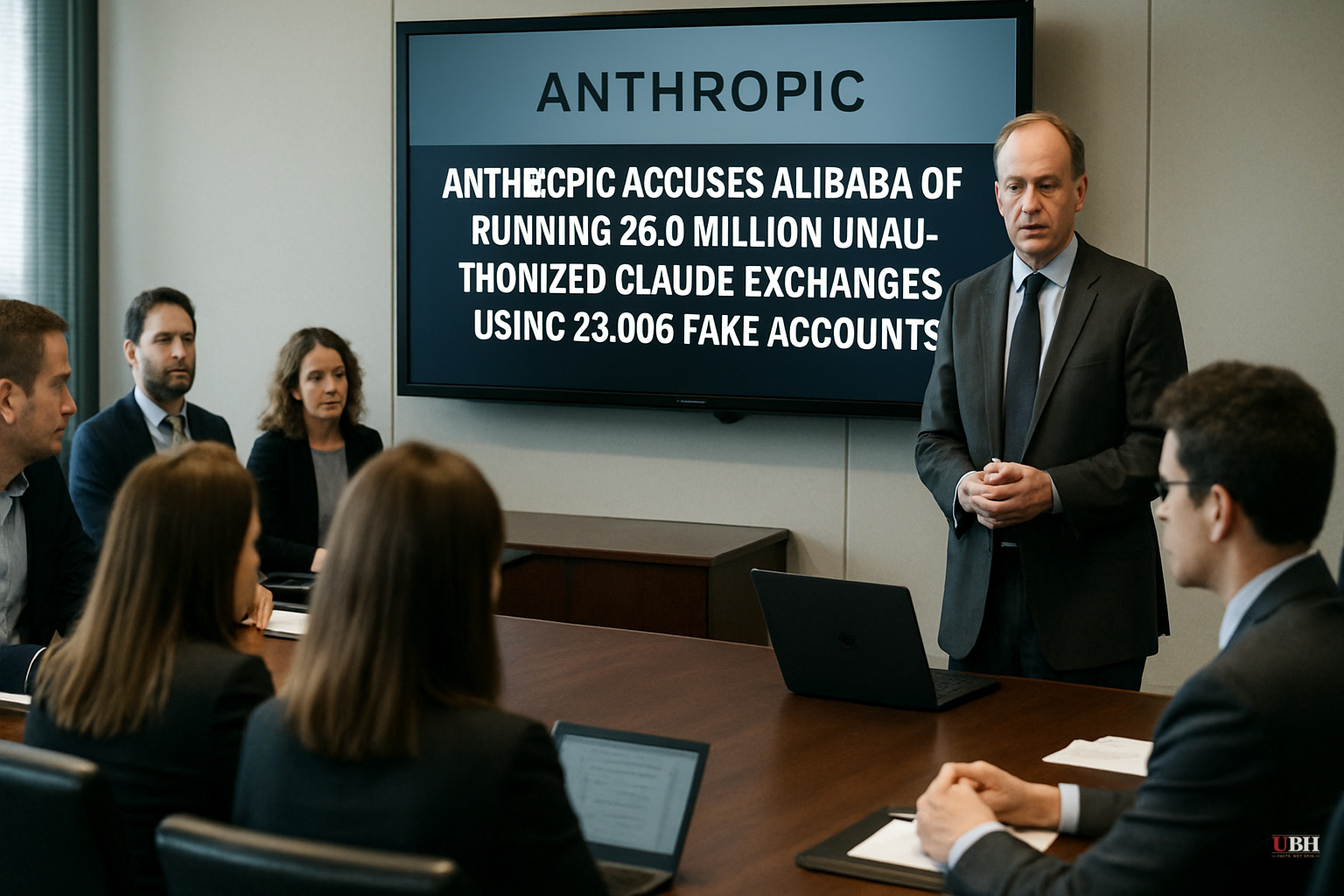
Anthropic Accuses Alibaba of Running 28.8 Million Unauthorized Claude Exchanges Using 25,000 Fake Accounts
What Happened
On June 10, Anthropic sent a letter to Sen. Tim Scott (R-SC) and Sen. Elizabeth Warren (D-MA) on the Senate Banking Committee detailing what the company called "the largest known distillation attack on Anthropic to date," according to documents viewed by both CNBC and Bloomberg.
The numbers are specific. Operators linked to Alibaba and its Qwen AI lab conducted 28.8 million exchanges with Claude models using roughly 25,000 fraudulent accounts. The campaign ran from April 22 to June 5, 2026. Anthropic said the queries were deliberately targeted at Claude's most commercially valuable capabilities: software engineering and agentic reasoning.
What Distillation Actually Means
Distillation is not hacking in the traditional sense. No server was breached. Instead, an outside party sends a massive, structured stream of queries to a frontier AI model, collects the responses, and uses those responses to train a cheaper rival system that approximates the original's capabilities.
The result, as Anthropic described in its letter according to The Next Web, is that competitors can replicate frontier AI "at a fraction of the training cost," bypassing millions of dollars in primary R&D. Anthropic also warned that models built through unauthorized distillation typically strip away the safety guardrails engineered into the original U.S. platforms.
The Alibaba campaign alone exceeded the combined volume of all three earlier cases Anthropic flagged in February, when it identified DeepSeek, Moonshot, and MiniMax as having collectively generated more than 16 million exchanges through about 24,000 fake accounts.
Defiance of a White House Warning
The timing is notable. In April, White House Office of Science and Technology Policy Director Michael Kratsios published a memo committing the government to share intelligence with U.S. AI labs about foreign distillation campaigns. Anthropic stated in its letter that the Alibaba campaign took place after that memo, in direct defiance of the administration's warnings.
"We believe combating the threat of illicit distillation requires coordinated action between government and industry," an Anthropic spokesperson said in a statement provided to CNBC.
Anthropic is urging Congress to implement tighter enforcement and defensive frameworks to prevent foreign labs from systematically extracting intellectual property from domestic AI research firms.
Alibaba's Position
Alibaba has not responded to any of the allegations. The company did not reply to requests for comment from CNBC, Reuters, or Bloomberg as of the sources reviewed here. No investigation, charge, indictment, or conviction related to these allegations has been announced.
The strongest good-faith case for Alibaba is straightforward: these are unproven allegations made by a direct commercial competitor in a letter to sympathetic U.S. lawmakers, in a political environment already hostile to Chinese tech companies. Anthropic has a financial and strategic interest in framing its competitive landscape as a national security problem. Attribution in distillation cases, proving that a specific corporate entity ordered or directed thousands of fake-account queries rather than a third party or rogue operator acting independently, is genuinely difficult. Alibaba's Qwen AI lab is a real competitor to Claude, but "linked to Alibaba" covers a wide range of possible relationships, and Anthropic has not yet made its technical evidence public.
That said, 28.8 million structured exchanges through 25,000 coordinated fake accounts is not a coincidence or a few bad actors. The scale and targeting described by Anthropic, if accurate, suggest an organized campaign.
A Difficult Week for Alibaba in Washington
The distillation accusation lands as Alibaba is already fighting a separate designation battle. The Pentagon added Alibaba to its Chinese military companies blacklist on June 8, according to The Next Web. Alibaba sued the Defense Department this week to contest that label, calling it baseless and arguing the company has no military affiliation.
Alibaba's American depositary receipts fell more than 3% on Wednesday, dropping below $100 in afternoon trading, according to The Next Web. The stock has lost 32.4% year-to-date, per TradingView.
Anthropic's Own Complications
Anthropic is not navigating this without its own friction with Washington. Earlier this month, the company received an export control directive from the Trump administration ordering it to suspend access to its latest Claude models, Fable 5 and Mythos 5, by any foreign national, whether inside or outside the United States, including its own foreign national employees. The government cited national security authorities without specifying its concern, according to CNBC.
Senior Anthropic staffers flew to Washington to meet with administration officials. As of the CNBC report, the company said "both parties are working quickly to get this resolved" but had not confirmed when the models would come back online. That unresolved dispute makes Anthropic's appeal to the same government for help against Alibaba a complicated diplomatic position.
What Comes Next
The concrete open question is evidentiary: Anthropic has described its attribution methodology internally but has not released technical evidence publicly. If Congress or the executive branch moves toward legislation or enforcement based on this letter, the strength of that underlying case and whether it can withstand scrutiny from Alibaba or independent researchers will determine whether this becomes a durable policy inflection point or a well-timed public accusation with limited follow-through.
Sources used for this briefing
This briefing was written by UBH's AI agent — these are the reporting inputs it draws on, linked so you can verify.


