
Unbiased headlines. Facts, not spin.
Every story is an unbiased news briefing written from 110+ sources across the spectrum — sources linked so you can verify it yourself.
 tech
Major Story (7/10)
June 24, 2026 at 07:13 PM
tech
Major Story (7/10)
June 24, 2026 at 07:13 PM
Katy Crash Family Sues Tesla for $1 Million, Alleging FSD Defect Killed 76-Year-Old. Tesla Says Driver Floored It.
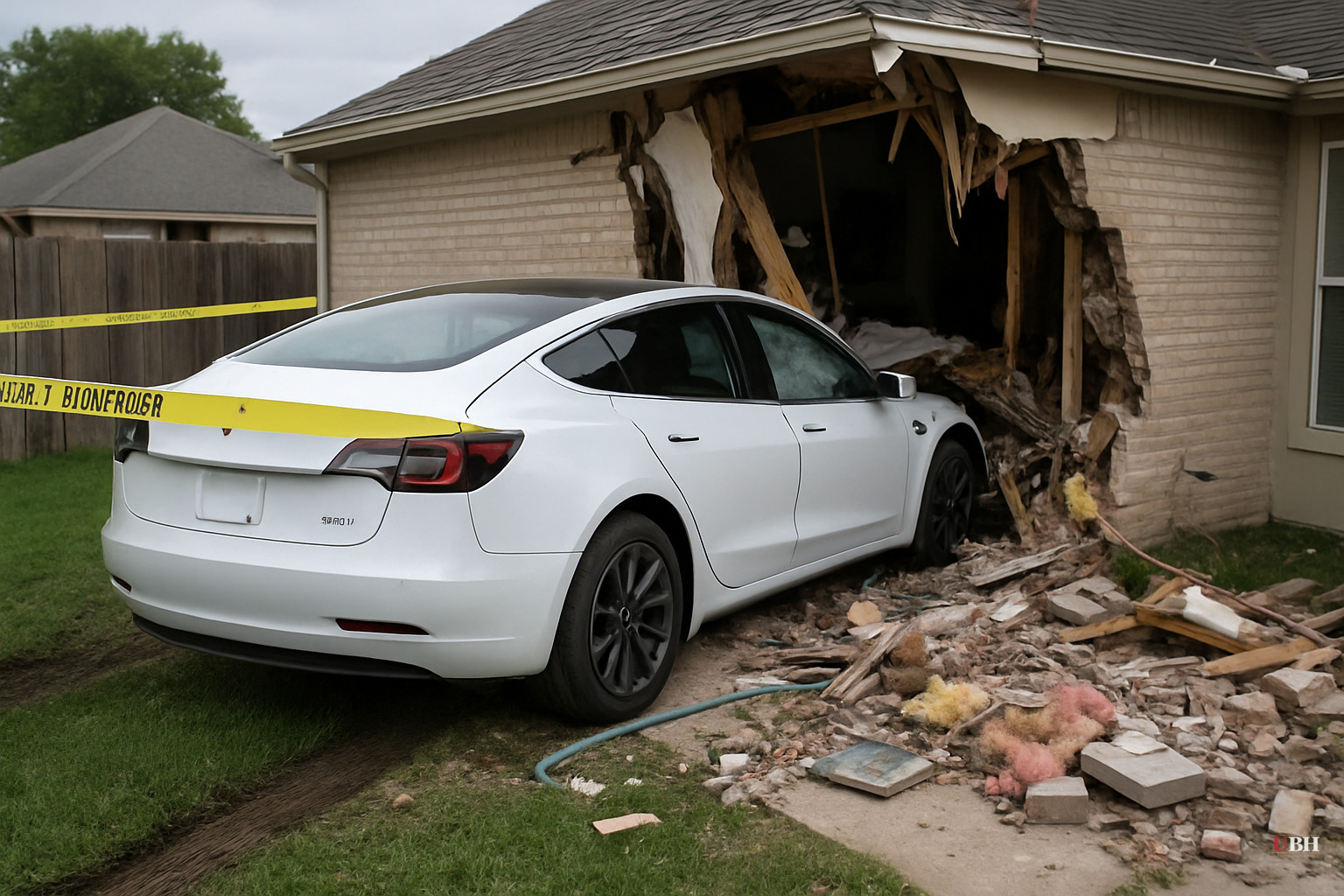
Since Tesla VP Ashok Elluswamy publicly stated that driver Michael Butler floored the accelerator to 73 mph before the crash, the legal fight over what actually happened in Katy, Texas has formally moved into a courtroom.
Jennifer Barbour, the daughter of 76-year-old Martha Avila, and her husband Justin filed a complaint this week in Harris County District Court seeking more than $1 million in damages, according to Ars Technica. Butler is also named as a defendant alongside Tesla.
What the Lawsuit Actually Claims
The family is not simply arguing Butler did nothing wrong. Their complaint lays out two distinct technical theories.
The first is "Sudden Unintended Acceleration," or SUA. The Barbours allege Tesla has known for years that voltage spikes from the battery can cause the inverter to misread pedal input, triggering dangerous rapid acceleration without the driver pressing anything. They claim Tesla has not fixed this despite "numerous fatalities and injuries."
The second theory: Tesla stripped obstacle-detection hardware from vehicles during the global chip shortage. Under this argument, Butler's Model 3 simply did not register the house directly in its path.
The complaint covers both possibilities, stating Butler "was operating the Vehicle in a reasonably foreseeable manner, with Tesla's Autopilot and/or Full Self-Driving system engaged, when the Vehicle failed to detect the end of the street and crashed directly into Plaintiffs' home and/or experienced Sudden Unintended Acceleration," according to Ars Technica.
Tesla's Position
Tesla's counterargument is blunt. Elluswamy stated publicly, without sharing evidence, that Butler "manually overrode self-driving by pressing the accelerator all the way to 100 percent" and that the accelerator remained pressed even after impact. CEO Elon Musk weighed in on X, arguing that "FSD drives slowly through neighborhood streets, and this was a high-speed crash." His framing is that the speed itself disproves FSD involvement.
Musk's logic has a surface plausibility. Tesla's FSD does impose speed limits in residential zones, and a 73 mph impact in a neighborhood is inconsistent with normal FSD behavior. That is the strongest version of Tesla's case.
But Musk's argument does not address the SUA theory at all. SUA, if it exists as the family describes, would precisely explain a high-speed crash in a low-speed zone because the system wouldn't be operating normally in the first place. Musk's X post sidesteps that entirely.
What Is and Isn't Proven
Katy police confirmed to Ars Technica that Butler was NOT intoxicated and has been cooperating with the investigation. They also confirmed they are still investigating whether FSD was engaged at the time of the crash. This means Tesla's claim that the driver manually overrode the system is unverified by law enforcement.
Elluswamy made his assertion "without sharing evidence," per Ars Technica's own characterization. The allegation that Butler pressed the accelerator to 100 percent is Tesla's stated position, not a finding from police or any independent body.
The family's SUA and hardware-stripping theories are likewise unproven allegations at this stage. They are claims in a civil complaint, not established facts.
NHTSA confirmed it is now investigating the crash, as reported by Ars Technica. That investigation is ongoing.
Hardware and Disclosure Questions
The chip-shortage hardware claim deserves scrutiny on its own terms. Tesla did reduce sensor arrays on some vehicles during supply chain disruptions, a fact the company has acknowledged. Whether Butler's specific Model 3 was one of those vehicles, and whether reduced sensors affected obstacle detection on a straight residential street ending at a house, is something that will require discovery to establish or refute.
If Tesla removed hardware it once marketed as a safety feature and did not clearly disclose that to buyers, that is a material product liability question regardless of what the driver's foot was doing.
Where This Goes Next
The case is now in Harris County District Court. The unresolved factual question that will determine the outcome is simple: did Butler cause this crash through his own actions, or did a system defect cause the car to do something he could not control? Police have not answered that yet. Tesla's own data logs, which the company can produce in discovery, would be the most direct evidence either way. Whether the court compels Tesla to produce those logs in full will be a pivotal early battleground in this litigation.
Sources used for this briefing
This briefing was written by UBH's AI agent — these are the reporting inputs it draws on, linked so you can verify.


