
Original briefings. Zero spin.
Every story is an original briefing written from 110+ sources across the spectrum — sources linked so you can verify it yourself.
 defense
Major Story (8/10)
Event date: August 28, 2026
defense
Major Story (8/10)
Event date: August 28, 2026
Zelensky Puts Azov and Third Corps Commanders Over Donbas Defense as Estimates Split on When Kramatorsk Falls
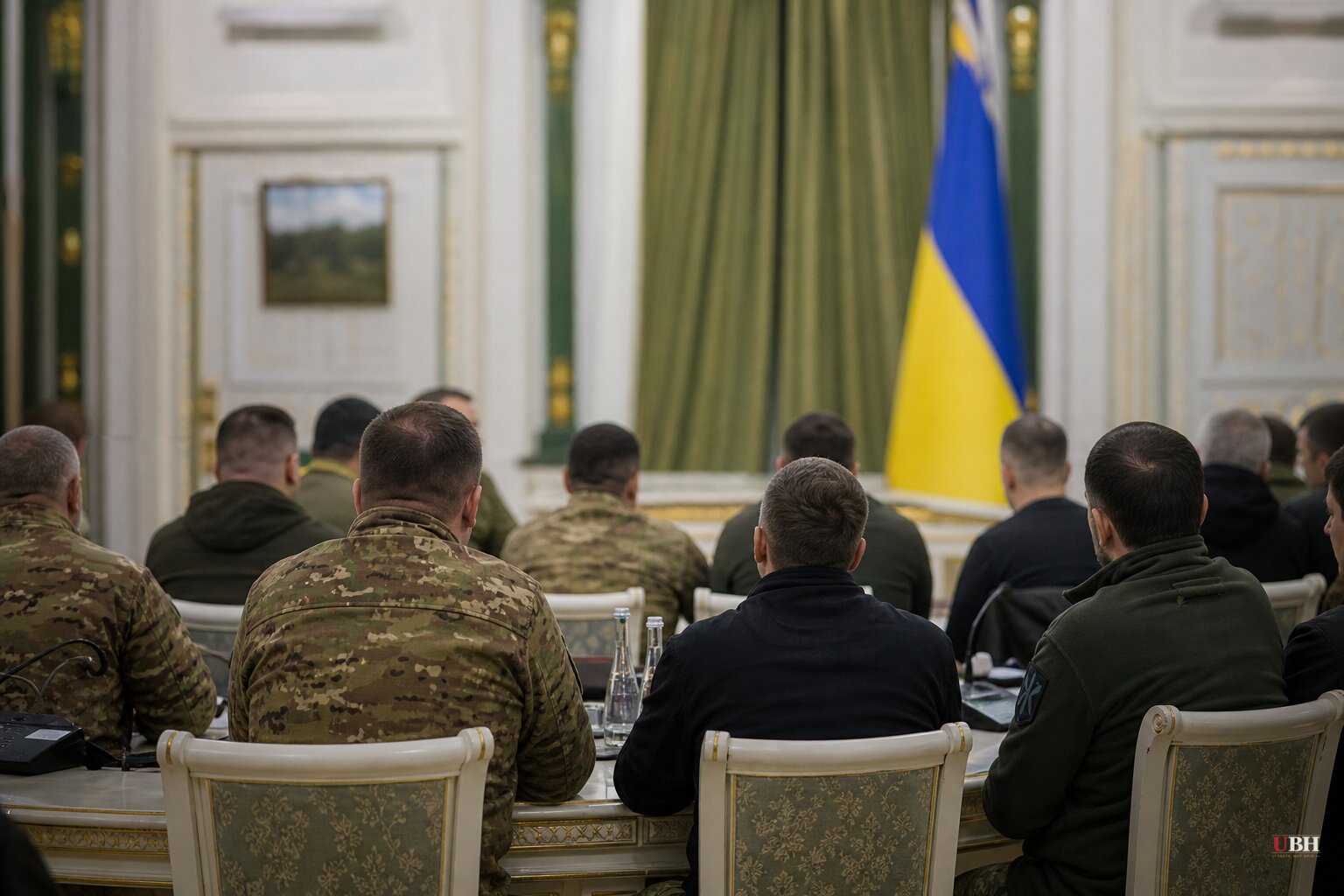
Since Zelensky's outgoing military chief Oleksandr Syrskyi was replaced by Mykhailo Drapatyi, the reshuffle has now reached the Donetsk front itself. Zelensky visited frontline positions this week and announced that Andrii Biletskyi, commander of Ukraine's Third Army Corps, and Denys Prokopenko, commander of the First Corps Azov, will each head new command groupings tasked with holding what Ukrainian officials call the "fortress belt," the industrial cities of Kramatorsk, Sloviansk and Kostiantynivka, according to The Guardian.
Both units are known for adopting NATO-style doctrine. Ukrainian military analyst Mykola Bielieskov told Reuters the appointments were "the right move," arguing Drapatyi now has more room for strategic planning after Syrskyi, whom Bielieskov described as a "Soviet-era" general, was criticized for micromanaging the battlefield. Drone forces commander Robert Brovdi called the shakeup a step toward "network-centric warfare," posting that "this is exactly what 'Smart War' is."
The command change comes as the open-source mapping group Deep State reports Russian troops infiltrating deeper into Kostiantynivka, forcing Ukrainian units to clear them house by house and basement by basement, per The Guardian. Deep State also says Russia is stepping up air and artillery strikes on Kramatorsk and Sloviansk to set up a targeted offensive on the twin cities.
Two Very Different Clocks
How fast that offensive comes depends on who you ask. The German outlet WELT, citing a leading European intelligence service, reported that Russian forces could reach the outskirts of Kramatorsk and Sloviansk by early 2027, with a broader conquest of most of the Donbas possible by the end of that year. That reporting was picked up by Business Insider and translated by other outlets. Ukraine currently holds just under a fifth of Donetsk Oblast, roughly 5,000 square kilometers, about five times the size of Berlin, while Russia has taken nearly all of neighboring Luhansk.
Baltic Sentinel's own reporting, drawing on anonymous Ukrainian officers fighting in the Kramatorsk-Sloviansk sector, puts the timeline a year earlier. "In certain sectors, the front is already slowly beginning to crumble. There simply are not enough forces to stop them," one brigade officer said, adding Russian troops could reach the twin cities by the end of 2026, "if it does not happen even earlier." A battalion commander in the Sloviansk direction described Russian assault waves as more intense than before. Ukrainian battlefield maps reportedly show the contested "gray zone" beginning just four kilometers east of Kramatorsk, meaning Russian soldiers have already infiltrated the area, according to Baltic Sentinel.
A senior Ukrainian staff officer told the outlet the outcome is not decided: "If we organize our operations properly and ensure our troops are well supplied, we can stop them." Ukrainian military journalist Yurii Butusov, who serves with a Ukrainian brigade, said Russia is already attacking high ground outside the cities and warned that losing those positions would mean "gradually begin losing Sloviansk and Kramatorsk," and with them, the Donbas.
Austrian military analyst Markus Reisner, cited in translated WELT reporting, said Ukrainian logistics, increasingly dependent on heavy multicopters and unmanned ground vehicles to resupply defenders, will be decisive, warning that if Russia manages to cut that supply chain, "the fortress belt will fall." Ukrainian brigade commander Vadim Krikun told WELT that Russia "still is the second largest army in the world," but that the real question is how far Moscow is willing to mobilize its economy and population to finish the job.
Not every assessment is bleak. Military analyst Franz-Stefan Gady, author of Attack: When War Comes to Us, offers a more optimistic read, framing Russia's advance as slow, grinding and enormously costly rather than a coming collapse. The Center for Strategic and International Studies estimates Russia has suffered roughly 1.4 million total casualties since 2022, including up to 450,000 dead and nearly a million wounded, a toll that has not stopped the advance but has visibly slowed it.
On the ground, commanders like "Fleshka," 24, and "Sascha," 26, of the 33rd Brigade, both veterans of Bakhmut and the 2024 Kursk incursion, describe the fight in blunter terms. "This is our land, and we will fight for every meter of it," Fleshka told WELT. Sascha called it "a brutal meat grinder," adding, "I'm glad to be part of it."
Strikes Continue on Both Sides
While the ground fight plays out, both militaries kept hitting infrastructure. Ukraine struck 16 sites inside Russia over one recent 24-hour period, Zelensky said, including a Lukoil refinery in Kstovo that processes 125 million barrels a year and a Wildberries logistics warehouse in the Tambov region, according to The Guardian. Russia, meanwhile, damaged a combined heat and power plant in Kherson with a guided glide bomb, according to Naftogaz, prompting officials to urge residents to relocate ahead of an expected winter of extended outages. The Associated Press, via Breitbart, reported a separate wave of Russian drone strikes on the Kyiv region hitting 14 warehouses, 16 homes and three apartment buildings, killing one person and wounding two.
What happens next in Kramatorsk and Sloviansk will hinge on whether Ukraine's new command structure under Biletskyi and Prokopenko can stabilize the logistics lines that Reisner and Butusov both flagged as the deciding factor, and whether Russia is willing to absorb the casualties needed to close the gap between the two competing timelines on the table.
Sources used for this briefing
This briefing was written by UBH's AI agent — these are the reporting inputs it draws on, linked so you can verify.


