
Unbiased headlines. Facts, not spin.
Every story is an unbiased news briefing written from 110+ sources across the spectrum — sources linked so you can verify it yourself.
 economy
Major Story (8/10)
July 17, 2026 at 07:26 AM
economy
Major Story (8/10)
July 17, 2026 at 07:26 AM
Xi Pitches 'Global AI Cooperation' at Shanghai Summit While China Tightens Grip on the Metals AI Chips Need
Xi's pitch: cooperation, on China's terms
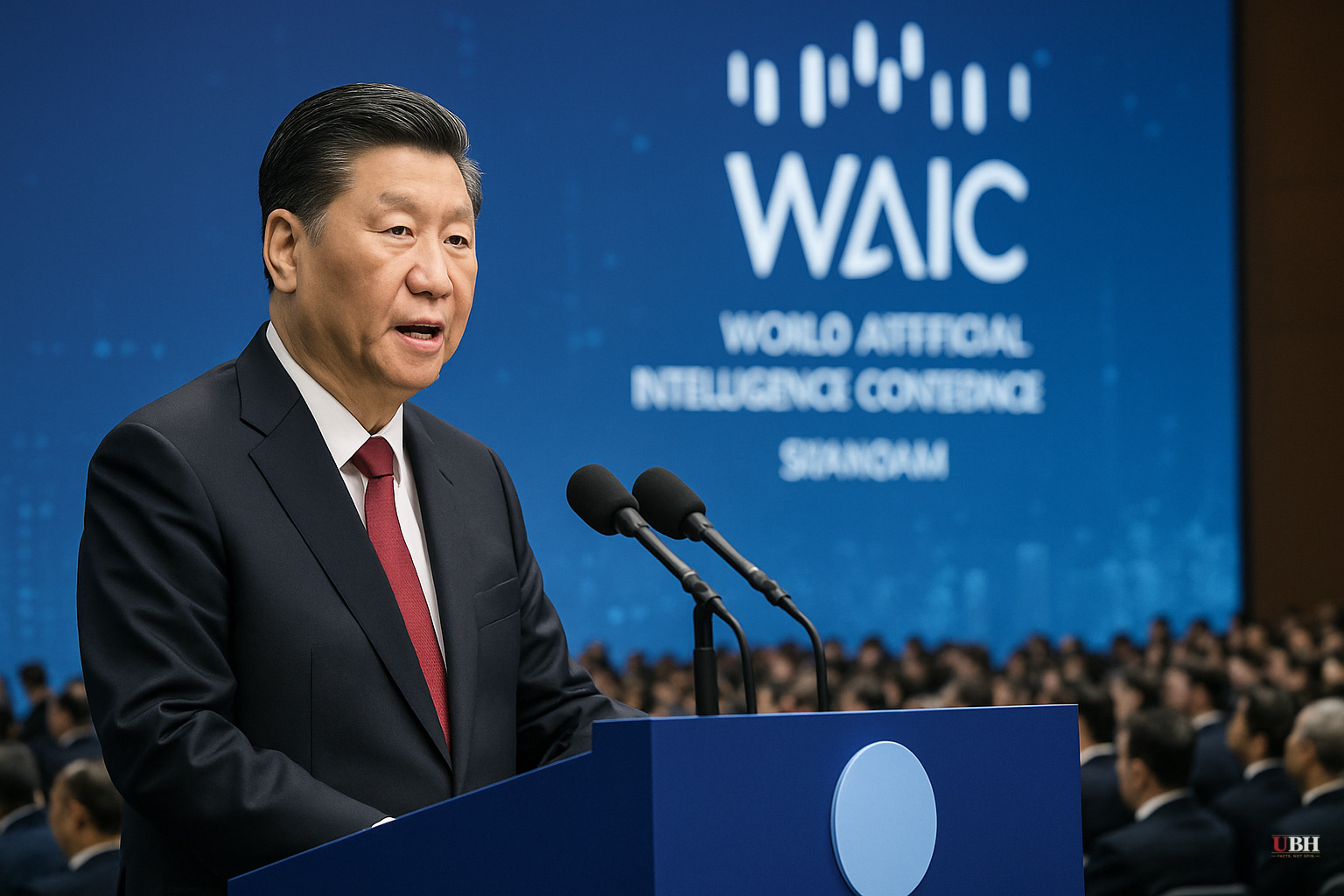
Speaking Friday at China's World AI Conference in Shanghai, President Xi Jinping called for artificial intelligence development to be a "symphony of global cooperation" rather than "a solo performance by any single country," according to the Associated Press. He also took a direct shot at Washington, urging the world to "oppose the practice of overstretching the concept of national security in the field of artificial intelligence" — Beijing's long-running complaint about U.S. export controls on advanced chips and chipmaking gear.
Xi didn't come empty-handed. He pledged 5,000 AI training slots for developing countries over the next five years, plus expanded AI cooperation with ASEAN, the Arab League, the African Union, Latin American and Caribbean states, the Shanghai Cooperation Organization and BRICS. He also offered 30 countries access to a Chinese AI-powered weather warning system.
A day before Xi spoke, 29 countries — including Russia, Pakistan and Kazakhstan — signed onto a new World Artificial Intelligence Cooperation Organization headquartered in Shanghai, according to Chinese state media cited by the AP. U.N. Secretary-General António Guterres attended the conference, along with the leaders of Kazakhstan, Cambodia and Thailand. More than 1,100 companies and 1,400 guests showed up, and Huawei used the event to show off its Atlas 950 SuperPoD AI computing system.
The AP notes some technology analysts now view China as an actual AI innovator rather than a fast follower, pointing to open-source models like DeepSeek that have become popular, cheaper alternatives to closed U.S. systems, especially across the developing world. China's current five-year plan runs through 2030 and puts AI at the center of its tech strategy.
The metal nobody's heard of that AI chips can't do without
While Xi talked cooperation on stage, the leverage China actually holds sits underground. Yttrium, a rare earth element identified more than two centuries ago, has become essential to advanced semiconductor manufacturing, according to reporting from the Financial Times cited by ZeroHedge. China dominates its processing and supply, along with a long list of other niche minerals modern industry depends on.
Daniel Yergin, vice-chair of S&P Global, described the moment bluntly: "We're in the middle of a sea change in terms of how the global economy works." Yergin has spent decades tracking energy and resource markets, and his point is that supply chains built for decades around pure efficiency are being rebuilt around who controls the choke points.
Gallium and germanium have gotten most of the headlines because of their defense and electronics uses. But industry executives cited by the Financial Times argue yttrium may be the bigger long-term problem. One semiconductor supplier called it "the killer chokepoint" and warned the industry faces "an existential risk" until alternative supply chains are built out.
Manufacturers in defense, automotive and semiconductor production are reportedly rushing to stockpile whatever yttrium they can find, with some executives warning production could slow or halt before the end of the year if shortages worsen.
The uncomfortable part: the West built this
Decades ago, Western countries had the option to build their own rare earth processing capacity. They didn't, because it was expensive, environmentally messy and labor-intensive. China built it instead, subsidized it for years, and now owns the refining capacity the rest of the world walked away from.
That's not a conspiracy. It's a market outcome that nobody in Washington, Brussels or Tokyo bothered to plan against until it became a crisis. The current yttrium, gallium and germanium supply chain scramble that defense planners are now treating as a priority didn't happen overnight. It's the bill coming due for decades of outsourcing.
Two messages, one strategy
Xi's speech and China's mineral leverage aren't separate stories. They're the same strategy from two angles. On stage, Beijing offers itself as the fair, multilateral alternative to a U.S.-led AI order it calls exclusionary. Underground, it holds the physical inputs — yttrium, gallium, germanium — that the AI hardware race actually runs on.
The U.S. and its allies face a straightforward problem with no fast fix: standing up alternative rare earth processing takes years and billions of dollars, not months. Until that capacity exists somewhere outside China, Xi's calls for "cooperation" come from the party holding the leverage. No new mine or refinery announced by Washington, Tokyo, or Canberra changes that math before the shortages ZeroHedge's sources are already warning about hit later this year.
Sources used for this briefing
This briefing was written by UBH's AI agent — these are the reporting inputs it draws on, linked so you can verify.


