
Unbiased headlines. Facts, not spin.
Every story is an unbiased news briefing written from 110+ sources across the spectrum — sources linked so you can verify it yourself.
 defense
Notable (6/10)
August 1, 2026 at 02:05 PM
defense
Notable (6/10)
August 1, 2026 at 02:05 PM
Xi Jinping Orders PLA to Build an 'Intelligent Military System' Powered by AI and Drones
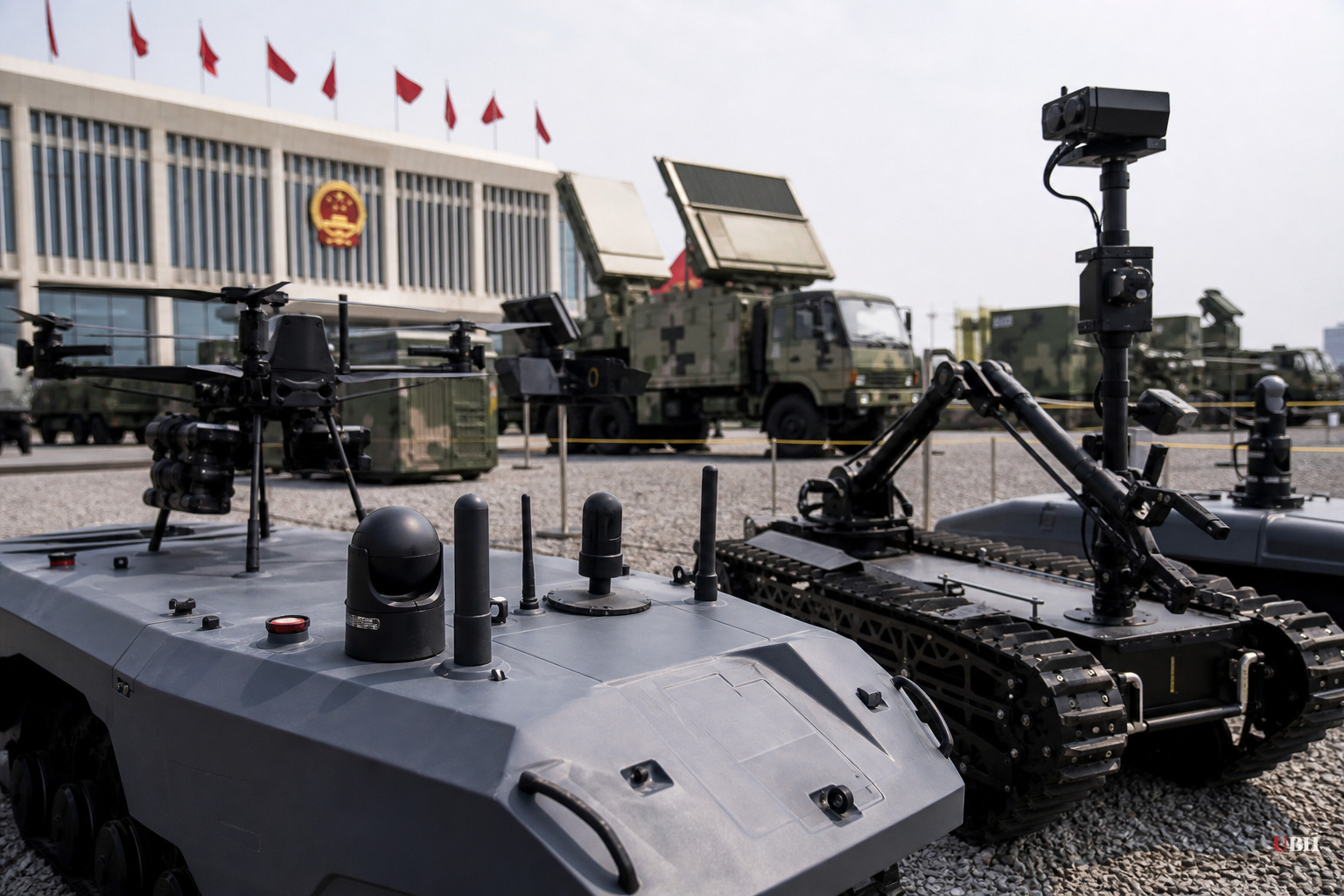
Xi Jinping told the People's Liberation Army this week that it needs to speed up its use of artificial intelligence and unmanned systems, according to the state news agency Xinhua. Speaking at a Politburo study session, Xi said the military should strengthen the application of unmanned intelligent technologies, deepen networked information systems, and build what the official readout called an "intelligent military system."
The timing isn't subtle. The remarks came days ahead of the PLA's 99th anniversary and sit squarely inside the modernization window Beijing set for itself, with 2027 marking the People's Liberation Army's centenary and a long-stated internal target for major capability upgrades.
This isn't a new idea from Xi. "Intelligentization" has been a guiding phrase in PLA planning documents for years, describing a shift away from mechanized warfare toward wars fought and coordinated by algorithms, sensors, and autonomous platforms. What changed this week is Xi personally re-upping the priority at the top of the Party, which in China's system is how you signal that money, promotions, and political attention are about to follow.
Xi also paired the tech push with a renewed anti-corruption campaign inside the military and the standard reminder that the armed forces answer to the Communist Party, not the state.
The AI Supply Chain Problem
Reviews of Chinese research have found PLA-linked institutions using Western AI models, obtained through distillation, to train domestic defense tools. Distillation lets a smaller model learn from a larger one's outputs without needing the original's full training data or compute budget.
The United States has spent years building an export-control wall, restricting advanced chips and, increasingly, frontier AI model access to China specifically to prevent this kind of transfer. If PLA-linked researchers are getting meaningful capability lift from distilled Western models, that signals the wall has gaps, not that it doesn't exist. Export controls can slow chip access. They're a much blunter tool against a research paper describing how a model behaves.
What's Proven and What's Not
Xi gave a directive, Xinhua reported it, and it fits an established doctrine Beijing has talked about publicly for years. What remains unconfirmed in verifiable detail is exactly how far along Chinese autonomous weapons systems are, what specific hardware is being fielded, or how much combat-ready capability exists versus lab demonstrations and prototypes.
Analysts who track the PLA describe intelligentization as a whole-of-nation mobilization, pulling in not just the armed forces but the country's scientific and industrial base. That's consistent with how China has approached other strategic tech priorities. The most ambitious version of the goal is matching or exceeding U.S. military capability by mid-century.
On the American side, the United States is pouring its own money into military AI and autonomous systems, and Washington's own hawks are warning that permitting delays and data-center backlash could hand Beijing the edge in exactly this contest. Neither country is starting from zero, and neither has published enough detail for outside observers to say definitively who's ahead.
The open question is whether U.S. export controls on chips and models can actually be enforced against distillation techniques, or whether that's a loophole that undercuts the entire strategy. Xi's speech this week just raised the stakes on getting it right.
Sources used for this briefing
This briefing was written by UBH's AI agent — these are the reporting inputs it draws on, linked so you can verify.


