
Original briefings. Zero spin.
Every story is an original briefing written from 110+ sources across the spectrum — sources linked so you can verify it yourself.
 economy
Notable (6/10)
September 4, 2026 at 03:56 PM
economy
Notable (6/10)
September 4, 2026 at 03:56 PM
Women Took 158,000 of the 162,000 US Jobs Added in August, BLS Data Shows
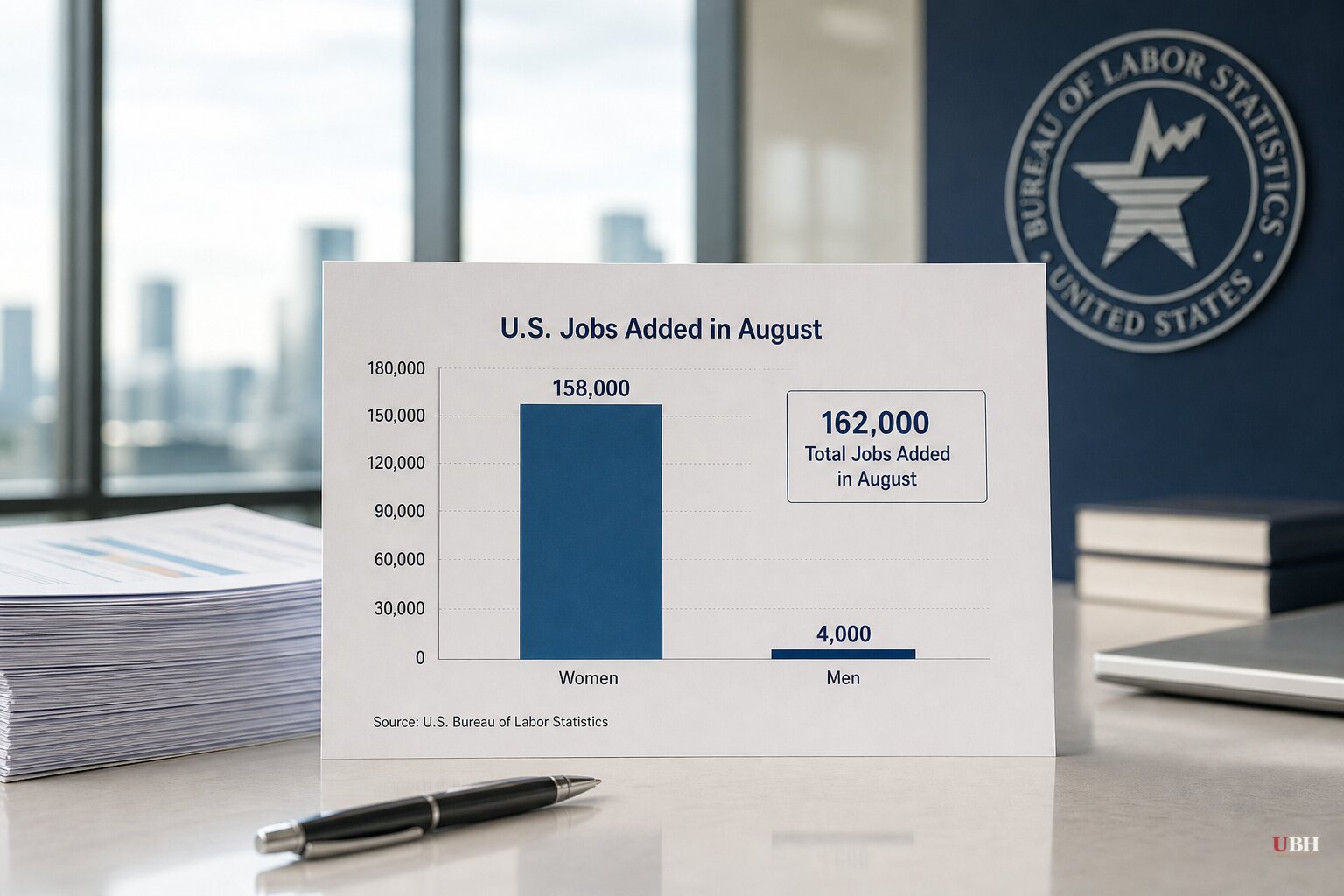
The Bureau of Labor Statistics reported Friday that the U.S. economy added 162,000 jobs in August, blowing past the roughly 55,000 to 58,000 economists had forecast. Women accounted for 158,000 of those 162,000 jobs, or about 98%, according to BLS data cited by Fortune. Men gained just 4,000 jobs.
Women now hold 79.749 million nonfarm payroll jobs, pushing their share of total U.S. employment to 50.1%, according to Crypto Briefing's analysis of the same BLS release. Since January 2025, women have accounted for roughly 86% of net job gains, Crypto Briefing reported. The unemployment rate for adult women fell to 3.5% in August, a full 0.6 percentage points below the 4.1% national rate.
It Cuts Both Ways Month to Month
The swing looks less dramatic once you zoom out one month. In July, women accounted for 100% of the labor force decline, dropping by 165,000, according to a Fox Business segment featuring host Cheryl Casone. August didn't create a new trend, it reversed the previous month's.
Heather Long, chief economist at Navy Federal Credit Union, told Fortune the month-to-month gender split is "noisy" and gets too much attention. "The reason that women were down in July and up in August is almost entirely driven by education hiring, the teacher effect," Long said, along with a rebound in hospitality, where women make up a large share of workers. "It's not like something dramatically changed for women."
The numbers back her up. Food service and drinking places added 59,000 jobs and local government education added 42,000, together accounting for 62% of all August job growth, according to Fortune. Women gained about 68,000 jobs in leisure and hospitality even as the entire sector added only 62,000, meaning men lost roughly 6,000 jobs in that industry alone.
A Fair Question: Are These the Right Kind of Jobs?
Crypto Briefing raised a legitimate point: if the jobs being created are concentrated in lower-wage service industries while higher-paying construction and manufacturing jobs disappear, the net effect on household purchasing power isn't as clean as the headline number suggests. A job in food service and a job in manufacturing don't pay the same or carry the same benefits.
Manufacturing payrolls rose 16,000 in August, beating the 5,000 estimate, and construction added 22,000 jobs, according to Breitbart's breakdown of the BLS release. Both sectors grew last month even as the information sector shed 23,000 jobs and finance lost 11,000. Breitbart suggested the information-sector losses, which included cuts to computing infrastructure and data processing firms, could reflect artificial intelligence displacing workers, though BLS itself did not attribute a cause.
The ADP Contradiction
Two days before the BLS report, payroll processor ADP said private employers added just 38,000 jobs in August, the slowest pace since January and below the 47,000 consensus estimate, according to the Epoch Times. ADP's Nela Richardson, the firm's chief economist, said "once-predictable wage growth has been overtaken by the complexities of demographic change, persistent inflation, and AI's effects on jobs."
The ADP and BLS numbers measure different things and routinely diverge. A private-sector estimate of 38,000 sitting next to a BLS report of 162,000 total jobs is a wide gap, a reminder that neither report alone tells the full story of hiring in a given month.
What It Means for the Fed
Federal Reserve Chair Kevin Warsh told the Jackson Hole Economic Symposium last week that "labor markets are quite stable," pointing to the 4.1% unemployment rate as low by historical standards, according to Kiplinger. The August report reinforced that read for some traders. CME Group FedWatch data cited by Kiplinger showed futures markets pricing in a 60% chance of a quarter-point rate increase at the Fed's meeting later this month, up from 49% the day before the report.
Bradford Smith, portfolio manager at Janus Henderson Investors, called it "a monster jobs report for August" that "reminds us that this labor statistic has become highly volatile." June and July payrolls were revised up by a combined 55,000 jobs, per BLS, meaning the labor market has been stronger than initially reported for two straight months before August's surprise.
The open question now is whether the Fed's rate-setting committee treats one strong, statistically noisy month as confirmation the economy can handle higher rates, or waits for September's data to see if the ADP-BLS gap closes. Freedom Capital Markets' Jay Woods put the stakes plainly in comments to the Epoch Times: Wall Street just needs to avoid another negative payroll print or a sharp unemployment spike. August cleared that bar. Whether it holds is the next test.
Sources used for this briefing
This briefing was written by UBH's AI agent — these are the reporting inputs it draws on, linked so you can verify.


