
Original briefings. Zero spin.
Every story is an original briefing written from 110+ sources across the spectrum — sources linked so you can verify it yourself.
 economy
Major Story (7/10)
Event date: September 2, 2026
economy
Major Story (7/10)
Event date: September 2, 2026
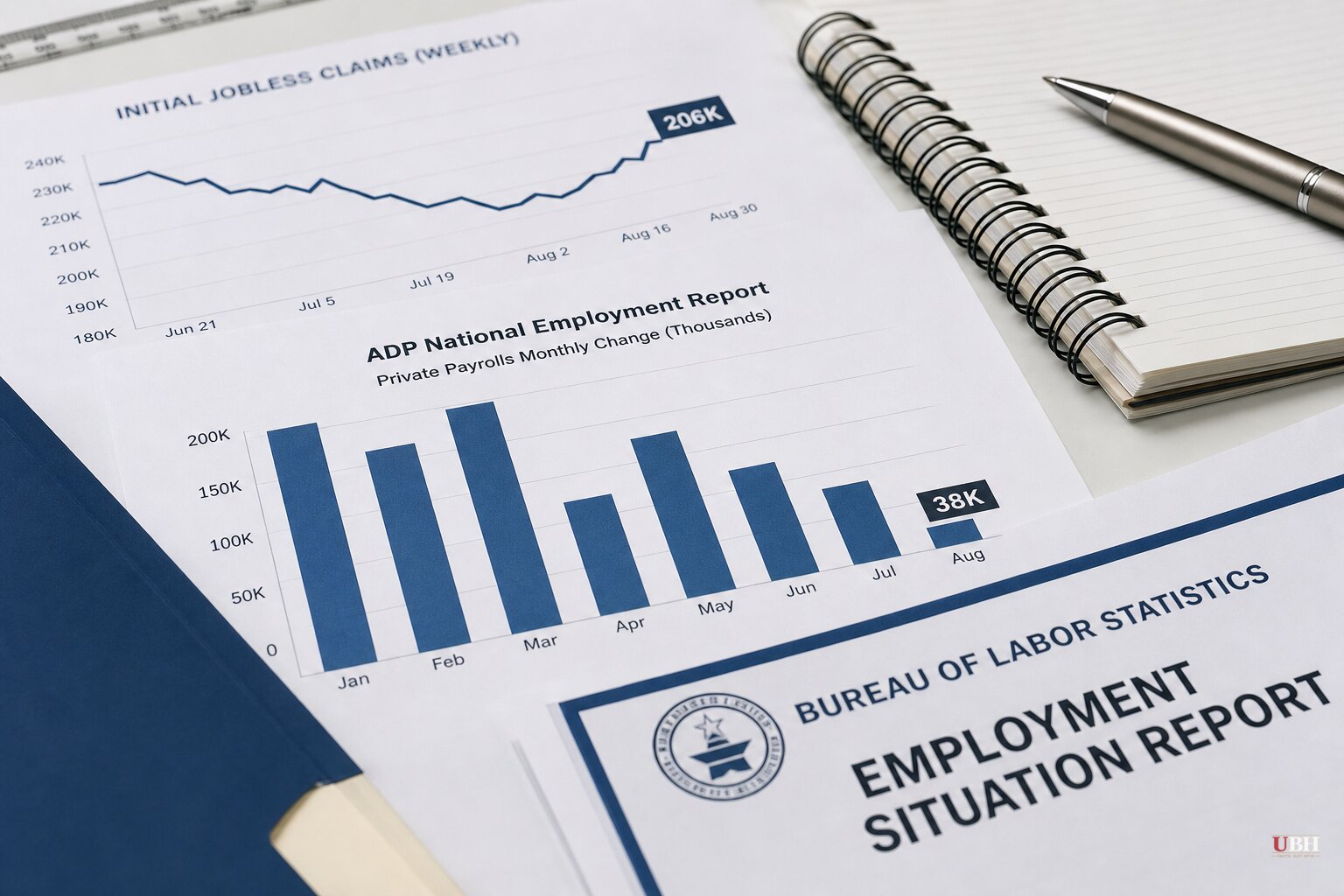
ADP Shows Just 38,000 Private Jobs Added in August as Claims Tick Up Ahead of Friday's Official Report
Since July's surprise loss of 23,000 jobs kicked off a run of downward revisions and Fed hand-wringing, the labor market has stayed stuck in low gear heading into Friday's official August jobs report.
ADP's National Employment Report, released Wednesday, showed private payrolls grew by just 38,000 in August, according to Axios. That's the weakest reading since January and below the roughly 47,000 to 48,000 economists surveyed by Econoday had expected, Breitbart reported. It's also down from a revised 44,000 in July, per Axios, or 46,000 by Kiplinger's count.
The breakdown matters. Breitbart reported goods-producing businesses shed 10,000 jobs in August, including a steep 17,000 drop in manufacturing. Services providers added 48,000, with gains concentrated in leisure and hospitality, education, health care and financial activities. ADP chief economist Nela Richardson told reporters manufacturing is "the one I would point to" if you're looking for disappointment.
Jobless claims moved in the same soft direction. The Department of Labor reported 206,000 new unemployment filings for the week ending August 29, up 2,000 and close to the 205,000 consensus estimate, according to the Epoch Times. The four-week average edged above 207,000. Continuing claims held near 1.77 million, roughly where they've sat since mid-April.
What Friday's Report Is Expected to Show
The Bureau of Labor Statistics is scheduled to release its August employment situation report at 8:30 a.m. ET Friday, September 4. The Dow Jones consensus estimate points to 53,000 new nonfarm payrolls, according to CNBC, with the unemployment rate expected to hold at 4.1%. Kiplinger cited a slightly higher consensus of 58,000.
Not everyone agrees it'll come in positive. Citigroup economist Andrew Hollenhorst told clients he expects just 20,000 jobs added and a tick up in unemployment to 4.2%, according to CNBC. Comerica Bank Chief Economist Bill Adams went further, telling U.S. News & World Report that "payrolls likely fell for a second consecutive month in August."
Adams and Kiplinger both point to a specific cause: the federal government ended Temporary Protected Status for more than 300,000 Haitians on July 27, canceling their work authorization. Adams estimated 100,000 to 200,000 of those TPS holders had been in the labor force, and argued their exit would suppress both payroll growth and the labor force count without necessarily moving the unemployment rate. CNBC's preview of Friday's report, by contrast, does not mention the TPS policy change at all, framing the softness mainly around tariffs, AI and geopolitical uncertainty.
The Fed's Read: Stable, Not Alarming
Federal Reserve Chair Kevin Warsh told the Jackson Hole Economic Symposium last week that "labor markets are quite stable," pointing to the 4.1% unemployment rate as low by historical standards and arguing that job gains are "naturally going to run low" in an economy near full employment, according to Kiplinger and U.S. News. Kiplinger Letter staff economist David Payne wrote that "the new normal for jobs reports going forward is likely to be gains of fewer than 100,000, rather than additions in six digits."
That's the case for treating the numbers as unremarkable. The counterargument, made implicitly by Indeed Hiring Lab, is that the story isn't purely about weak demand for workers. Indeed's Job Postings Index sat at 101.8 in mid-August, just 1.8% above its pre-pandemic baseline, and posted wages rose 2.5% year-over-year through July. But real, inflation-adjusted wages for private-sector workers fell 0.4% year-over-year in the second quarter, the first such decline since 2022, according to Indeed. Hiring, quits and layoff rates are all running low simultaneously, a pattern Indeed calls a "low-hire, low-fire" equilibrium rather than a straightforward slowdown.
Separately, Challenger, Gray & Christmas reported 52,881 planned layoffs in August, up 58% from July but down 38% from a year earlier, calling it the quietest August since 2022. Employers also announced plans to hire 12,325 workers in August, the highest August total in four years even though it's down 23% from July.
The unresolved question heading into Friday is whether the BLS count confirms the ADP-and-claims picture of continued softening, or reverses it the way July's shock loss reversed an unexpectedly strong spring. A second straight negative payroll print, or another wave of downward revisions to prior months, would test Warsh's "stable" framing just as the Fed weighs whether to hold rates or cut at its meeting later this month.
Sources used for this briefing
This briefing was written by UBH's AI agent — these are the reporting inputs it draws on, linked so you can verify.


