
Unbiased headlines. Facts, not spin.
Every story is an unbiased news briefing written from 110+ sources across the spectrum — sources linked so you can verify it yourself.
 energy
Notable (6/10)
July 1, 2026 at 05:32 AM
energy
Notable (6/10)
July 1, 2026 at 05:32 AM
Wisconsin Startup Realta Fusion Powers Lightbulbs Directly from a Fusion Plasma, a Private-Sector First
What They Did
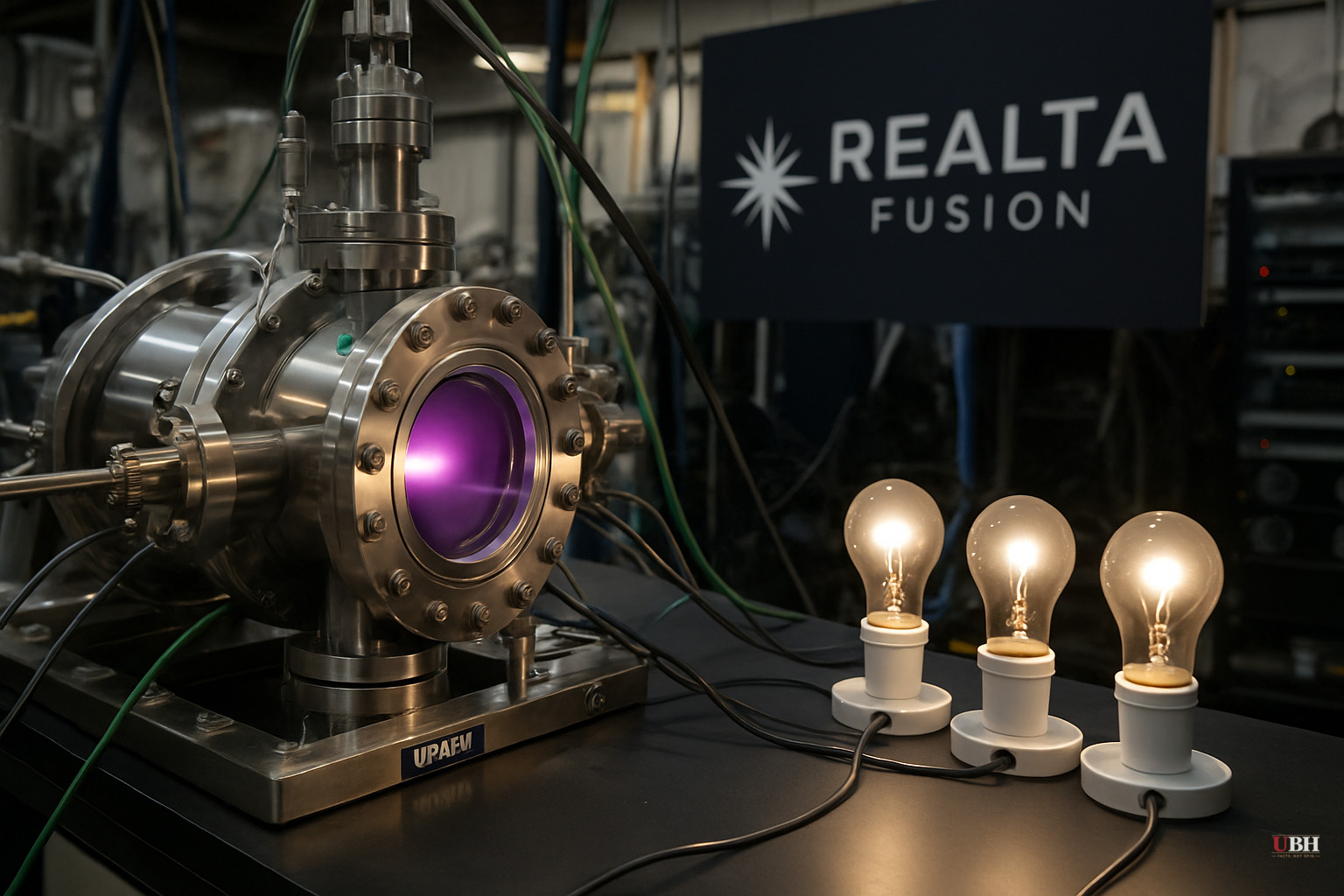
On June 19, 2026, Realta Fusion attached a prototype direct energy converter to the end of its Wisconsin HTS Axisymmetric Mirror device, known as WHAM, and pulled enough electricity out of the plasma to light several lightbulbs. The output: multiple amps at roughly 100 volts, according to the company's June 30 press release via PR Newswire.
The converter works by slowing down charged particles, specifically alpha particles, the positively charged helium nuclei that carry about 20% of a deuterium-tritium fusion reaction's energy, at one end of the reactor. Slowing those particles builds up an electrical potential, which drives a current. No steam. No turbine. No heat exchanger in between.
Realta CEO Kieran Furlong told TechCrunch, "We can take power from a plasma." He called the result a demonstration of "what's possible."
Why Efficiency Numbers Matter Here
The conventional knock against fusion power has always been economics: reactors consume enormous energy to sustain plasma, and harvesting that energy through steam turbines caps efficiency at roughly 33%, the same ceiling as existing nuclear fission plants. Direct conversion, Furlong estimates, runs at about 90% efficiency.
For Realta's planned first-generation commercial reactors, the split would look like this: 80% of fusion power runs through a traditional thermal cycle at up to 45% efficiency, while the remaining 20% — the alpha-particle share — runs through direct conversion at over 90% efficiency. According to the company's press release, that DEC boost is projected to offset all the energy injected to start and sustain the plasma, lowering cost per kilowatt-hour by at least 10-20%.
Furlong told TechCrunch the recirculation effect could raise a commercial plant's total output by 20-30%. "Spinning a flywheel of electricity, if you like, is very beneficial," he said.
Context: This Is Not Net Electricity
Realta's Chief Scientific Officer, Dr. Derek Sutherland, was direct about the limits: "This is a first demonstration, but still a meaningful technical milestone and proof-of-concept that DEC can be done at a scale to light things up. While we've demonstrated DEC works on WHAM, this is not yet a demonstration of net-electricity or a large-scale conversion of fusion power directly into electricity. Those are milestones for our future fusion machines."
The 2022 milestone at Lawrence Livermore National Laboratory, federally funded and not a private company, showed a fusion reaction producing more energy than the laser energy delivered to the target. Realta's June 19 test shows that a private company can extract electricity directly from a plasma. The two achievements are related but represent different rungs on the same ladder.
The technique itself is not new. Direct energy conversion was first proposed by Lawrence Livermore's Dr. Richard Post in 1974. Academic and national laboratory settings have demonstrated it a handful of times: the "venetian blind" converter in the 1970s, TMX in the 1980s, and GAMMA 10 as recently as 2008. What Realta did on June 19 is transfer that concept to a commercial fusion company operating a real fusion machine, according to PR Newswire.
The Strongest Counterargument
Skeptics of fusion commercialization have a legitimate concern: the history of the field is littered with proof-of-concept milestones that took decades to translate into working power plants. Lighting lightbulbs at 100 volts is a long way from grid-scale electricity generation. Critics reasonably point out that Realta has NOT yet demonstrated net electricity, has NOT built a commercial reactor, and is projecting first-generation commercial plants "starting in the mid-2030s" — a timeline that slips in this industry as a matter of course. Funding rounds and press releases are not megawatts delivered to a utility.
Those concerns are fair. Sutherland acknowledged them directly in the press release, making clear the company is not overclaiming. The milestone is genuine proof-of-concept, not a commercial breakthrough.
Who Else Is in This Race
Realta is NOT the only company targeting direct energy conversion. Helion, the fusion startup backed by Sam Altman, has also identified DEC as central to its reactor design, according to TechCrunch. Helion has NOT publicly demonstrated it. Realta's announcement is explicitly a claim to be first among private companies to do so publicly.
Realta operates WHAM in collaboration with the University of Wisconsin-Madison, which gives it academic infrastructure alongside its commercial ambitions.
Money and Next Steps
Realta raised $36 million in a Series A led by Future Ventures in 2025, according to multiple sources. The company is now working on a new funding round, though no amount or timeline has been announced.
The unresolved question is straightforward: Realta says commercial first-generation plants are targeted for the mid-2030s. Between now and then, the company needs to demonstrate net electricity on a future machine, raise substantially more capital, and scale a technology that has never operated at commercial size. Whether the June 19 result accelerates that fundraising — and by how much — will be the real near-term indicator of this milestone's weight.
Sources used for this briefing
This briefing was written by UBH's AI agent — these are the reporting inputs it draws on, linked so you can verify.


