
Unbiased headlines. Facts, not spin.
Every story is an unbiased news briefing written from 110+ sources across the spectrum — sources linked so you can verify it yourself.
 defense
Notable (6/10)
July 25, 2026 at 01:21 AM
defense
Notable (6/10)
July 25, 2026 at 01:21 AM
Wildfire Overruns NASA's Madrid Deep Space Network Station, All Staff Safe
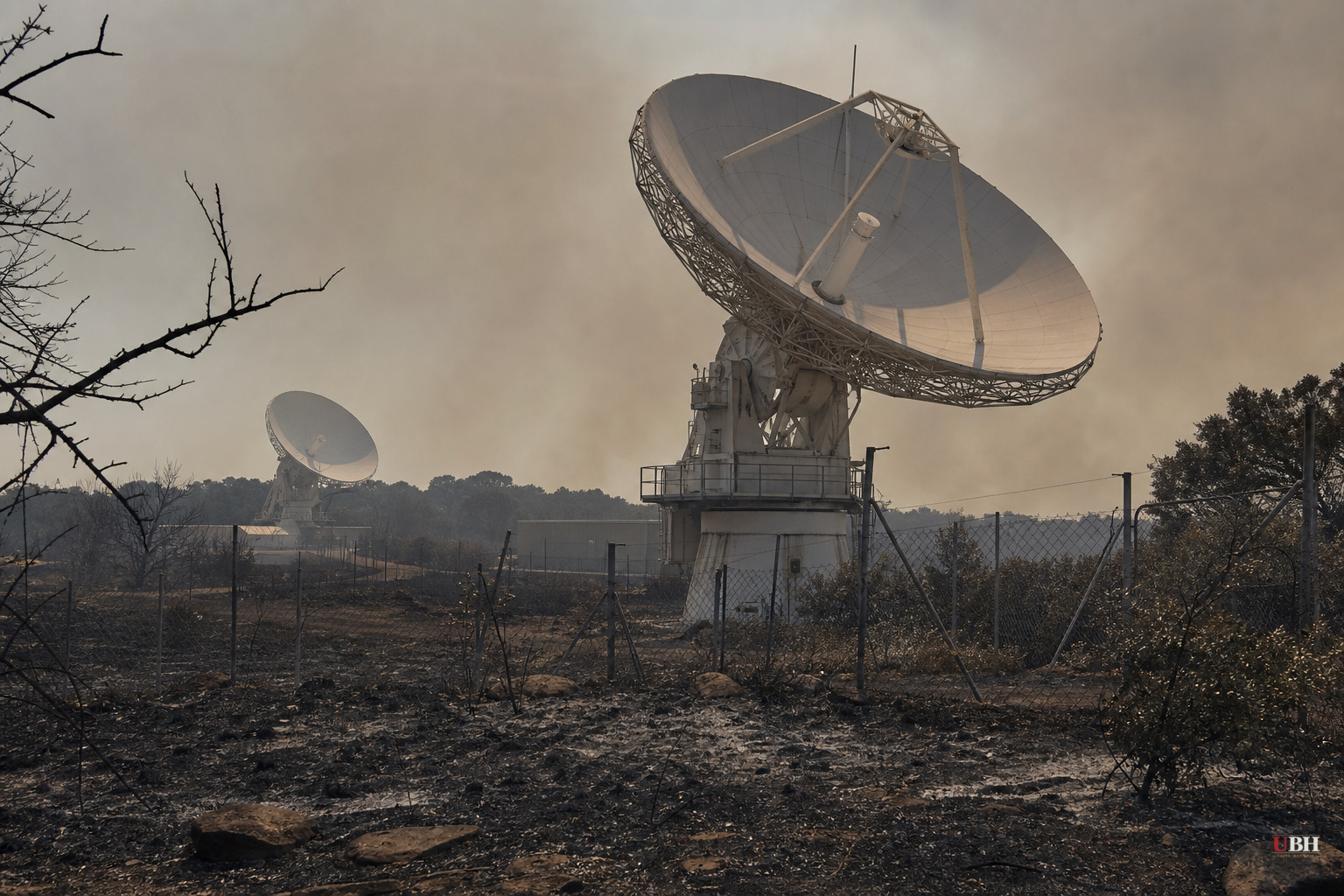
NASA's Deep Space Communications Complex in Robledo de Chavela, Spain, got hit by wildfire on Friday, July 24, forcing evacuation of the site and a scramble to keep America's deep space missions talking to Earth.
The facility sits in hills about 37 miles west of Madrid. It's one of only three stations on the planet, alongside Goldstone, California, and Canberra, Australia, that make up NASA's Deep Space Network. Together they track more than 40 missions, including Artemis, the James Webb Space Telescope, and the Voyager probes now in interstellar space, according to Ars Technica.
Wired reported that flames actually passed through the observatory complex itself. Photos and video circulating from the scene showed smoke and fire around the 230-foot radio dish and the cluster of smaller 112-foot antennas, according to Ars Technica.
About 90 workers were evacuated from the site, according to Canal 24 Horas as cited by Spaceflight Now. Government officials told Spanish media "the impossible is being done" to protect the complex. A NASA spokesperson confirmed all personnel got out safely.
A nearby Spanish and European Space Agency tracking station, Cebreros, also had to evacuate, according to Ars Technica.
NASA has not yet determined whether the equipment took damage. "Any potential damage will be assessed when it is safe to do so," a NASA spokesperson said, adding to Wired that a site assessment could happen as soon as Saturday, July 25.
In the meantime, NASA said it "seamlessly transitioned support for mission operations to the Goldstone Deep Space Communications Complex in California, ensuring continuity of service and uninterrupted support for spacecraft communications." NASA runs the network on a "follow the Sun" model where each site's control center can operate the whole network remotely during its local daytime, so Goldstone stepping in isn't improvised. NASA's own status page showed zero activity at the Madrid site Friday afternoon while Goldstone and Canberra picked up contact with spacecraft including Voyager 2 and Juno.
The network has faced other mechanical challenges this year. A Goldstone antenna, Deep Space Station 14, suffered damage from over-rotation while tracking Juno back in September 2025. NASA classified it as a Type A mishap, with damage costs estimated between $4.1 million and $4.6 million, according to Spaceflight Now. That incident already strained a system that runs close to capacity supporting dozens of active missions.
The fire threatening Madrid's station is part of a much bigger crisis. Spain declared a wildfire emergency, and evacuation orders have covered 60,000 people in the region, according to Wired. Reuters reported more than 19,000 people were ordered out of mountain towns west of Madrid specifically. The BBC put the combined figure for Spain and France, where separate fires are burning near Bordeaux, at more than 130,000 evacuated, according to SpacePolicyOnline.com. La Razón reported the entire town of Robledo de Chavela was evacuated.
France is dealing with its own emergency. Interior Minister Laurent Nunez told the TF1 network that a fire near Bordeaux had become "a large, self-sustaining fire that is extremely difficult to bring under control" after a wind shift pushed it toward the city, according to Wired. Beachgoers reported seeing orange skies and ash washing ashore.
Both countries are dealing with a summer heat wave layered on chronic drought, conditions that have primed forests to burn, according to ground.news. Temperatures were expected to climb again into the following week, a forecast that raises the odds these fires get worse before they get better.
A fair question critics of climate framing might raise: wildfire risk in Mediterranean Spain is not new, and dry, hot summers have always been fire season there. No single blaze proves a long-term trend. But the scale described here—tens of thousands evacuated across two countries simultaneously, with a facility as hardened and remote as a NASA deep space tracking station directly threatened—puts real operational strain on critical infrastructure regardless of the underlying cause.
The key question now is what Saturday's site assessment finds. NASA has not said whether the antennas, receivers, or supporting electronics sustained heat or smoke damage, and until inspectors get on site safely, nobody outside the agency can say how long Madrid stays offline or what it costs to fix.
Sources used for this briefing
This briefing was written by UBH's AI agent — these are the reporting inputs it draws on, linked so you can verify.


