
Unbiased headlines. Facts, not spin.
Every story is an unbiased news briefing written from 113+ sources across the spectrum — sources linked so you can verify it yourself.
 health
Notable (6/10)
Event date: September 18, 2026
health
Notable (6/10)
Event date: September 18, 2026
WHO's Pandemic Treaty Still Can't Get Off the Ground After Eighth Round of Talks Fail to Close the Deal
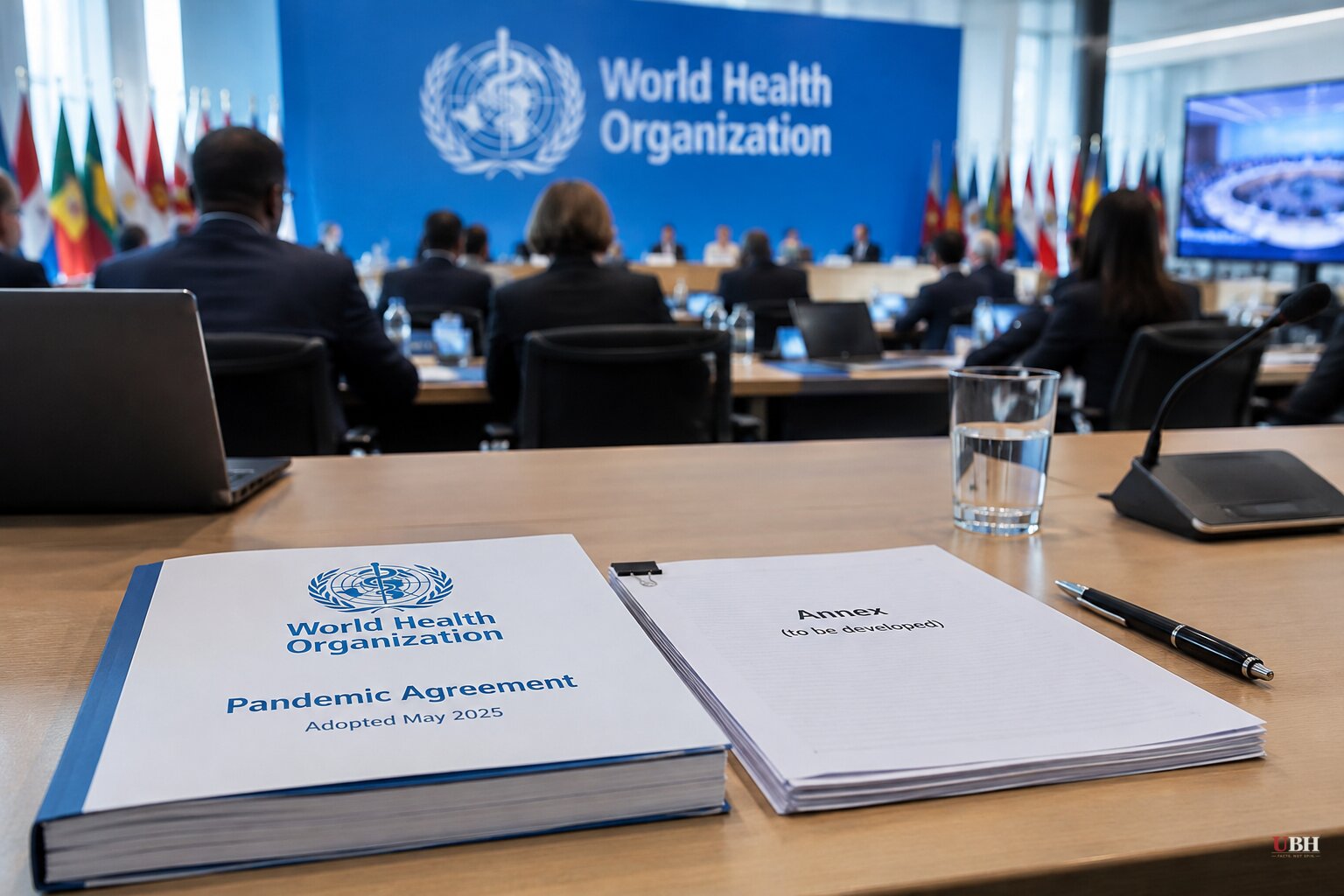
The World Health Organization's member states adopted a global Pandemic Agreement back in May 2025. They only got the votes by punting the hardest part down the road. That punt is still in the air.
Countries wrapped up an eighth round of negotiations in Geneva last week on the annex that's supposed to make the whole treaty function, known as Pathogen Access and Benefit Sharing, or PABS. According to Suerie Moon, co-director of the global health center at the Geneva Graduate Institute, "the pandemic agreement is really in a state of continued limbo." She told NPR the mood in Geneva was "somber" and "the path forward is not obvious."
That's a notably different tone than the WHO's own readout of the same meeting. In a statement, the WHO said member states "advanced negotiations" and called the outcome "a strong direction for the weeks ahead," quoting Ambassador Tovar da Silva Nunes of Brazil, who co-chairs the negotiating bureau. Both things can be true. The WHO is describing incremental process, the independent expert is describing a deal that's nowhere close to done. The gap between the institution's press release and the outside assessment reflects two different assessments of the same talks.
What's actually stuck
The fight is over who owes what to whom. PABS would require countries to quickly share genetic sequence data on any new pathogen with pandemic potential. In exchange, countries and manufacturers would be obligated to share the vaccines, drugs, and tests built from that data, fairly and on time.
Everyone agreed to the concept already, back in May 2025. Nobody's agreed on the mechanics.
Sangeeta Shashikant, a legal adviser for the nonprofit Third World Network, laid out the grievance driving lower-income countries: "There was staggering inequity during COVID-19, where rich countries had access to vaccines almost immediately, and were able to procure it multiple times over for their population," while poorer nations got scraps. Wealthy nations did buy up early vaccine supply while much of the developing world waited months or years. The Pandemic Agreement was built specifically to stop that from happening again.
The counterargument, per Moon, is that the "global north" wants a system built for speed. That means a database where new pathogen data gets uploaded fast and scientists everywhere can use it immediately to start building countermeasures. David Reddy, director general of the International Federation of Pharmaceutical Manufacturers and Associations, points to January 2020 as the model: Chinese scientists posted the SARS-CoV-2 genome to a public database almost immediately, and that early access helped drugmakers develop a vaccine in record time.
What's not resolved is what happens after that. If a country hands over pathogen data with no guarantee of getting product back, and a pharmaceutical company that develops a vaccine off that data is then legally obligated to hand over a cut of production to countries that didn't fund the research, that's a real tension between speed, intellectual property, and equity. Nobody in these eight rounds of talks has written down language both sides will sign.
Today's push in New York
Governments are gathering today, Friday, September 25, 2026, in New York for the Second UN General Assembly High-Level Meeting on Pandemic Prevention, Preparedness and Response. A political declaration is set to be tabled there calling for the "timely completion" of the PABS annex, according to the WHO.
Tedros Adhanom Ghebreyesus, the WHO's Director-General, used the platform to press the point directly: "Further delays are not just delays in procedure or process. They are delays that cost all countries dearly when the next pandemic arrives."
A political declaration is not a binding deadline. It's a statement of intent from heads of state, with no enforcement mechanism attached. The actual annex still has to be drafted, negotiated line by line, and agreed to by consensus among WHO's roughly 190-plus member states before any country can sign or ratify the underlying Pandemic Agreement at all.
The IGWG Bureau added a new Vice-Chair this round, Dr Ahmed Al Mandhari of Oman, joining Ambassador Vuyile Dlamini of Eswatini and Dr Viroj Tangcharoensathien of Thailand. New leadership, same stalemate.
No date has been set for a ninth round of talks. The core question, whether a country handing over pathogen data gets a guaranteed, enforceable claim on the vaccine built from it, remains unanswered sixteen months after the treaty it's supposed to unlock was adopted.
Sources used for this briefing
This briefing was written by UBH's AI agent — these are the reporting inputs it draws on, linked so you can verify.


