
Original briefings. Zero spin.
Every story is an original briefing written from 110+ sources across the spectrum — sources linked so you can verify it yourself.
 energy
Major Story (8/10)
September 11, 2026 at 11:30 PM
energy
Major Story (8/10)
September 11, 2026 at 11:30 PM
White House Weighs Defense Production Act as Refiners Run at 98% and Diesel Tops $6 a Gallon
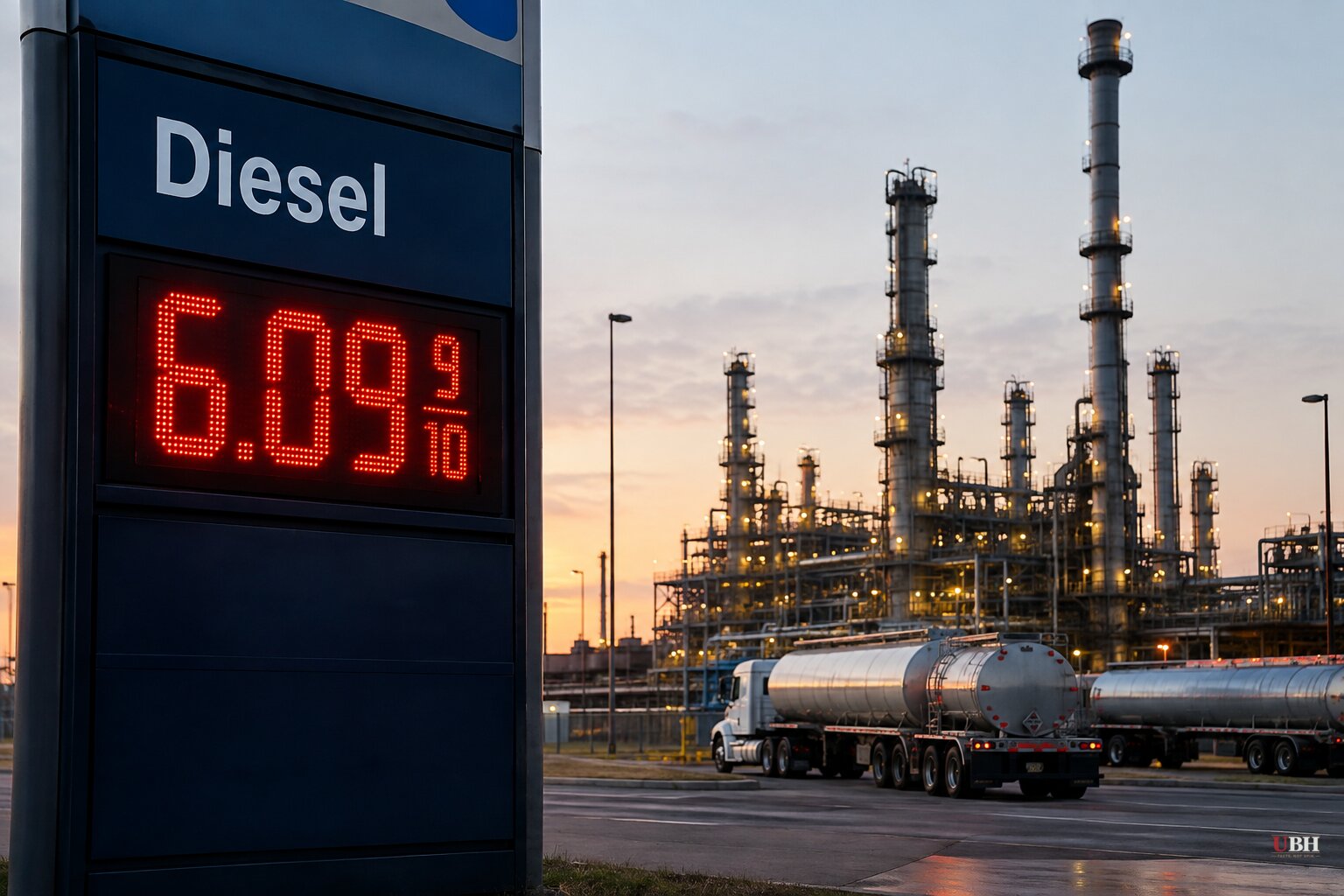
The Trump administration is weighing whether to invoke the Defense Production Act to expand U.S. oil refining capacity, according to Reuters reporter Jarrett Renshaw, who cited two sources familiar with the discussions. The move would be unprecedented: the 1950 law has never before been used to add refining capacity, according to Reuters.
The pressure is real. GasBuddy data cited by jobbersworld shows the national average diesel price surpassed $6 a gallon on Sept. 10 for the first time. Crude has stayed elevated too, with WTI trading above $100 a barrel and Brent above $104, according to OilPrice.com pricing data. OilPrice.com also reported drone strikes hit Saudi Arabia's East-West oil pipeline and that the International Energy Agency projects a 5.7 million barrel-per-day supply plunge as Gulf output recovers slowly, both adding to the squeeze tied to the ongoing conflict with Iran.
U.S. refiners are already running at 98% utilization, according to Reuters, leaving almost no slack to absorb the disruption. The proposal surfaced at a recent meeting between Trump and roughly a dozen U.S. refining executives. Reuters reported no final decision was made, and participants expected the conversation to continue.
The refiners pushed back on building brand-new plants. They told administration officials federal money would go further making existing refineries more efficient or expanding them, since new construction is far costlier and takes years, according to Reuters. That request builds on an April presidential determination that already authorized using Section 303 of the Defense Production Act to support petroleum production, refining and logistics capacity.
White House spokeswoman Taylor Rogers defended the effort in a statement to Reuters: "America's refining capacity is essential to ensuring the United States has continuous access to secure, affordable, and reliable energy. Expanding that capacity is a top priority for the President and his energy team, who are evaluating concrete options to increase our refining capacity through regulatory reform, faster permitting, and additional investment."
A Third Cabinet Official Gets Emergency Powers
Separately, Trump issued an executive order on Sept. 8 giving Interior Secretary Doug Burgum independent Defense Production Act authority over energy matters, according to the Epoch Times. That authority had mostly rested with the energy secretary, who was added alongside the commerce secretary back in March. Three Cabinet officials, Interior, Energy and Commerce, now hold that power independently. The order also routes disputes between Interior and Energy to the National Energy Dominance Council, which Burgum chairs, and sends national-security-related conflicts to the National Security Council in coordination with the Department of War, per the Epoch Times.
The Brownsville Test Case, and a Discrepancy Worth Flagging
One project has emerged as an early test of how this might work: America First Refining's proposed 168,000-barrel-per-day facility at the Port of Brownsville, Texas. Coverage aggregated by Ground News notes the project has drawn scrutiny over ties to Trump's family and administration, though the specifics of those ties were not detailed in that reporting.
A related deal requires clarification. Ground News's summary states that Trump personally "secured a 35% equity stake" in North American Blue Energy Partners, the Venezuelan oil operator now controlled by businessman Alejandro Betancourt. But Fox News's own reporting on the underlying deal says the equity stake, 35% of NABEP's corporate parent, goes to the Pentagon's Office of Strategic Capital, a federal government office, not to Trump personally. This represents a difference between a U.S. government stake and personal presidential enrichment. Ground News's phrasing blurs this distinction. NABEP is expected to pay $200 billion in royalties and taxes over 25 years tied to 65 billion barrels of Venezuelan reserves, with Reliance Industries signing a 20-year deal to buy the refinery's output, according to Reuters reporting relayed by Fox News.
No investigation or ethics complaint tied to the Brownsville project or the NABEP arrangement has been announced by any federal body as of this writing. The strongest case against using the Defense Production Act for this purpose is straightforward. The law was created to mobilize industry for war, not to backstop refinery upgrades. Its first-ever use for this purpose would put the federal government in the business of picking which refiners get financial help ahead of a midterm election where fuel prices are a live political liability. Reuters explicitly ties this point to the November midterms.
No decision has been finalized. Reuters reports refiners and the White House expect to keep talking. The next marker to watch is whether the administration moves from discussion to a formal determination, and whether America First Refining or any Trump-linked project is among the first to receive federal backing under it.
Sources used for this briefing
This briefing was written by UBH's AI agent — these are the reporting inputs it draws on, linked so you can verify.


