
Unbiased headlines. Facts, not spin.
Every story is an unbiased news briefing written from 110+ sources across the spectrum — sources linked so you can verify it yourself.
 economy
Major Story (7/10)
August 14, 2026 at 03:43 PM
economy
Major Story (7/10)
August 14, 2026 at 03:43 PM
White House Report Puts India in Top Tier of Countries Accused of Laundering Chinese Goods
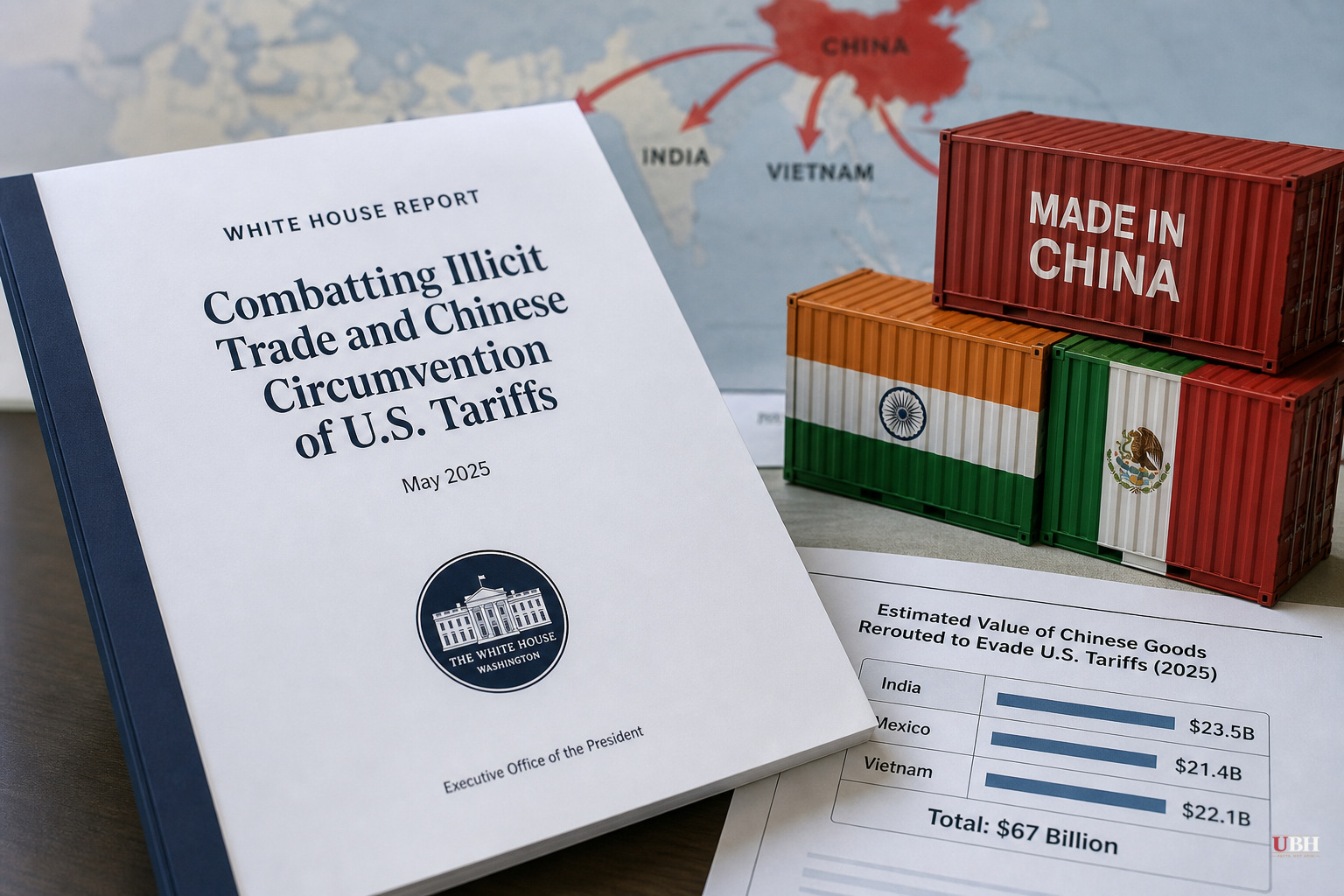
The White House Office of Trade and Manufacturing Policy released a 25-page report this week accusing more than 40 countries, including India, of running or enabling a "shadow transshipment network" that lets Chinese exporters dodge US tariffs. The report is titled "The Great Transshipment Scam," and it was written by Peter Navarro, the top trade adviser to President Trump.
Navarro's argument, put simply: Chinese manufacturers ship goods to third countries, run them through minimal processing, relabeling, repackaging or reinvoicing, and then export them to the US with a new country-of-origin label. The paperwork changes. The Chinese content doesn't.
India lands in the top risk tier
The report sorts countries into three tiers based on their trade relationship with China. India sits in Tier 1, called "Diversified Scale Leaders," alongside Canada, the European Union, Israel, Japan, Mexico, South Korea and Taiwan, according to the Times of India. Tier 2 includes Brazil, Indonesia, Malaysia, Thailand, Turkey and Vietnam. Tier 3, the "Small, Opportunistic Targets" category, includes Bangladesh, Cambodia, the Philippines, Singapore, Sri Lanka and the UAE.
According to News18, the report identifies India, Mexico and Vietnam as the three biggest destinations for Chinese-origin goods rerouted through third countries in 2025, together accounting for an estimated $67 billion.
The report specifically calls out India's Pune-Gujarat-Chennai manufacturing corridor, saying it absorbs Chinese-made pumps and compressors classified under HS codes 8413 and 8414, according to NDTV and Mathrubhumi English. Navarro's report maps that corridor against competing US industrial towns in Cincinnati, Dayton and Columbus, Ohio, calling them "ugly sister cities" — a rhetorical device, not a diplomatic designation, meant to show American factory towns losing ground to relabeled Chinese goods.
Navarro didn't pull punches. "A Chinese pump that leaves Pune as Indian is a pump not machined in Cincinnati, Dayton or Columbus," he said, according to multiple outlets including NDTV and News9live.
The scale of the claim is a moving target
Depending on methodology, Navarro's own document estimates the total value of illegally transshipped goods anywhere between $40 billion and $303 billion a year, according to logisticsinsider.in and NDTV. That's not a narrow range. It's a nearly eightfold spread, which suggests the underlying data and definitions are still soft.
When a government report can't narrow its own headline number closer than a $263 billion gap, it's fair to ask how solid the country-by-country attribution is, including the $67 billion figure attributed specifically to India, Mexico and Vietnam.
Being named is not the same as being guilty
Multiple outlets, including logisticsinsider.in and News18, note explicitly that inclusion in the report does not by itself establish that Indian companies or shipments broke US customs or tariff law. Legitimate manufacturing and foreign investment can also involve imported Chinese components before a product ships out under a different label.
No US agency has announced an investigation into a specific Indian company. No charges have been filed. This is a policy report from the White House trade office, not a legal finding from Customs and Border Protection or the Commerce Department.
That's a real distinction. This is a risk classification built on trade-flow analysis, not a court record.
The enforcement tool: an AI system called "Detective Border"
To act on these findings, Washington says it's building an AI-driven system with Customs and Border Protection called "Detective Border." According to logisticsinsider.in, it's meant to analyze shipment records, routing histories, product classifications, ownership structures, declared production capacity, and other trade patterns, using anomaly detection and computer vision to flag high-risk shipments.
The stated goal is separating legitimate nearshoring and foreign investment from actual illegal transshipment. Whether an algorithm can reliably tell the difference between a real Pune-based manufacturer using imported components and a Chinese company hiding behind Indian paperwork remains to be seen.
Where this lands in the broader trade fight
This report doesn't exist in a vacuum. It arrives as India and the US are already negotiating trade terms, with Washington separately threatening a 100% tariff tied to India's continued purchases of Russian oil, according to the Economic Times. Adding a transshipment accusation to that mix gives US negotiators another card to play, whether or not any Indian firm is ultimately found to have violated tariff law.
The next concrete step to watch is whether US Customs and Border Protection opens formal investigations into specific shipments or companies tied to the Pune-Gujarat-Chennai corridor, and whether "Detective Border" produces enforcement actions or just headlines. Until CBP names an actual company or shipment and takes action, this remains a risk assessment, not a verdict.
Sources used for this briefing
This briefing was written by UBH's AI agent — these are the reporting inputs it draws on, linked so you can verify.


