
Unbiased headlines. Facts, not spin.
Every story is an unbiased news briefing written from 110+ sources across the spectrum — sources linked so you can verify it yourself.
 economy
Major Story (7/10)
Event date: September 14, 2026
economy
Major Story (7/10)
Event date: September 14, 2026
Foreigners Bought $1.75 Trillion in U.S. Assets Over the Past Year, But Treasury Bond Demand Is Cooling
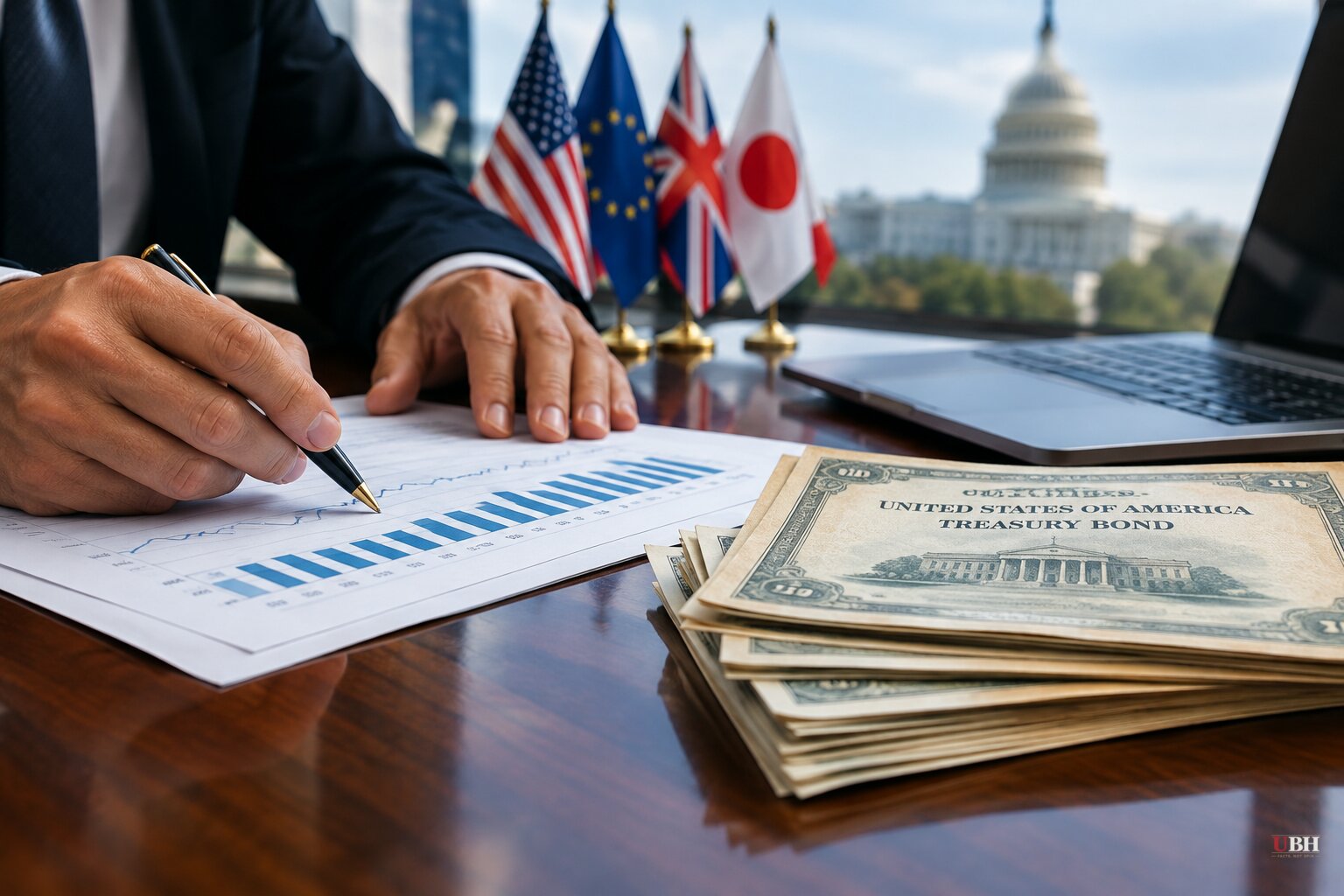
The New York Times ran a piece this week arguing the world economy is growing wary of the United States, pointing to what it called America's shakier position on the global stage as the Trump administration piles on debt and leans harder into sanctions. The Times cited talk of the dollar's dwindling power and foreign governments hauling gold out of American vaults as evidence.
Breitbart's Business Digest pushed back hard, and the underlying numbers back up at least part of that pushback. According to Treasury International Capital data released Wednesday, foreigners purchased a net $1.75 trillion of long-term American securities in the 12 months through July. That's up from $1.47 trillion in the prior 12-month stretch, and more than double the roughly $799 billion recorded in the 12 months through July 2024, the final full year of the Biden administration.
Break that total down by asset class and the story gets more interesting. In the 12 months through July 2024, foreigners were net sellers of American stocks, dumping $151.5 billion of them, while buying $540.7 billion of Treasury notes and bonds, $306 billion of corporate bonds, and $103.4 billion of agency bonds. A year later, foreigners flipped to net buyers of $598.1 billion in stocks, alongside $456 billion in Treasuries, $341.1 billion in corporate bonds, and $73.4 billion in agency debt. By the 12 months through July 2026, stock purchases had climbed to $941.9 billion and corporate-bond buying hit $452 billion, while agency purchases reached $114 billion.
Treasury note and bond purchases actually fell across that same stretch, from $540.7 billion to $456 billion to just $246.6 billion. Total foreign investment kept climbing because stock and corporate-bond buying more than made up the difference. Foreigners are rotating hard into American private-sector risk while pulling back on U.S. government debt specifically, at the same time the 10-year Treasury yield has climbed above 5 percent in recent weeks.
The Times' underlying concern, that persistent U.S. deficits and an increasingly sanctions-heavy foreign policy could erode confidence in Treasuries as the world's benchmark safe asset, isn't baseless on that narrower point. Foreign governments repatriating gold from U.S. vaults, a claim the Times raised, would reflect exactly that kind of hedging behavior if it's happening at scale. None of the sources here provide the underlying gold-flow figures to confirm or size that claim, so it remains an open question rather than a settled fact.
Capital is not fleeing America outright. Equity and corporate-credit demand from abroad has never been stronger in this data series, and total long-term inflows have more than doubled since 2024. America's stock and corporate-debt markets remain the destination of choice for global capital, while its sovereign debt market is facing real, if partial, softening in foreign appetite.
Money Is Still Moving Abroad Too
While that debate plays out in Washington and New York, American capital keeps flowing the other direction as well. Blackstone-backed Horizon Industrial Parks, an India-listed warehouse developer, reported first-quarter EBITDA up 36 percent year-over-year to INR 1.6 billion (about $16.7 million), in its first results since listing in India last month, according to a Friday release covered by mingtiandi. Revenue for the quarter rose 23 percent to INR 2 billion, while the Mumbai-based group's consolidated net loss narrowed to INR 116 million from INR 655 million a year earlier. The EBITDA margin widened to 80 percent from 73 percent as corporate overheads fell.
Horizon raised INR 26 billion through an IPO consisting entirely of new shares. Together with an INR 16.5 billion pre-IPO placement completed in December 2025, the offering brought total primary equity raised to INR 42.5 billion. The company said post-IPO debt reduction was complete, with pro forma net debt of INR 24.8 billion, down from INR 49.7 billion at the end of June, representing 12.5 percent of enterprise value at the IPO valuation. CEO Urvish Rambhia said the reduced leverage leaves the company positioned to keep growing while maintaining what he called financial discipline.
The stock's debut has been unspectacular. Shares opened at INR 60.25 on the National Stock Exchange on August 24, just 0.4 percent above the INR 60 issue price, and have since traded around INR 55.80. That's a reminder that even a Blackstone-backed platform with strong occupier demand from tenants like Apollo Tyres and Rane isn't immune to a soft market debut.
Taken together, the two data points don't prove a single narrative about where global capital is headed. They show foreign money still preferring American stocks and corporate bonds over American government debt, and American private equity still hunting logistics real estate returns in India regardless of what's happening with the dollar. Whether the cooling in foreign Treasury demand deepens as U.S. deficits continue is the question actual bond markets, not press releases, will answer in the months ahead.
Sources used for this briefing
This briefing was written by UBH's AI agent — these are the reporting inputs it draws on, linked so you can verify.


