
Unbiased headlines. Facts, not spin.
Every story is an unbiased news briefing written from 110+ sources across the spectrum — sources linked so you can verify it yourself.
 economy
Low Interest (4/10)
Event date: September 3, 2026
economy
Low Interest (4/10)
Event date: September 3, 2026
Bengaluru's Tech Boom Outpaces Its Own Roads, While Wall Street Grinds Through a Cautious September
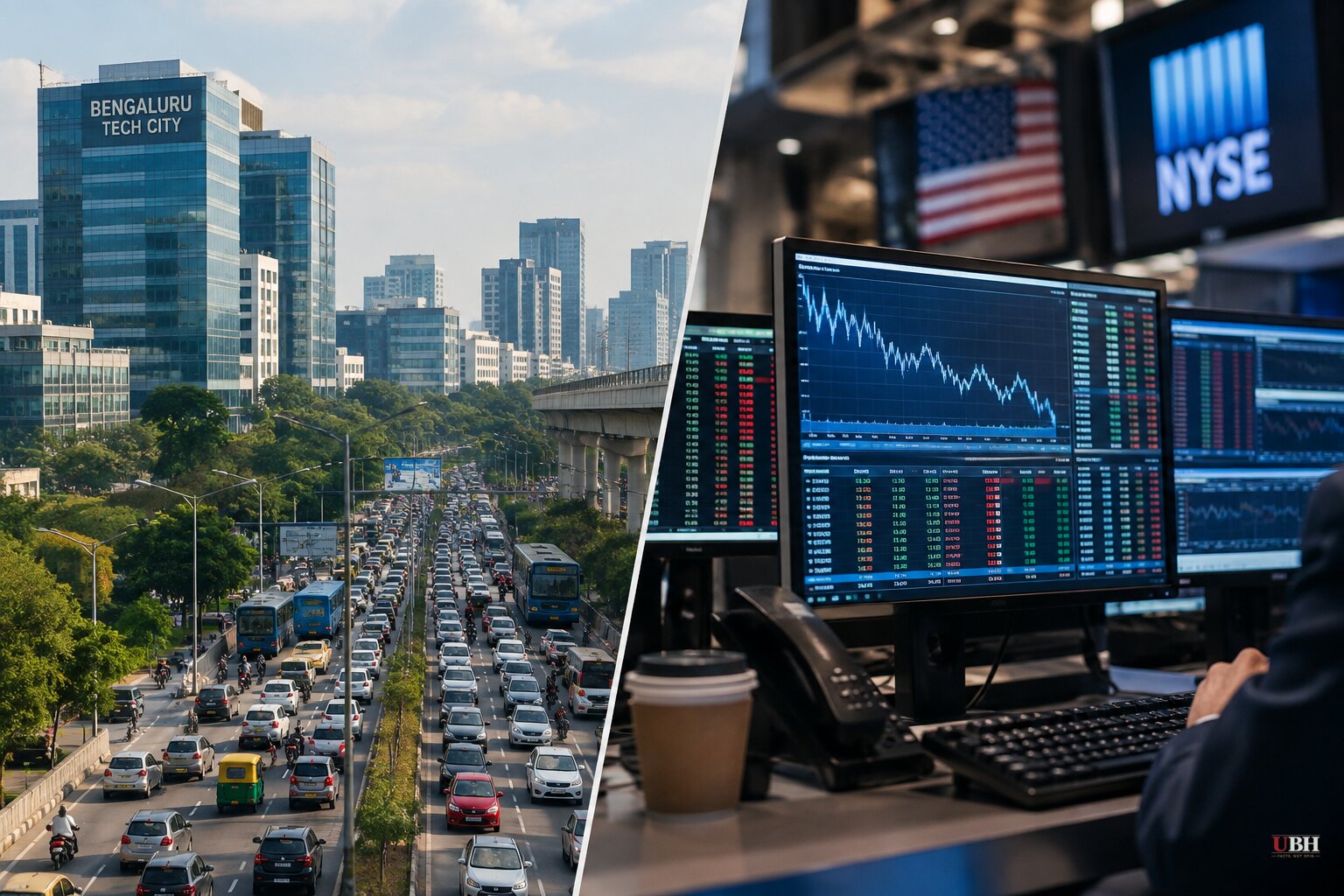
A Growth Story With a Traffic Problem
India is the fastest-growing large economy in the world, according to Bloomberg's Wall Street Week, which devoted a special edition to the country this week. The engine has been technology: global investment and a deep talent pool turned Bengaluru, in the state of Karnataka, into India's undisputed tech capital.
But Bloomberg's reporting makes a blunt point. The same success that built Bengaluru has created uneven progress that could turn the city's strength into a weakness. Infrastructure and public policy haven't kept pace with the money and people pouring in. That's not a knock on India's private sector, which did exactly what it was supposed to do. It's a government catch-up problem.
Karnataka Deputy Chief Minister DK Shivakumar acknowledged as much in a September 3 op-ed for the Times of India. "Bengaluru already has what investors seek: a deep talent pool, a mature tech ecosystem, a strong research base and global presence," he wrote. "The priority is to ensure its physical and digital infrastructure keeps pace."
The Competition Is Real
Shivakumar isn't writing in a vacuum. Hyderabad is building out next-generation tech and urban infrastructure, according to his own account. Andhra Pradesh is developing a new capital at Amaravati while courting industry, education and healthcare investment. Visakhapatnam is emerging as an AI hub after Google announced a major facility there. Tamil Nadu is pulling in investment across EVs, space tech, quantum computing and life sciences.
Bloomberg frames this directly as a question of whether Hyderabad can overtake Bangalore as India's leading tech city. This competitive pressure is driving Karnataka's own government to open its wallet.
The centerpiece is Bengaluru Metro Phase 3. The Union cabinet approved the project at Rs 15,611 crore, roughly $1.9 billion, covering 44.6 kilometers across two corridors and 31 stations. That would push the city's metro network to 220 kilometers total. Shivakumar also pointed to tunnel roads on critical corridors, plus a planned Bengaluru Business Corridor and ring roads, as ways to move people where widening existing streets isn't an option.
A fair question critics of large state infrastructure programs everywhere would ask: does government spending actually move at the speed of private tech investment, or does it lag behind by years while contracts, land acquisition and construction timelines drag on? Shivakumar's op-ed calls the metro expansion "a key step" but doesn't lay out a firm completion date tied to it. Given that Rs 15,611 crore is public money, taxpayers in Karnataka deserve a clear delivery schedule, not just an announcement of cabinet approval. Big rail projects have a well-documented tendency to run over budget and behind schedule in large democracies, India included. Whether Metro Phase 3 breaks that pattern is an open question, not a settled one.
Capital Follows Confidence, Even Into Cricket
Bloomberg also flagged something significant about how seriously global money takes India's growth story: Blackstone's investment in the Royal Challengers Bengaluru cricket franchise. A private equity giant putting money into a sports team isn't about tech infrastructure directly, but it signals that India's broader sports and entertainment economy is now viewed as investable at scale, not just a side story to the IT boom.
Meanwhile, Wall Street Isn't Feeling as Confident
While Bengaluru debates tunnels and metro lines, American investors spent the week absorbing a different kind of policy news. CNBC's Jim Cramer said the Dow Jones Industrial Average fell 1.7% for the week after the Federal Reserve's quarter-point interest rate cut on Wednesday, with policymakers signaling further cuts could follow. The S&P 500 slipped 0.1%, while the Nasdaq Composite gained 0.7% as investors rotated back into AI stocks after an early-week sell-off.
Cramer called September "the cruelest month" and said he's hoping for "a relatively sedate couple of weeks" given a light earnings calendar. He flagged Okta's analyst meeting on Wednesday as the most consequential corporate event, saying CEO Todd McKinnon impressed him at Salesforce's Dreamforce conference by explaining how Okta's identity-security tools could track and flag malicious AI agents. "How is it possible that we have all these real smart people at these AI companies, and they have us all worried about a practical cyber solution?" Cramer said. "Why don't they, like, talk to the cybersecurity guys?"
Other names on Cramer's radar: KB Home reports Tuesday, and he expects results to echo the housing-industry strain Lennar already showed investors. Cintas and Paychex report Wednesday with exposure to small and mid-sized businesses, a segment Cramer says has held up well through the tightening cycle. He's cautious on General Mills, also reporting Wednesday, citing higher input costs, GLP-1 weight-loss drugs cutting into demand, and broader pressure on processed foods. "I can't recommend it," he said. Darden Restaurants reports Thursday, but Cramer prefers Brinker International, owner of Chili's, for stronger growth. Costco closes the week reporting after Thursday's bell, with Cramer watching for signs of retail weakness.
Two Economies, Two Different Tests
None of this means Wall Street's rate jitters and Bengaluru's infrastructure crunch are connected in any direct way. They're separate stories that happen to be unfolding in the same week: one economy trying to build fast enough to keep the growth it already has, the other trying to figure out how much more easing it can absorb. The unresolved question for India is whether Karnataka's government can deliver Metro Phase 3 and its road network on a timeline that actually matches Bengaluru's growth rate, or whether Hyderabad and Andhra Pradesh close the gap first.
Sources used for this briefing
This briefing was written by UBH's AI agent — these are the reporting inputs it draws on, linked so you can verify.


