
Unbiased headlines. Facts, not spin.
Every story is an unbiased news briefing written from 110+ sources across the spectrum — sources linked so you can verify it yourself.
 economy
Breaking / Critical (9/10)
Event date: September 12, 2026
economy
Breaking / Critical (9/10)
Event date: September 12, 2026
Fed Raises Rates for First Time in Three Years, Days After Interest on the National Debt Topped $1 Trillion
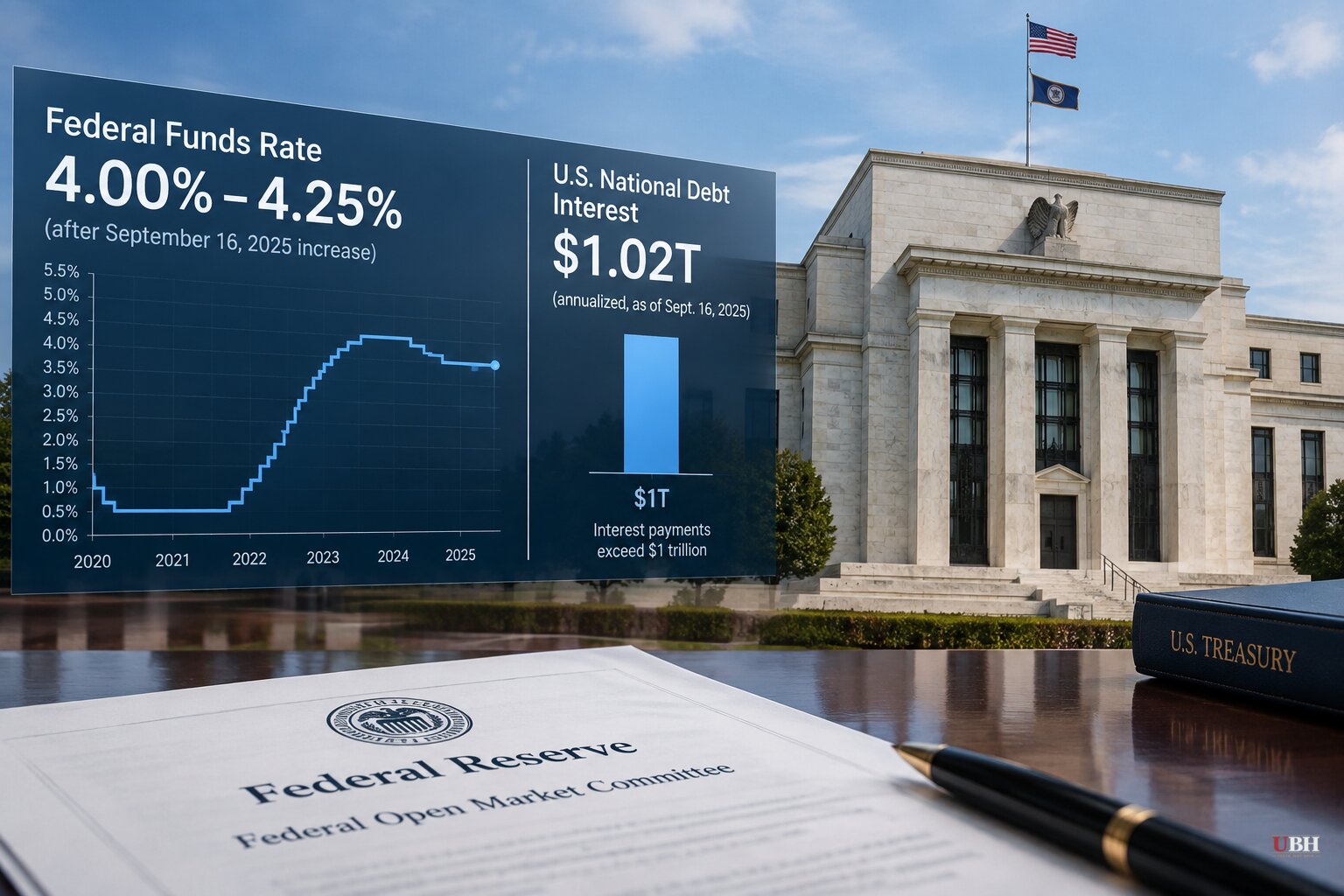
Since the national debt crossed $40.048 trillion on September 10, according to Treasury Department data reported by The Epoch Times, the bill for carrying it has hit a threshold it never had before. Net interest payments broke $1 trillion for a single fiscal year for the first time, according to the Peterson Foundation, tracking Treasury data through August, the 11th month of fiscal year 2026. Now the Federal Reserve has made that debt more expensive to service, not less.
The Fed raised its benchmark rate a quarter point on Wednesday, September 16, its first increase in three years, according to The Center Square's reporting carried by Eurasia Review. The vote was unanimous, 12-0, including Chair Kevin Warsh. That's a reversal from July, when the same quarter-point hike failed on a 9-3 vote, with three dissenters wanting to raise rates and getting outvoted.
The Fed also dropped language blaming inflation on energy and supply shocks, saying instead that inflation "remains elevated." Warsh told reporters inflation "has been too high, too long," pointing to a stronger economy, inflation trends he says haven't genuinely improved, and shifting geopolitics. Sixteen of 18 Fed officials expect the funds rate to go even higher by year-end, per the meeting's projections. Warsh declined to discuss President Trump directly, saying Fed independence "is a two-way street."
Hours after the hike, Trump posted on Truth Social that rates should be at 1% or below. He has been pushing the opposite direction from the Fed all year.
Not every economist backed the hike. Orphe Divounguy wanted the Fed to hold, citing an energy shock, a frozen housing market, and weak hiring outside health care, according to Eurasia Review. On the other side, Penn Wharton's Kent Smetters called the hike's added debt cost "trivial" if it restores Fed credibility and lowers real borrowing costs down the line. Both are legitimate reads of the same weak-but-not-collapsing economic data, and neither has been proven right yet.
The debt math keeps getting worse
Net interest payments hit $1.017 trillion in the first 11 months of FY2026, up about 9% from the same period a year earlier, according to Treasury data cited by Eurasia Review. The Peterson Foundation puts the comparable figure at $1.02 trillion, up from $933 billion the year before, also a 9% jump. That already exceeds every category of federal spending except Social Security, per the Peterson Foundation, and works out to roughly $6,247 per individual tax return filed in FY2025.
A broader gross-interest measure tracked by Crypto Briefing, which includes intragovernmental transfers rather than just net payments, puts the 11-month FY2026 total at $1.27 trillion, up roughly 13%, or $139 billion, from the same period last year. That figure is larger than net interest because it counts interest the government pays itself on trust-fund holdings, but by either measure debt service now outpaces the roughly $876 billion the Department of Defense has spent year-to-date, per Crypto Briefing's figures.
The Congressional Budget Office projects net interest will total $16.2 trillion over the next decade, climbing from $1.0 trillion this year to $2.1 trillion by 2036, according to the Peterson Foundation.
Deficit still near $2 trillion
The Congressional Budget Office's August budget review put the 11-month fiscal 2026 deficit at $2 trillion, reported by both Fox Business and KTVU. The CBO noted the 11-month total was actually $6 billion lower than the same period a year earlier, though it said the deficit would have been $82 billion higher than last year's shortfall if not for shifts in the timing of certain payments around Labor Day in 2025. Interest expenses rose $111 billion, or 12%, CBO said, while Social Security spending climbed $78 billion, Medicare $73 billion, and Medicaid $47 billion. Tax receipts rose 3%, or $154 billion, per CBO, driven by individual income and payroll taxes, though corporate income tax collections fell 25% following 2025 tax reforms under the One Big Beautiful Bill.
Separately, Treasury's own Monthly Treasury Statement showed August's standalone deficit at $167 billion, far below the $404 billion consensus estimate and down sharply from July's $432 billion, according to The Epoch Times.
Bond markets aren't waiting around. Ten-year Treasury yields closed the week ending September 11 at 4.97%, and 30-year yields at 5.36%, The Epoch Times reported, rattled partly by Trump's pledge of $5,000 dividend checks to Americans if Republicans win the November midterms, a proposal analysts say could add $1.2 trillion to the deficit, per Fox Business. Treasury Secretary Scott Bessent has run $31 billion in debt buybacks this month alone and has 12 more operations scheduled, but LPL Financial's Adam Turnquist noted rates have been climbing "the elevator" rather than the stairs lately.
The open question now is whether the Fed's dot plot holds. If 16 of 18 officials are right and rates go higher before December, the interest bill that already exceeds the Pentagon's budget has nowhere to go but up, right as Washington debates writing $5,000 checks it would have to borrow to cover.
Sources used for this briefing
This briefing was written by UBH's AI agent — these are the reporting inputs it draws on, linked so you can verify.


