
Unbiased headlines. Facts, not spin.
Every story is an unbiased news briefing written from 110+ sources across the spectrum — sources linked so you can verify it yourself.
 economy
Notable (6/10)
Event date: September 14, 2026
economy
Notable (6/10)
Event date: September 14, 2026
Canada Negotiates Entry Into EU's €90 Billion Ukraine Loan, Trump Threatens Tariffs Over the Deal
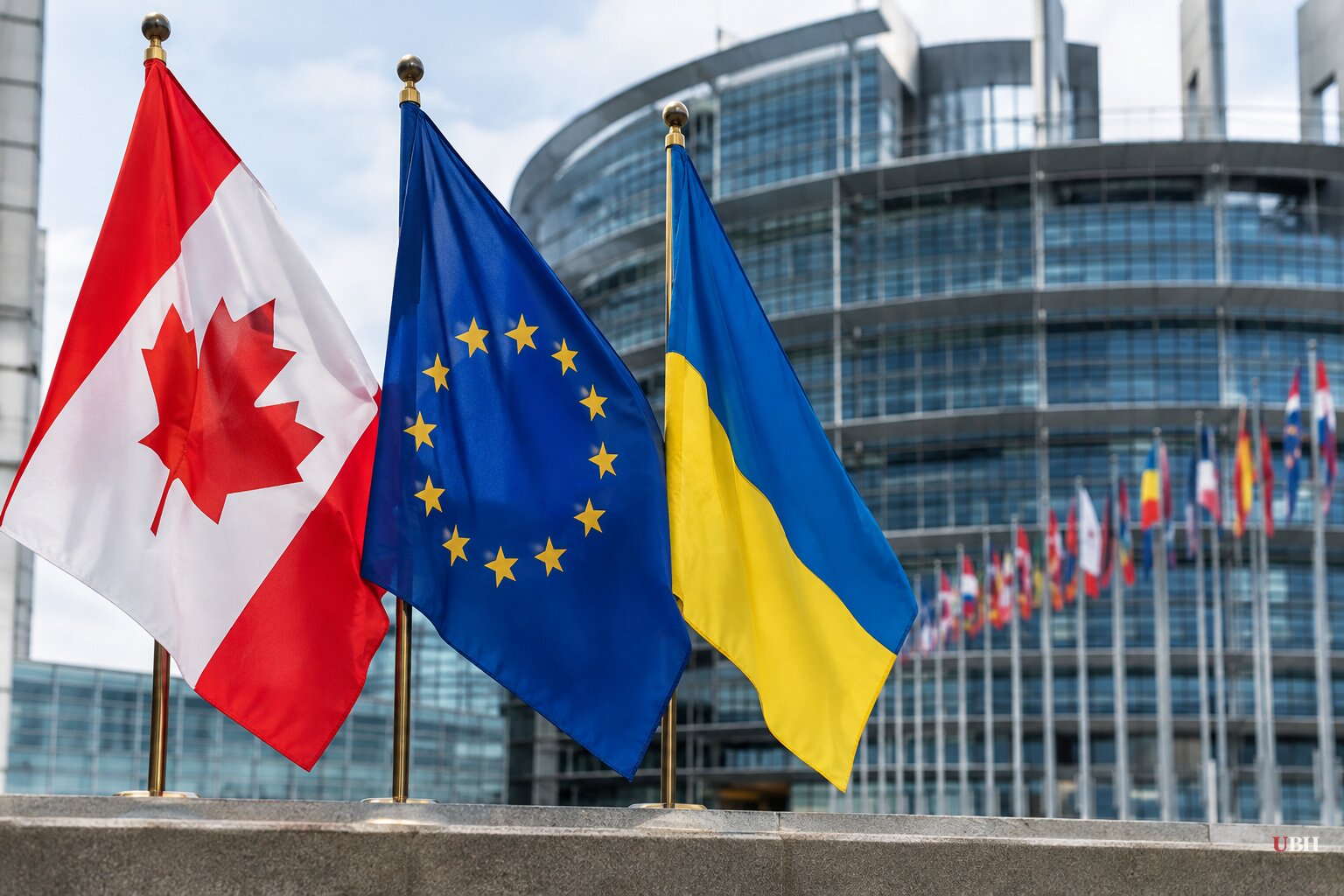
Since the Financial Times first reported on September 13 that Ottawa and Brussels were negotiating Canada's entry into the EU's Ukraine financing scheme, the talks have moved from leaked sourcing to an on-record confirmation. European Commission spokesperson Balazs Ujvari told reporters in Brussels on September 18 that Canada "has expressed an interest in joining" the €90 billion loan and that "technical talks are still ongoing," according to the Kyiv Independent.
The loan, finalized by EU member states in April, is designed to cover two-thirds of Ukraine's financial and military needs through the end of 2027, funded by joint EU borrowing on capital markets. Brussels has disbursed close to €15 billion so far, according to Euronews. The debt generates roughly €3 billion a year in interest, split proportionally among 24 of the EU's 27 members. Hungary, Slovakia and the Czech Republic negotiated opt-outs.
If Canada signs on, it would become the second non-EU country in the program after the United Kingdom, which joined in July. In exchange for shouldering a slice of that interest bill, Canadian defense manufacturers get to sell weapons and ammunition to Ukraine under the same terms as EU firms, sidestepping the "Made in Europe" procurement rule that otherwise governs the credit line.
Brussels wants understood clearly that joining the loan is not the same as giving Ukraine more money. Ujvari told the Kyiv Independent that Canada's participation "does not unlock additional financing for Ukraine" and that Kyiv still needs Ottawa to donate directly. President Volodymyr Zelensky has identified a $27 billion shortfall in Ukraine's 2026 budget, and so far only Norway has stepped up with new money, a $9 billion pledge for 2027.
Ujvari said the Commission raises the need for direct Canadian and British contributions "regularly," and pointed to two upcoming moments where Canada could announce something concrete: the UN General Assembly gathering in New York, and a September 28 summit in Toronto focused on Ukrainian children abducted by Russia.
The timing lines up with a broader diplomatic push. Canadian Prime Minister Mark Carney met European Commission President Ursula von der Leyen in Strasbourg on September 16, where von der Leyen used her State of the Union address to propose making Canada the EU's first "associate member," a status with no formal precedent. According to the Financial Times, as relayed by Ukrainska Pravda and the Kyiv Post, Carney is trying to build what he's called a "unique alliance" with Europe among "liberal states" as a hedge against a "rupture in the world order" driven by President Donald Trump's trade policy. Canada is currently in a trade dispute with its largest trading partner, the United States.
Trump did not let that pass quietly. CNN reported that Trump told reporters he could hit the EU with "heavy tariffs" if he judges any new Canada-EU arrangement to be a "hostile act," while adding that a deal with "good intention" would be fine. Trump has separately floated Canada becoming the 51st US state, an idea Carney has flatly rejected.
There is a question worth examining: is expanding the loan pool a genuine financial win for Ukraine, or mostly a way for Brussels to spread its own interest burden across more shoulders while it markets the move as generosity? The loan's repayment terms make this more than academic. Under the December 2025 structure, Kyiv doesn't have to start repaying the €90 billion until Russia pays reparations, while Europe holds roughly €200 billion-plus in frozen Russian assets as leverage, according to NV. That means the debt Canada is negotiating to help finance is contingent on a reparations scheme that has no timeline and no guarantee. European lawmakers pushed in September for Brussels to unblock talks on using those frozen assets directly, arguing the €90 billion loan alone won't cover Ukraine's needs through 2027.
CNN frames the story mainly around the EU-Canada "associate member" idea and the geographic and legal obstacles to anything resembling accession, while the Kyiv-focused outlets zero in on the harder number: Ukraine's cash shortfall isn't solved by Canada joining a loan mechanism that was already fully allocated.
Canada has already provided roughly CA$6.5 billion, about $4.7 billion, in military aid to Ukraine, and signed a 100-year partnership agreement with Kyiv on September 10, according to NV. What Ottawa hasn't done is put a number on new direct funding. Both sides are aiming to settle the size of Canada's loan contribution before an EU-Canada summit in Montreal at the end of October, according to the Financial Times reporting carried by the Kyiv Post and eurointegration.com.ua. Whether that summit produces an actual dollar figure for Ukraine, or just another framework for future talks, is still an open question.
Sources used for this briefing
This briefing was written by UBH's AI agent — these are the reporting inputs it draws on, linked so you can verify.


