
Unbiased headlines. Facts, not spin.
Every story is an unbiased news briefing written from 110+ sources across the spectrum — sources linked so you can verify it yourself.
 economy
Major Story (8/10)
Event date: September 16, 2026
economy
Major Story (8/10)
Event date: September 16, 2026
Eurozone Finance Ministers Meet in Dublin as Bond Yields Hit Multi-Decade Highs and Oil Stays Above $100
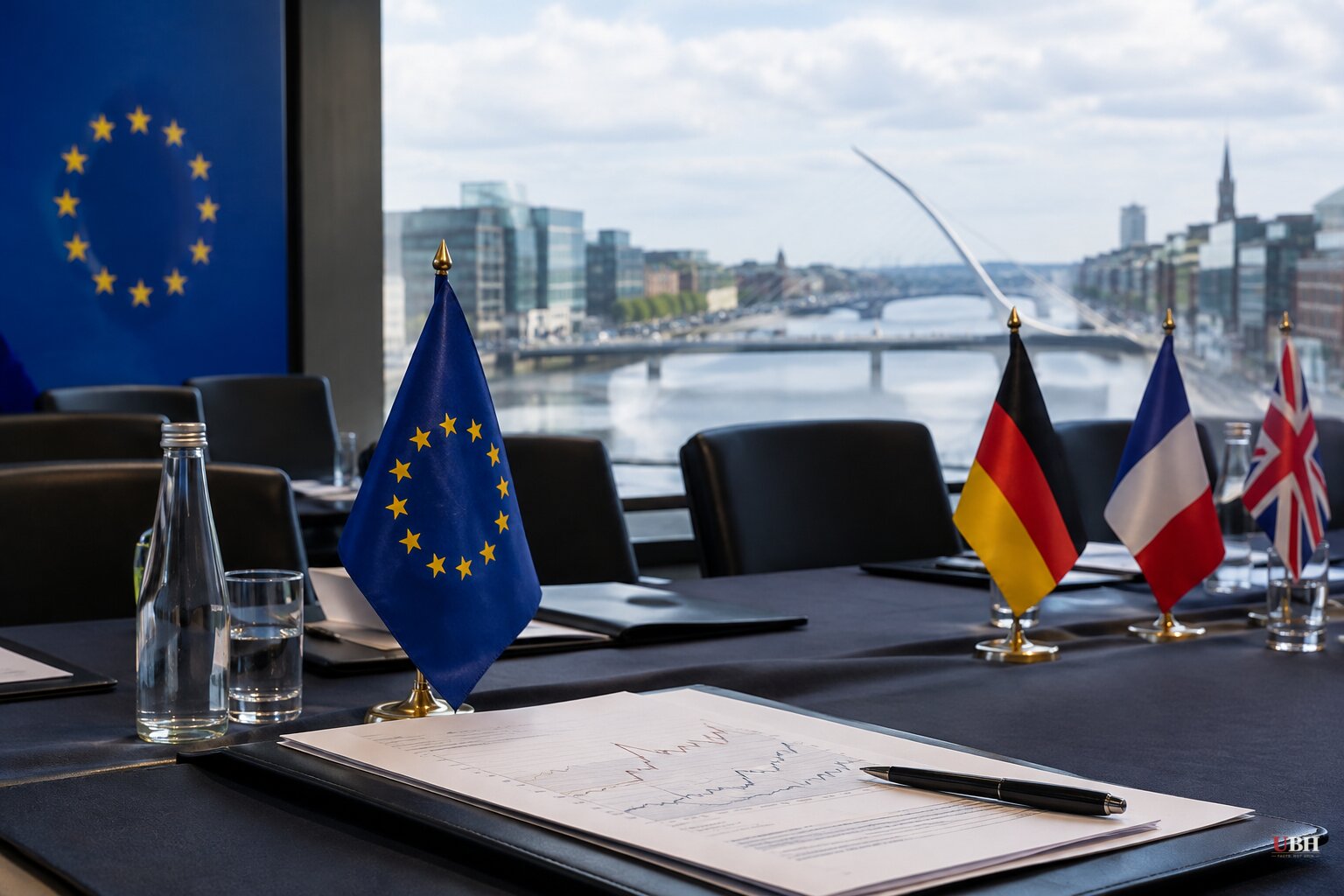
Euro-area finance ministers sat down in Dublin on Friday, September 18, 2026, for an informal Eurogroup session meant to take stock of an economy getting squeezed from two directions at once: an energy shock and a bond market that's gone haywire.
Aurore Lalucq, chair of the European Parliament's Committee on Economic and Monetary Affairs, joined the discussion, according to Agence Europe. OECD Secretary-General Mathias Cormann was also on hand to walk ministers through productivity numbers, a topic that will matter a lot less to voters than what's happening at the gas pump.
The Bond Market Is Ugly Everywhere
German 10-year bund yields hit 3.57% this week, the highest since 2009, according to Yeni Şafak. France's 30-year yield touched 5.1766%, a level unseen since 2002. UK 30-year gilts hit 5.94%, the highest since 1998. U.S. 10-year Treasury yields were closing in on 5% for the first time since October 2023, per BNN Bloomberg.
European officials are trying to draw a clear line: this isn't Europe's fault. A European source cited by Agence Europe said the rise in long-term rates is driven mainly by the United States and Japan, not by anything happening in the eurozone. That same source added a caveat worth remembering: "This does not mean that Europe is immune."
CNN's reporting cuts a little differently. It frames the global bond rout as rooted in investor unease over government spending broadly, with rising bond supply from war funding and defense budgets forcing investors to demand higher yields to hold all that new debt. Marco Papic, chief investment strategist at BCA Research, told CNN the market is reacting to the risk of a prolonged crisis that forces governments to spend even more. That's a materially different emphasis than the EU's own framing, which downplays European culpability and points the finger at Washington and Tokyo. Both things can be true at once, but readers should know the EU's own talking points and the CNN framing aren't the same story.
Why It's Happening: Iran, the Gulf, and the Strait of Hormuz
The proximate trigger, according to multiple sources, is the ongoing conflict tied to Iran and attacks around the Persian Gulf. Saudi Arabia closed its East-West Crude Oil Pipeline after attacks originating from Iraq, cutting an alternative route that normally carries 7 million barrels a day around the Strait of Hormuz, according to Yeni Şafak. BNN Bloomberg reported energy shipments through the Strait have slowed to a handful of tankers as producers start cutting output.
The European Central Bank raised its three key policy rates by 25 basis points this week. ECB President Christine Lagarde called the move a "no-brainer" and warned, according to Yeni Şafak, that headline inflation will stay well above the 2% target for longer because of the Middle East conflict layered on top of the Russia-Ukraine war. The ECB also raised its inflation forecast and cut its growth projection, according to BNN Bloomberg.
Governments Have Way Less Cash This Time
During the 2022 energy crisis triggered by Russia's invasion of Ukraine, European governments deployed more than €700 billion in support measures, according to Crypto Briefing. This time around, the aggregate fiscal response across the euro area sits at roughly 0.1% of GDP. Governments are entering round two of an energy crisis with a fraction of the fiscal room they had last time, and bond markets are making new borrowing more expensive by the week.
Greece has already committed €800 million to cost-of-living measures and has earmarked another €130 to €150 million in reserves for possible new energy subsidies, according to tovima, citing Greek public broadcaster ERT. Prime Minister Kyriakos Mitsotakis chaired a planning session at the Maximos Mansion looking at extending a 10-cent-per-liter diesel subsidy, reviving a "Fuel Pass," and raising heating allowances that currently range from €100 to €800 and reach as high as €1,200 in mountainous areas.
Germany's Economy Minister, Katherina Reiche, is pushing to temporarily cut VAT on fuel from 19% to 7%, arguing it would deliver immediate relief at the pump, per tovima.
The Windfall Tax Fight, and a Real Discrepancy in the Coverage
Germany has also pushed for an EU-level windfall tax on energy companies posting outsized profits as crude prices climb, arguing that a patchwork of national windfall taxes distorts competition inside the single market. That's a fair complaint from Berlin's side: if one country taxes energy profits and its neighbor doesn't, companies and capital shift accordingly.
Agence Europe reported plainly that the windfall-tax request is officially not on the Dublin agenda, and that a European source said the impact of Middle East tensions on energy company profits varies so much by country that handling it at the EU level is difficult. The European Commission has also said windfall taxation remains primarily a national matter, not a Brussels-level decision, according to Crypto Briefing.
Crypto Briefing's reporting reads as though windfall taxes are a live item under active debate in Dublin. Agence Europe's sourcing says the opposite, that it's explicitly off the formal agenda even as ministers discuss it informally.
Eurogroup President Kyriakos Pierrakakis has emphasized the importance of keeping any energy interventions temporary, warning that permanent subsidies could distort energy markets and undermine the bloc's decarbonization commitments, according to Crypto Briefing. Spain, meanwhile, continues to push a European safe asset proposal; Agence Europe reports that technical follow-up work has started but no political process has launched.
What happens next depends largely on oil prices and how long the Gulf tensions persist. If Brent stays above $100 through the winter heating season, ministers with a tenth of the fiscal firepower they had in 2022 will face pressure to borrow more into a bond market that's already punishing them for it.
Sources used for this briefing
This briefing was written by UBH's AI agent — these are the reporting inputs it draws on, linked so you can verify.


