
Unbiased headlines. Facts, not spin.
Every story is an unbiased news briefing written from 110+ sources across the spectrum — sources linked so you can verify it yourself.
 economy
Major Story (8/10)
Event date: September 15, 2026
economy
Major Story (8/10)
Event date: September 15, 2026
China's Yttrium Squeeze Puts Rare Earth Supply Chain at Center of Sept. 24 Trump-Xi Summit
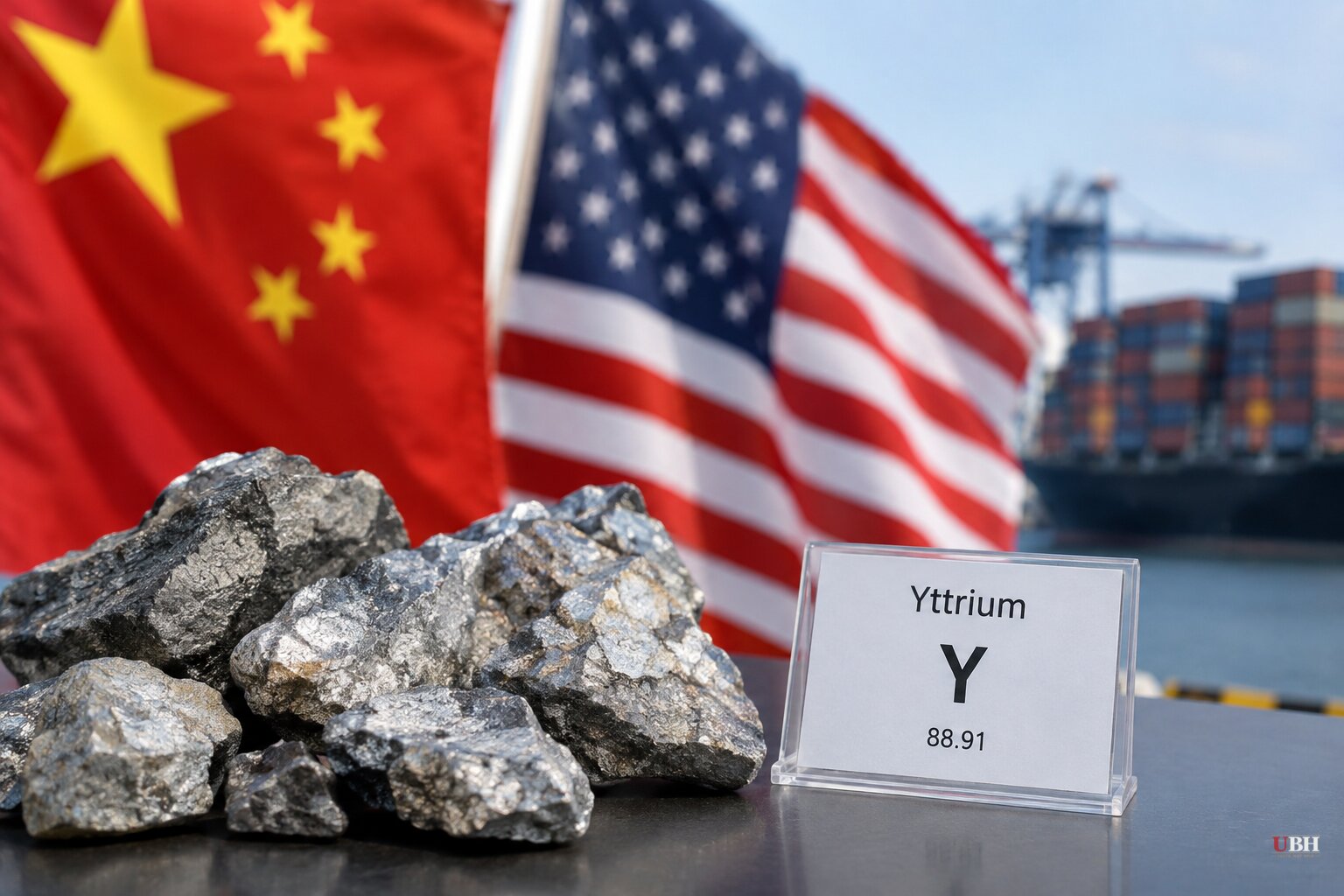
A metal nobody heard of a year ago is now a trade weapon
Yttrium isn't technically a rare earth element. It's always found alongside them, and it was the first rare earth relative ever discovered, near the Swedish village of Ytterby in the 18th century, according to Reuters columnist Andy Home. Today it coats jet engine turbine blades to protect them from extreme heat, and it shows up in semiconductors, lasers, and screen displays.
China mines and separates almost all of it. The U.S. Geological Survey isn't even sure how much comes out of the ground worldwide, estimating global production last year at somewhere between 10,000 and 15,000 metric tons, per Home's reporting. Beijing doesn't publish separation or mining quotas.
The timeline of the squeeze
China imposed export controls on yttrium and six other rare earths in April 2025, according to Reuters. Shipments to the U.S. stopped completely and didn't resume until October 2025, timed just ahead of a Trump-Xi summit in Busan, South Korea. At that meeting, Beijing agreed to defer even tougher rare earth and magnet restrictions for a year, but kept the yttrium controls in place, requiring exporters to certify the metal will only be used for civilian purposes.
Trump called the Busan meeting "amazing," but the yttrium flow dried up again shortly after, according to ZeroHedge and Reuters. By February 2026, the shortage had triggered production stoppages across the U.S. coating supply chain. China shipped a 60-ton batch of yttrium oxide to the U.S. in March 2026, which Home reports followed a direct White House intervention on behalf of a major U.S. company that couldn't get an export license. Another 29 tons arrived in July, and shipments slowed again after that.
Japan has it worse. Reuters reports Tokyo has received almost no yttrium since November 2025, after Prime Minister Sanae Takaichi made comments defending Taiwan. Beijing cut off other rare earths and critical minerals to Japan at the same time. Rare Earth Exchanges, citing Silverado Policy Accelerator data, documented a 95% collapse in direct Chinese yttrium shipments to Japan over an eight-month span and a 6,900% price spike through February 2026, prompting the Pentagon to solicit new supply proposals.
China's stated rationale versus how analysts read it
Beijing's public justification for the controls is end-use verification: exporters must prove the yttrium is going to civilian, not military, applications. That's a legitimate stated licensing requirement, not something Chinese officials have publicly framed as coercion in these reports.
But Home writes plainly that the licensing regime has "transformed yttrium into a precision weapon for deployment against specific trade partners." Barclays global head of economics research Christian Keller made a similar point, saying China's "quasi-monopolistic position provides it with significant geopolitical leverage." Rare Earth Exchanges calls the uneven flow "calibrated scarcity," arguing Beijing ships just enough to prevent full decoupling while preserving uncertainty and leverage. Whether that's deliberate strategy or the ordinary friction of a new bureaucratic licensing system is something none of these sources can prove definitively, since China's export-licensing decisions aren't transparent.
The bigger critical minerals picture
China's grip isn't limited to yttrium. Reuters, cited by IDN Financials, reports China's overall rare earth market share fell from more than 90% in 2023 to around 85% in 2025 as U.S. and Malaysian refining investment came online. But strip out rare earths, and China's share of critical minerals refining broadly actually rose, from 70% to 72%, according to the International Energy Agency's Global Critical Minerals Outlook 2026, published in July. The IEA projects China's rare earth dominance will only fall to about 70-73% by 2035 even if every planned refining project worldwide gets built on schedule.
The Trump administration says it has signed or approved 160 critical minerals agreements worth more than $40 billion since January 2025, per IDN Financials. But the same administration canceled $7.5 billion in clean energy grants approved under the Biden administration and ended several EV and clean energy tax credits. Peter Trousdale, an associate policy fellow at the Center for Climate and Energy Solutions, warned that pulling already-awarded grants risks eroding investor confidence in government financing, at a time when mining and refining projects take years to plan and build.
On the ground, the shortage is already showing up in prices. MSC Industrial executive Martina McIsaac told the Jefferies Industrials Conference last week that the supply crunch has pushed up prices for tools and supplies used by factories and machine shops across North America.
What's next
Xi and Trump are scheduled to meet in Washington on September 24, 2026, and Reuters reports yttrium is expected to be high on the agenda. Whether Beijing eases the licensing bottleneck again, as it did ahead of the Busan summit, or holds firm, will be the clearest signal yet of how much leverage China intends to keep squeezing out of a metal most Americans have never heard of.
Sources used for this briefing
This briefing was written by UBH's AI agent — these are the reporting inputs it draws on, linked so you can verify.


