
Unbiased headlines. Facts, not spin.
Every story is an unbiased news briefing written from 110+ sources across the spectrum — sources linked so you can verify it yourself.
 economy
Notable (5/10)
September 18, 2026 at 04:20 PM
economy
Notable (5/10)
September 18, 2026 at 04:20 PM
Ten Years Into Trump's Tariff Era, US Growth Outpaces the G7 While Canada Turns Toward Europe
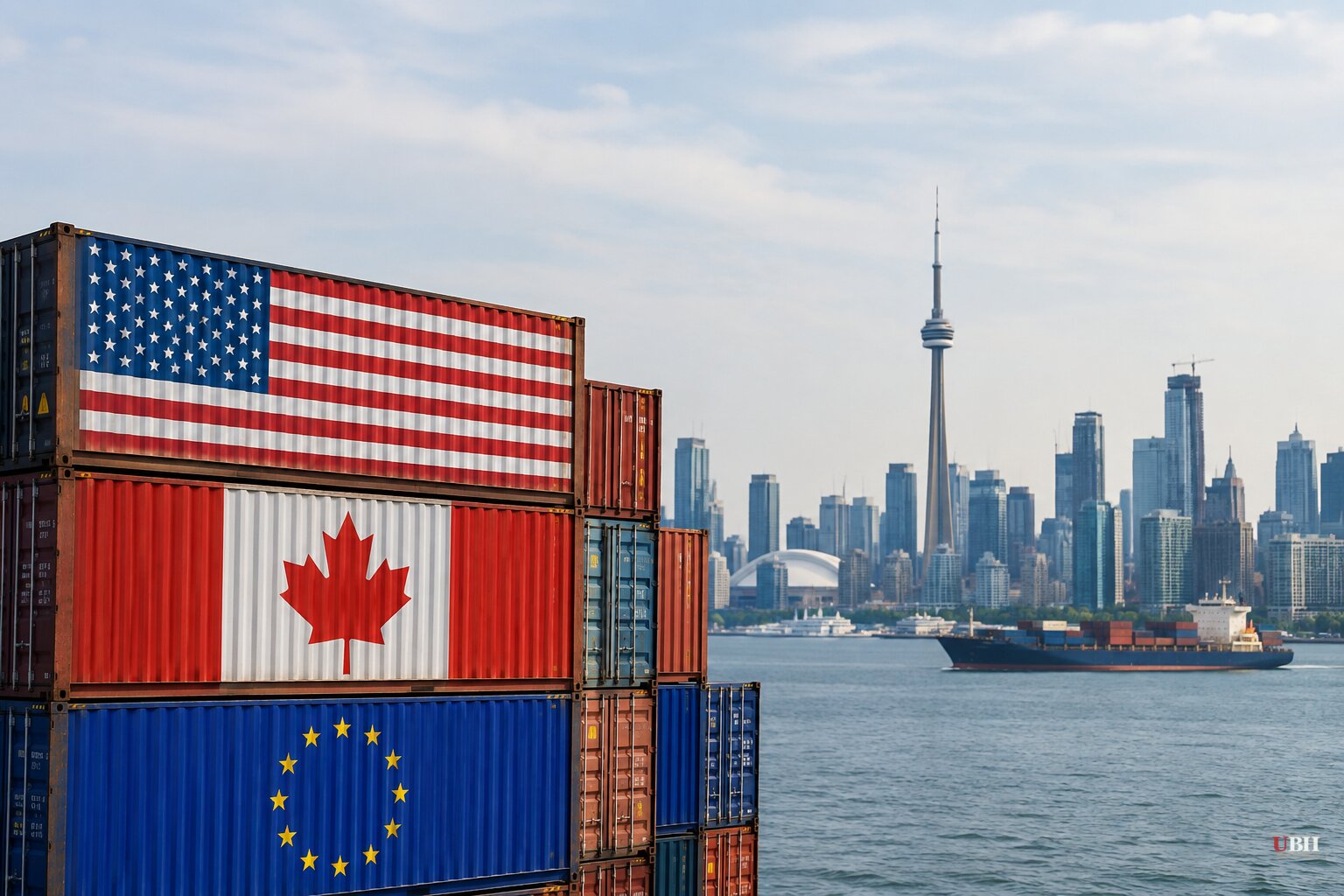
Donald Trump called the World Trade Organization "a total disaster" back in 1999. Ten years into a trade policy shift that started with his first term, the numbers say the disaster he predicted for the American economy never arrived, according to a decade-in-review analysis published by the Atlantic Council.
Real median household income in the United States, measured in 2025 dollars, rose from $77,230 in 2016 to $87,460 in 2025, the Atlantic Council reported. The S&P 500 more than tripled, from 2,271.31 on Trump's first inauguration day in January 2017 to 7,718.60 by September 4, 2026. US GDP per capita grew 18.3 percent between 2016 and 2025, the fastest pace among all G7 countries, per the same analysis.
That data cuts against a warning that has anchored American trade debates since Al Gore invoked the Smoot-Hawley Tariff Act during a 1993 NAFTA debate: that protectionism triggers economic catastrophe. It also challenges what former US Trade Representative Robert Zoellick called the "bicycle theory" of trade in 2001, the idea that liberalization has to keep moving forward or collapse under the weight of special interests. Global trade as a share of world GDP actually rose from 54 percent in 2016 to 68 percent in 2025, according to the Atlantic Council, even as Washington walked away from the Trans-Pacific Partnership and blocked new judges from the WTO's appellate body, effectively freezing its dispute-resolution system.
Allies Are Building Around Washington, Not Waiting For It
The tariffs that Trump has used as leverage are pushing US trading partners to hedge. The Hill reports that Canada is explicitly pursuing deeper integration with Europe, and Australia says it's watching Canada's playbook closely while pursuing its own diversification.
That process is already visible. Canadian Prime Minister Mark Carney received a standing ovation in the European Parliament this week after EU officials floated a proposal to make Canada the bloc's first-ever "associate member," according to Down Under Voices. German Green MEP Terry Reintke, who wore a Canadian hockey jersey for the occasion, called it a historic moment: "Europe has extended a hand, and Canada has taken it." What associate membership would actually mean in practice remains unclear, and no formal agreement has been finalized.
European Commission President Ursula von der Leyen has also proposed an "Alliance for the Future" covering defense production, critical minerals, batteries, and artificial intelligence with Canada, building on the existing Canada-EU Comprehensive Economic and Trade Agreement, according to The Hill.
The Fragmentation Concern Is Real, and the WTO's Own Data Backs It
Critics of this piecemeal approach have a legitimate point worth stating plainly. If Canada and Europe strike one critical-minerals arrangement, Australia negotiates a separate one, and Japan builds a third, the result is a patchwork of incompatible rules, digital standards, and procurement preferences rather than a unified trading system. The WTO's own World Trade Report warns that targeted agreements in areas like digital trade and critical minerals can either serve as useful laboratories for cooperation or actively fragment global trade if they substitute for multilateral rules instead of feeding into them, The Hill notes.
Smaller economies without Canada's or Australia's negotiating leverage could get left out of these bespoke deals entirely, stuck outside blocs built by bigger players. Whether that becomes the dominant pattern, or whether the aggregate trade-to-GDP numbers keep climbing as they have since 2016, is genuinely unresolved.
The Hill argues the fix is for the WTO to stop trying to originate sweeping multilateral rounds and instead aggregate deals that countries strike bilaterally elsewhere, pointing to the Information Technology Agreement, which grew from 29 original signatories to cover roughly 97 percent of global tech trade, as a model.
Trump's WTO Skepticism Has Odd Company
Trump's distrust of the WTO isn't new, and it wasn't always a right-of-center position. Breitbart notes that when Gloria Steinem, the feminist writer and activist, signed a 1994 letter urging President Bill Clinton to delay the Uruguay Round agreement that created the WTO, she stood alongside an unusual coalition that included Pat Buchanan, Ralph Nader, Noam Chomsky, and Phyllis Schlafly. Steinem argued that global trade rules let companies exploit pools of cheap labor, particularly women's labor, telling a Canadian interviewer around the 1999 Seattle WTO protests that "Seattle is the women's movement."
Trump was making a nearly identical argument in a December 1999 ABC interview, saying the WTO was "not necessarily fair to America" and declaring, "I'm not a World Trade Organization fan." The overlap doesn't make either side right, but it shows WTO skepticism has never been a purely partisan position in American politics.
What happens next depends on institutions that are currently in limbo. The WTO's appellate body has had no functioning quorum for years because Washington has refused to confirm new judges, according to the Atlantic Council, meaning trade disputes between member nations currently have no binding way to be resolved through the organization. Whether Trump's tariffs end up forcing a genuine WTO reform, as The Hill suggests is possible, or simply accelerate a world of competing regional blocs, is a question neither side of this debate can yet answer with data.
Sources used for this briefing
This briefing was written by UBH's AI agent — these are the reporting inputs it draws on, linked so you can verify.


