
Unbiased headlines. Facts, not spin.
Every story is an unbiased news briefing written from 110+ sources across the spectrum — sources linked so you can verify it yourself.
 economy
Major Story (7/10)
September 19, 2026 at 09:37 AM
economy
Major Story (7/10)
September 19, 2026 at 09:37 AM
Trump Extends $100,000 H-1B Fee Through 2027, Even Though a Federal Court Still Blocks Collecting It
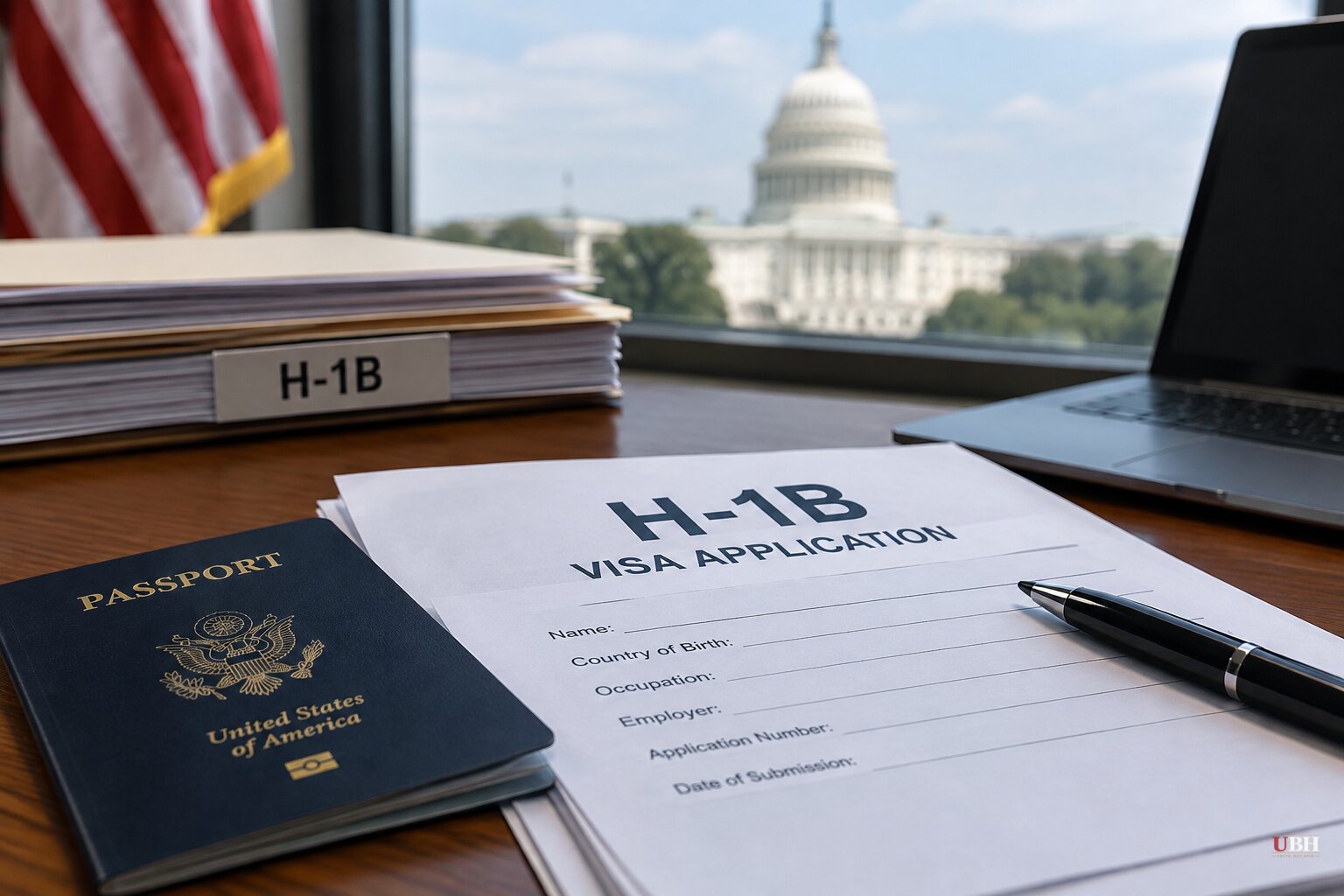
President Trump signed a presidential proclamation on Friday extending the $100,000 H-1B visa fee for another 12 months, pushing the policy through September 21, 2027, according to the White House. He also signed a separate executive order directing the Secretaries of State, Labor and Homeland Security to weigh an employer's recent or planned layoffs of American workers before approving H-1B applications, according to a White House fact sheet cited by Deccan Chronicle and ANI News.
A federal judge in Massachusetts already vacated the government's guidance implementing the fee back in June 2026, and the Trump administration is appealing that ruling, according to Hindustan Times and Outlook India. USCIS is barred from collecting the fee while the appeal is pending. Extending an already-blocked policy doesn't unblock it.
Mitch Wexler, senior counsel at the immigration law firm Fragomen, told the Times of India that USCIS "remains barred from collecting the $100K H-1B fee" under the original order. Since the new proclamation is framed as an extension, the same court order should apply. If USCIS tries to argue otherwise, Wexler says plaintiffs in the ongoing litigation will challenge it immediately.
Greg Siskind of Siskind Susser told the Times of India the new proclamation's language is nearly identical to the original, but it formally writes into the proclamation text something that had only been agency guidance before: the fee applies to people seeking admission from outside the U.S. through consulates or ports of entry. Siskind reads the proclamation's preamble, which references "cost-recovery for immigration program administration," as a signal the administration wants to lock in a permanent high fee through standard notice-and-comment rulemaking rather than relying on proclamations that keep getting struck down.
The Numbers Behind the Push
The White House says the original 2025 fee worked exactly as intended. "Since the 2025 Proclamation took effect, H-1B registrations filed by the largest IT outsourcing firms have been reduced by 92%," the administration's fact sheet states, as reported by Hindustan Times, Deccan Chronicle and ANI News. The White House also claims a nearly 97% drop in consular processing requests and a shift toward higher-skilled, higher-paid foreign workers.
Department of Homeland Security data reviewed by Bloomberg Law backs up the scale of the drop, if not necessarily the administration's framing of it. Lottery entries fell 85% to 100% at the firms most exposed to the fee. Infosys cut its entries by more than 8,100, a 91% drop from the prior year. Tata Consultancy Services cut entries by more than 5,600, a 95% drop. Cognizant Technology Solutions, which submitted 3,752 entries the year before, entered zero this year. IBM cut its entries by more than 2,700.
Indian nationals remain the single largest beneficiary group of the H-1B program, according to Outlook India, which is why the fee lands hardest on outsourcing-heavy firms and Indian tech professionals specifically.
The Layoffs Order and a Fraud Investigation Already Underway
The companion executive order directs agencies to consider whether an employer has recently laid off or plans to lay off "similarly situated" American workers before approving that employer's H-1B petitions. The fact sheet, quoted by Deccan Chronicle, alleges "many employers have laid off large numbers of highly qualified, highly skilled American workers, only to promptly hire large numbers of H-1B workers who are often lower-skilled and lower-paid." That's a serious accusation aimed at specific hiring practices, not a proven finding against any named company in these sources.
Separately, the Labor Department's inspector general has been investigating alleged fraud in the H-1B and permanent labor certification programs, and the department recently suspended Cognizant's PERM filings, a key green-card step, amid that investigation, according to a report tracked by nationalrevealed and corroborated by Bloomberg Law. No charges have been filed against Cognizant in connection with that suspension based on available reporting.
The Bigger Fee Still Coming
The administration has also proposed a separate $103,265 fee that would hit H-1B applicants currently exempt from the $100,000 charge, including recent U.S. college graduates and people applying for the roughly 85,000 capped visas from inside the country. DHS says the fee is meant to offset $8.7 billion in immigration-related costs identified across federal agencies, according to Bloomberg Law.
Michael Clemens, an economics professor at Johns Hopkins University, told Bloomberg Law that DHS's own data show H-1B petitions "will collapse" under the new fee, warning that "unless American firms respond radically differently to the new rule than the old one, that means that the taproot for global talent fueling the American innovation economy will be decimated." The Institute for Progress estimated the new fee could cut H-1B demand by 63% to 91%, potentially pushing applications below the annual cap for the first time in over a decade, according to Bloomberg Law.
DHS counters that it studied several smaller fee hikes between fiscal 2021 and 2025 and found H-1B demand "weakly inelastic," concluding the current drop is a short-term reaction to "an information shock that H-1B petitioners did not have time to absorb" rather than a lasting structural change.
The proclamation also sets a 30-day deadline for the Labor Secretary to begin reviewing previously submitted labor condition applications to determine whether further enforcement action against sponsoring employers is warranted, according to Outlook India. The $103,265 fee proposal remains in the public comment period, with the appeal over the original fee still pending in federal court. Neither dispute is resolved, and until the appellate court rules, the headline number attached to this policy, whether it's $100,000 or $103,265, remains legally unenforceable.
Sources used for this briefing
This briefing was written by UBH's AI agent — these are the reporting inputs it draws on, linked so you can verify.


