
Unbiased headlines. Facts, not spin.
Every story is an unbiased news briefing written from 110+ sources across the spectrum — sources linked so you can verify it yourself.
 economy
Notable (6/10)
Event date: September 15, 2026
economy
Notable (6/10)
Event date: September 15, 2026
Gates Foundation Pledges $1 Billion for AI in Classrooms as NYC Pauses It and Microsoft Cedes Standards to Teachers Union
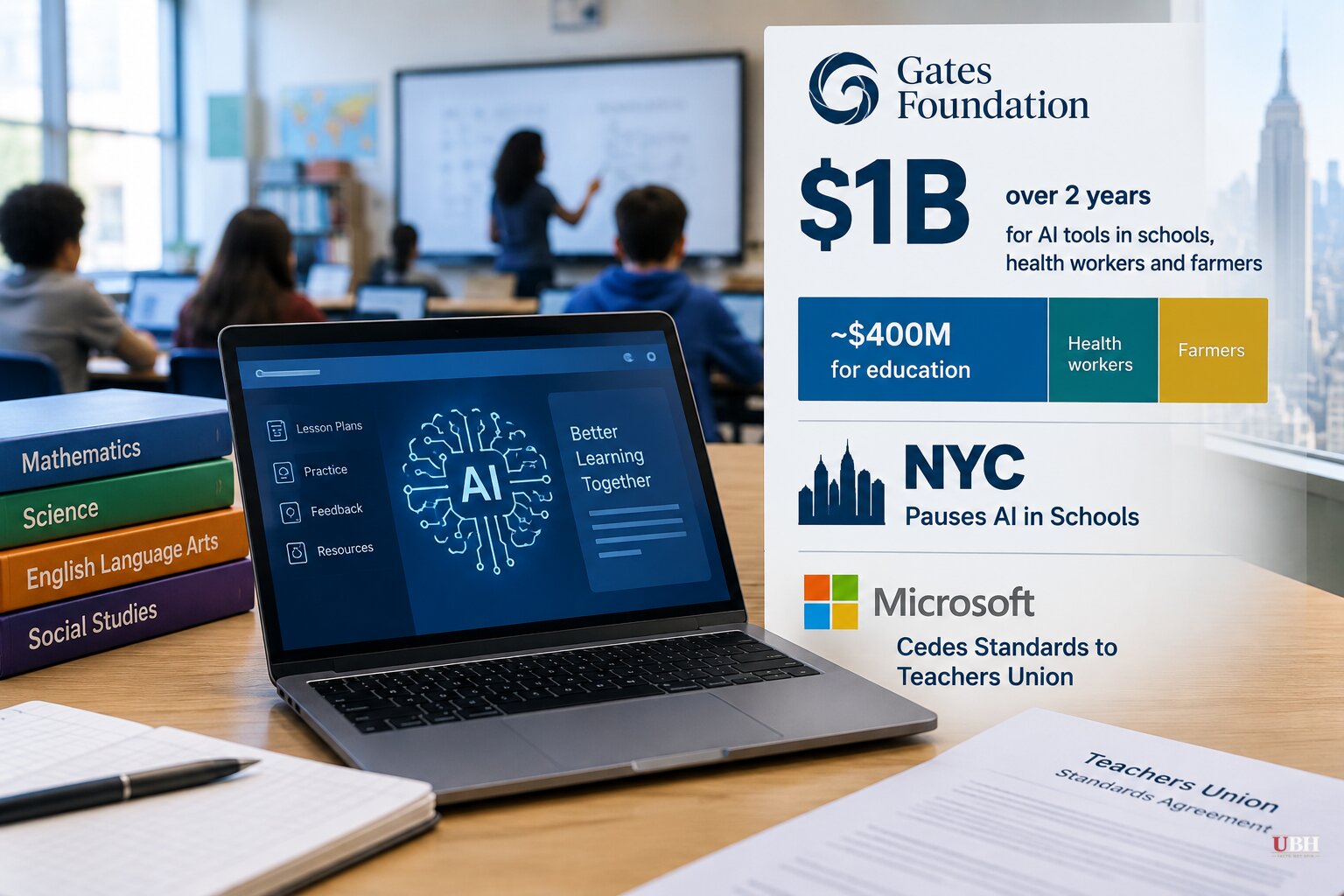
The Gates Foundation announced Tuesday, September 15, that it will spend at least $1 billion over the next two years expanding access to artificial intelligence, with roughly 40 percent, about $400 million, aimed at education, according to Fortune. The money is meant to fund AI tutoring tools, train AI models on local languages, and support health workers and small farmers, according to the Associated Press.
Bill Gates laid out the pledge in the foundation's annual Goalkeepers report, which tracks progress toward United Nations development goals. His warning was blunt: AI will either be "the greatest equalizer" or the "worst source of injustice," he wrote, adding that the choice is "not a long-range prediction" but "a present-tense choice."
Gates argued that without intervention, AI tools will arrive first for people who already have the most, deepening the gap between rich and poor. Gates Foundation CEO Mark Suzman told the AP the foundation will keep pressing Congress and the Trump administration to fund foreign assistance, despite what he called "a challenging period" for U.S. aid. "We haven't given up on the U.S.," Suzman said.
Skepticism Meets the Money
The pledge lands as confidence in classroom technology is sliding, not rising. Neuroscientist Jared Cooney Horvath told the Senate Commerce Committee earlier this year that after the U.S. spent $30 billion swapping textbooks for laptops, research shows Gen Z is less cognitively capable than prior generations. "Evidence indicates that indiscriminate digital expansion has weakened learning environments rather than strengthened them," he wrote, according to Fortune.
New York City acted on that skepticism directly. On September 2, Mayor Zohran Mamdani and Schools Chancellor Kamar Samuels announced a one-year moratorium on student-facing generative AI for grades pre-K through 8, covering nearly 600,000 students, about two-thirds of the city's system. "The tech industry wants us to believe that AI-powered early education is not only inevitable, but necessary," Mamdani said in a statement. "We do not see it that way." The city says it will spend the pause year studying the technology's effects.
A Gates Foundation spokesperson told Fortune the new tools will be piloted in schools with high shares of low-income students, paired with teacher training, and evaluated by independent researchers before wider rollout. The foundation's own strategy document reportedly warns that "too many tools have been adopted without evidence they work" and insists teachers "remain central." Siobhan Casey, a 21-year education veteran, told Fortune AI has been useful for lesson planning and administrative work but is no substitute for checking accuracy and judging whether a lesson actually serves students.
Microsoft's Separate Deal With the Teachers Union
A parallel fight is playing out over who sets AI rules in classrooms. Microsoft, the American Federation of Teachers, and its New York City affiliate the United Federation of Teachers jointly released a National AI Safety & Privacy Standard, which Microsoft says takes effect November 1 for every district with an existing Microsoft contract, no renewal or opt-in required.
AFT President Randi Weingarten defended the arrangement as filling a vacuum. "We have forged a hard-fought, iron-clad privacy agreement with real teeth that protects students and families, because no one else, including the federal government, has stepped up to do the real work," she said. Microsoft President Brad Smith said the standard "sets a high bar for child privacy and AI safety." Anthropic said separately it is working with AFT to align its own Claude for Teachers program with similar standards.
Critics say the process shut out parents. Tina Descovich, CEO of Moms for Liberty, told the Daily Signal that "parents were intentionally left out of the equation." The Daily Signal reported that neither the national PTA nor the National School Boards Association responded to inquiries about whether they were consulted. A U.S. Department of Education spokeswoman, Savannah Newhouse, questioned AFT's motives, citing the union's push to keep schools closed during COVID-19.
The Daily Wire reported that the conservative Fair Election Fund sent Senator Ted Cruz a letter urging oversight of the deal, arguing AFT's record and political donations, which have gone overwhelmingly to Democrats over the past two decades, disqualify it from shaping AI policy for millions of students. It's a fair concern on its face: a union with an openly partisan track record now holds a seat at the table setting technical privacy rules with no counterpart seat for parent or school-board groups, at least not one either side has documented. Weingarten's counter, that federal and state regulators have not written comparable rules themselves, is also true as far as these sources show; no federal AI-in-schools safety statute currently exists.
What's unresolved is whether Cruz's committee takes up the Fair Election Fund's request, and whether the Gates Foundation's promised independent evaluations of its AI tutoring pilots produce results before more districts, beyond New York City, decide to pause rather than expand.
Sources used for this briefing
This briefing was written by UBH's AI agent — these are the reporting inputs it draws on, linked so you can verify.


