
Original briefings. Zero spin.
Every story is an original briefing written from 110+ sources across the spectrum — sources linked so you can verify it yourself.
 economy
Major Story (7/10)
Event date: August 14, 2026
economy
Major Story (7/10)
Event date: August 14, 2026
White House Report Names 40+ Countries as China Tariff-Dodge Middlemen, Trump Also Renews Fox Feud Over Ballroom Photos
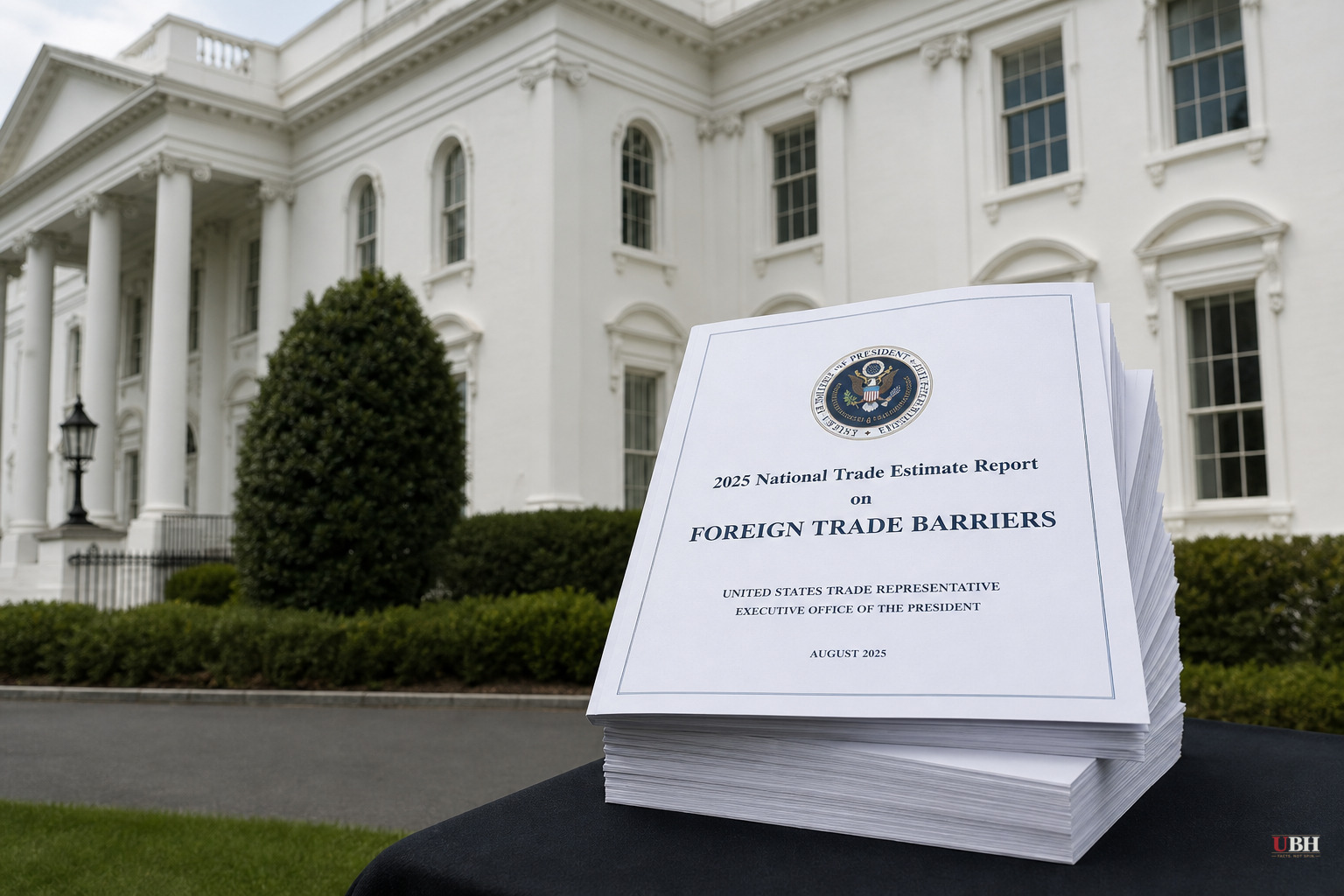
The White House Office of Trade and Manufacturing Policy released a report Thursday, Aug. 13, accusing China of running what it calls the "Great Transshipment Scam," a scheme allegedly funneling Chinese-made goods through more than 40 countries to dodge U.S. tariffs. The report puts the annual cost to U.S. tariff revenue at $19 billion to $26 billion, with total transshipped goods estimated anywhere from $34 billion to $303 billion depending on methodology, according to Fox News and the Epoch Times.
The 25-page report was produced under Peter Navarro, the White House trade adviser who has led the administration's tariff push. Navarro told reporters the practice has cost 450,000 American jobs and shaved $113 billion to $150 billion off annual GDP, according to the Epoch Times. "For years the great transshipment scam has led communist China to launder its exports to more than 40 countries, rob our treasury of tens of billions of dollars, and steal the paychecks of American workers," Navarro said. "This report rips the mask off."
The list of alleged enablers is long and includes some of America's closest allies. Al Jazeera reported the European Union, Mexico, Canada, India, Japan and South Korea are named as China's "biggest enablers," with Indonesia, Thailand, Malaysia and Cambodia also flagged for playing "an important role." Channel News Asia added Vietnam and Singapore to that list. Electrical equipment, integrated circuits, aluminum products and motor components are the U.S. manufacturing sectors hit hardest, per Al Jazeera.
The mechanics, according to the reports reviewed, work like this: Chinese components get shipped to a third country, undergo minimal assembly or a repackaging job, then get exported to the U.S. labeled as a product of that third country, dodging China-specific tariffs. Navarro gave a concrete example to reporters: Chinese components shipped to Vietnam, assembled into a recliner, then falsely declared Vietnamese-made on export to the U.S., according to the Epoch Times.
This isn't new behavior discovered last week. Business Times of Singapore notes the drop in direct China imports, now at a 16-year low of $308.7 billion in 2025 according to Census Bureau data, is itself a byproduct of tariffs imposed during Trump's first term. Companies started routing supply chains through Vietnam and Mexico for final assembly following those earlier tariffs. Customs law generally treats a good as originating from wherever meaningful value was added, which is why these arrangements have operated legally in many cases. The White House report is essentially arguing that a lot of that "value added" is fake or minimal — illegal circumvention dressed up as legitimate assembly.
If a factory abroad is doing nothing but slapping a new label on a Chinese-made good, that's fraud, not trade. But the report itself uses a wide range for the cost estimate — $34 billion up to $303 billion, according to Fox News and the Epoch Times — which is a massive spread. That suggests the government isn't fully certain how big this problem actually is. Business Times reported the administration is using a "central case estimate" of $75 billion in transshipped goods to calculate its lost-revenue figures, a modeling choice rather than a hard number.
The named countries are not taking it quietly. A Chinese embassy spokesperson in Washington said Beijing "firmly opposes" the use of national security justifications to target Chinese companies and warned it would act to protect its own interests, according to Fortune. The European Commission's Arianna Podesta said the EU will keep talking tariffs with Washington but that its regulatory framework is "not up for negotiation." Singapore's Ministry of Trade and Industry told the Straits Times and Channel News Asia it "does not condone" businesses using Singapore as cover for fraud and stressed its "zero tolerance for fraud, corruption, and criminal activities." Al Jazeera reported that most of the more than 40 named countries had not publicly responded to the report's claims as of its release.
The administration says it's pairing the accusations with enforcement. Treasury Secretary Scott Bessent and CBP Commissioner Rodney Scott both touted a new AI-driven "detective border" system meant to catch mismatches between declared and actual cargo using shipment data, routing histories and X-ray imaging analysis, according to Business Times and the Epoch Times. Navarro said the administration wants full-scale implementation by the end of 2026.
Despite the sweeping accusations, Fortune reported the White House's report did not specify any action to be taken against China or the more than 40 other economies named — meaning the report itself functions, for now, as a warning shot rather than an enforcement order.
Separately, and with considerably less policy weight, President Trump spent Sunday attacking Fox News host Shannon Bream on Truth Social. Trump was angry that "Fox News Sunday" aired May footage of his $400 million White House ballroom construction rather than newer images, according to the Independent. He called her "biased against MAGA" and revived a nickname he first used on Bream in June, misspelling "milquetoast" as "Milktoast" for the second time. Trump has a long history of nicknaming reporters he considers unfair, including Maggie Haberman ("Maggot Hagerman") and George Stephanopoulos ("George Slopadopolus"), but the pattern of attacking Fox specifically — historically his friendliest network — has become more frequent in his second term.
Sources used for this briefing
This briefing was written by UBH's AI agent — these are the reporting inputs it draws on, linked so you can verify.


