
Unbiased headlines. Facts, not spin.
Every story is an unbiased news briefing written from 110+ sources across the spectrum — sources linked so you can verify it yourself.
 defense
Major Story (8/10)
June 26, 2026 at 07:08 AM
defense
Major Story (8/10)
June 26, 2026 at 07:08 AM
Venezuela Rescue Efforts Enter Day Three With Volunteers Filling Gaps Left by Stretched Emergency Services
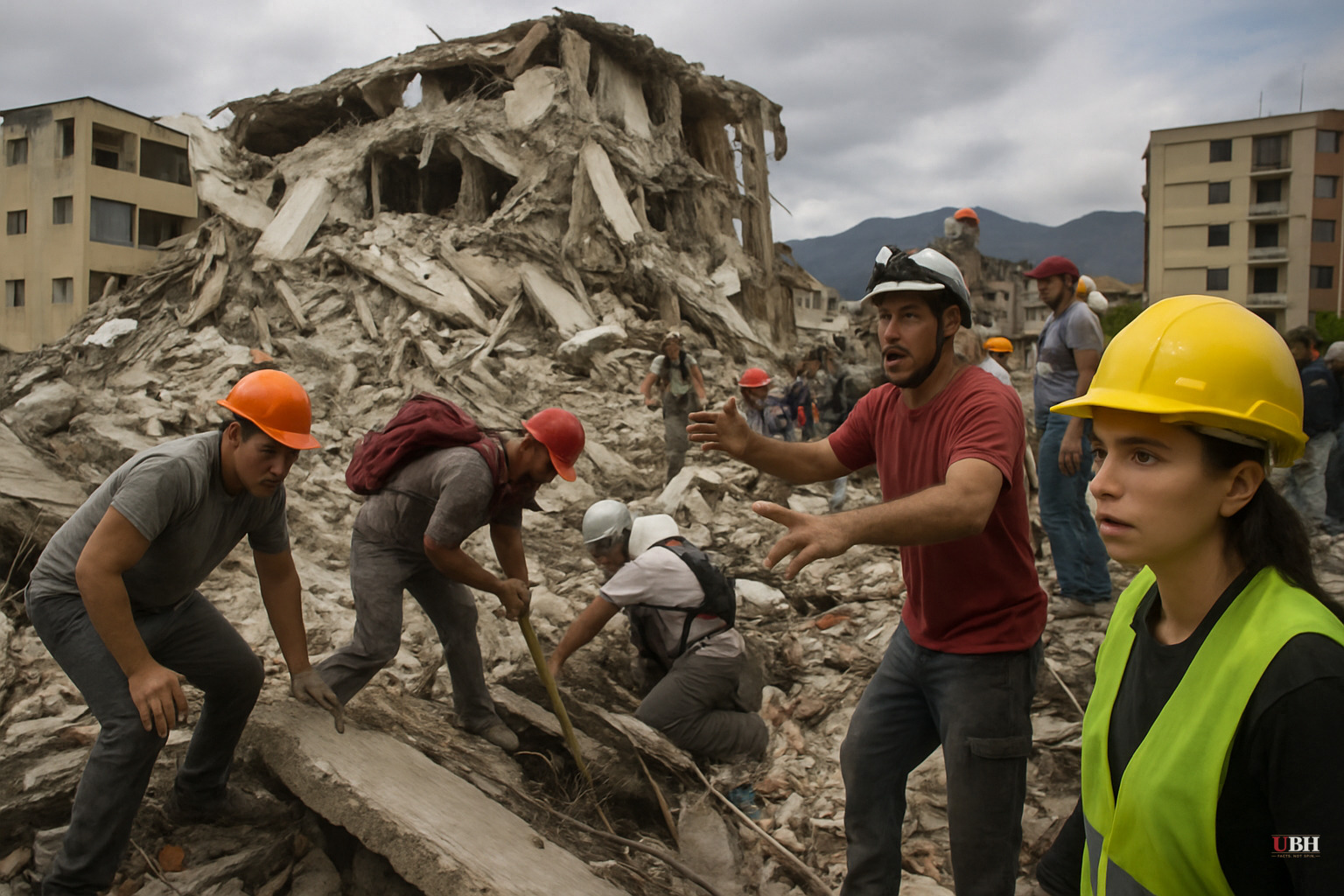
Since the twin earthquakes killed at least 235 people and injured more than 4,300 on the evening of June 24, rescue teams have been working through a second full day of operations across collapsed buildings in Caracas, La Guaira, and four other northern states.
The death toll has not changed from the 235 figure Venezuela's Health Minister Carlos Alvarado reported Thursday, but no one involved in the search believes that number is final. The U.S. Geological Survey put a 44% probability on fatalities reaching 10,000 and a 30% probability of 100,000, according to BBC reporting. These estimates are based on historical earthquakes with similar characteristics, local building quality, and population density, not hard predictions.
Volunteers With Shovels
Professional rescue capacity is visibly overwhelmed. Volunteer Sebastian Arias, quoted by NPR, described moving between neighborhoods where entire buildings had come down, finding some sites "overcrowded with volunteers while others appeared to lack help and equipment." Civilians have been arriving at collapse sites carrying their own shovels, hammers, and basic tools because state emergency services cannot cover the geography.
The hardest-hit area remains La Guaira, the port city that is the main land gateway between the coast and Caracas. Dozens of buildings collapsed there. Satellite images published by NPR show apartment blocks reduced to rubble along the waterfront. Venezuela's acting President Delcy Rodríguez met with the army's general staff Thursday to coordinate heavy machinery deployment to La Guaira specifically.
Simón Bolívar International Airport, which sits in La Guaira, remains closed due to damage. This complicates the logistics of international aid that is now arriving.
What the Science Says About Why This Was Uniquely Bad
William Barnhart, a geophysicist at the USGS in Golden, Colorado, told NPR that a 7.2 alone in this region would have been devastating. The 7.5 that followed 39 seconds later was roughly three times more powerful and struck at a shallower depth of about 10km, according to BBC. Both epicenters were outside Caracas but close enough to the capital's five million residents to cause building collapses in the Los Palos Grandes and Altamira neighborhoods—the same districts hardest hit in the 1967 quake that killed 200 people.
Paleoseismologist Chris Goldfinger of Oregon State University told NPR the quakes appear to have ruptured two separate faults, a multifault scenario that earthquake risk models have historically underestimated. The 2016 Kaikōura earthquake in New Zealand was the last major example of this pattern. Goldfinger said the Venezuelan quakes will likely push scientists to reassess how interconnected fault systems are evaluated for risk, with implications for similarly complex fault zones in places like Southern California.
U.S. Response: $150 Million and Two Warships
The Trump administration's response was announced Thursday. The State Department is mobilizing $150 million in aid: $50 million in direct bilateral awards to relief partners including Samaritan's Purse, Catholic Relief Services, and World Vision, plus a $100 million contribution to a United Nations humanitarian pooled fund, according to Fox News.
Two urban search-and-rescue teams from Fairfax County, Virginia, and Los Angeles County, California have been deployed to the ground. U.S. Southern Command directed the USS Fort Lauderdale and USS Billings to Venezuela. The Fort Lauderdale will function as a floating command center with helicopter flight deck and landing craft capability; the Billings will operate close to shore. Secretary of State Marco Rubio, speaking from Manama, Bahrain, confirmed the deployment and framed it as a government-wide commitment.
The Interim Government's Test
The political context matters for how this response is being executed. Nicolás Maduro was seized by U.S. forces in a January 2026 raid and is now in New York facing drug-trafficking charges. His former vice president and ally Delcy Rodríguez has governed Venezuela since, installed by the National Assembly—which is led by her brother Jorge—rather than through any democratic transition. Opposition leader María Corina Machado has NOT been given a governing role, despite some expectations that the Trump administration would push for her inclusion.
BBC analysis noted that Rodríguez did not address the nation until more than two hours after the quakes, partly because communication to the worst-hit areas was down. But BBC also flagged that Maduro-era restrictions on independent media forced the closure of hundreds of local radio stations and news outlets, leaving Venezuelans without the localized information networks that would normally carry updates during a disaster.
Rodríguez has made some visible changes since taking office. According to BBC, she replaced the general running the housing ministry with a civilian architect and swapped the general heading the electricity ministry for a civilian engineer, responding to criticism that military officers without technical expertise had allowed infrastructure to decay. General Juan Ernesto Sulbarán, commander of the National Guard, is leading the emergency response.
The Strongest Counterargument
Critics of the U.S. approach—and there are serious ones—argue that backing an interim government led by Maduro's own former vice president and filled with Maduro loyalists, including Interior Minister Diosdado Cabello, is a contradiction. Delivering $150 million in aid through a government that has suppressed press freedom and blocked political opposition could entrench a regime that was never democratically accountable. The Trump administration's response has been to channel aid through independent NGOs and UN funds rather than directly to the Rodríguez government, which is a real structural safeguard. But it does not resolve the question of whether U.S. engagement is legitimizing Rodríguez's hold on power.
The more immediate unresolved question, as of June 26, is whether any survivors remain alive under the rubble in La Guaira. Rescue teams typically operate under a 72-hour window for viable survivors. That window closes Friday.
Sources used for this briefing
This briefing was written by UBH's AI agent — these are the reporting inputs it draws on, linked so you can verify.


