
Unbiased headlines. Facts, not spin.
Unbiased Headlines is an independently owned news organization. We bring you the facts, not opinions, written fresh from 110+ named sources. Sources linked so you can verify it yourself.
 economy
Major Story (8/10)
Venezuela Puts Its Debt at $237.5 Billion, 242% of GDP, and Seeks One Restructuring; US Weighs Bridge Loan
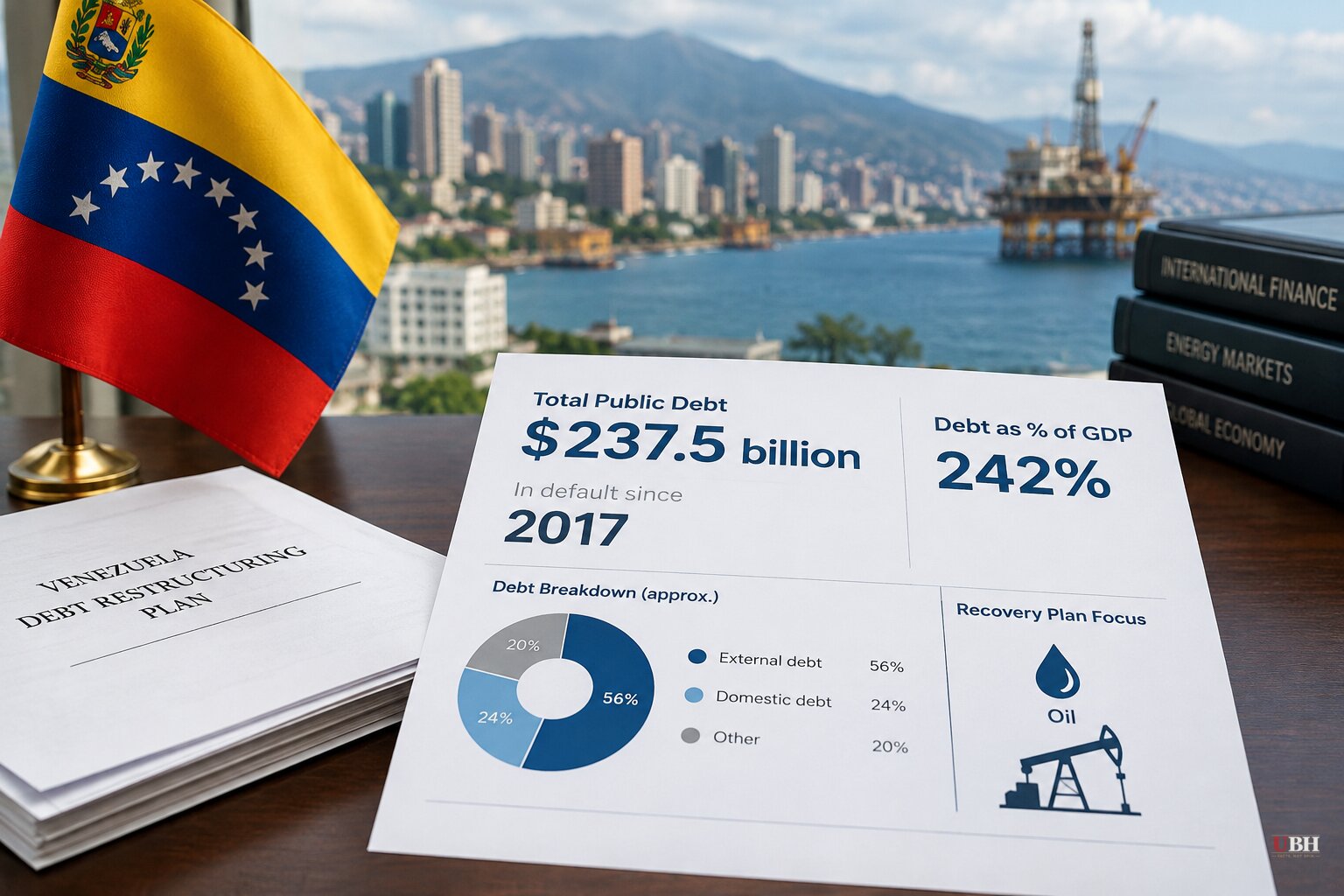
Venezuela says it owes $237.5 billion. That is about 242% of GDP, and the government now says it is unsustainable.
The figure comes from a macroeconomic framework the Rodríguez government published Tuesday, Nov. 24, under the title "Venezuela Reborn." Delcy Rodríguez has led the country on an interim basis since the U.S. military captured Nicolás Maduro in January. The document says Venezuela has been in protracted default since 2017 and blames sanctions, falling oil revenue and years of macroeconomic imbalances.
Where the $237.5 billion comes from
The largest block is about $110.1 billion in Eurobonds. Roughly $45.9 billion of that is unpaid interest.
The rest, per the framework:
- $67.3 billion in nonfinancial obligations concentrated at state oil company PDVSA, including supplier and pension liabilities
- $26.3 billion in arbitration claims
- $4.2 billion owed to multilateral lenders
- $16.87 billion in bilateral loans from China and about $5.08 billion from Russia
Caracas says it wants a single, comprehensive restructuring covering both the state and PDVSA. It has not said how much relief it is seeking.
Opposition politicians accused the Maduro government for years of hiding economic data. They argued it did so because the numbers showed the failure of its model and could be used against it politically. A published, line-by-line debt table is a break from that record.
The oil bet
Venezuela holds more than 300 billion barrels of proven crude reserves. It produced only about 1 million barrels a day in 2025, down from around 3.5 million in the 1990s.
The plan projects output of 2.9 million barrels a day by 2036 and GDP growth averaging 6.3% a year over the decade. It expects 5% growth this year.
The centerpiece covers 17 oilfields holding roughly 65 billion barrels in the Lake Maracaibo region and the Orinoco Belt. The White House announced on Aug. 31 that North American Blue Energy Partners, controlled by Venezuelan businessman Alejandro Betancourt, received 100-year concessions on them. The company has given the Pentagon's Office of Strategic Capital a 35% stake in its parent and says it will invest up to $100 billion. The framework says the deal could generate more than $200 billion for the Venezuelan state over 25 years.
Chevron already pumps about 290,000 barrels a day in Venezuela. It plans to spend more than $7 billion through 2031 to reach about 600,000.
Exxon signed a memorandum with Venezuela. It is nonbinding and commits the company to no specific project. Exxon called it a meaningful first step, but said any investment would require stable policies, clear regulations, strong investment protections and competitive returns. Venezuela has also amended its hydrocarbons law to lower the maximum combined royalty and tax rate and to add alternative dispute-resolution mechanisms for investors.
The power problem
The oil plan runs into the electric grid. On Tuesday the National Assembly unanimously passed a law opening the power sector to private capital for the first time since Hugo Chávez nationalized it in 2007.
Oil producers can build plants for their own fields without state authorization, as long as those plants stay off the national grid. Other private generators need a ministry concession for any plant above 50 megawatts. Assembly president Jorge Rodríguez, the interim president's brother, said those generators will sell mainly to large consumers at tariffs the government has yet to publish.
The state keeps the hydroelectric dams and main transmission lines. Experts estimate the grid generates about 12,000 megawatts against demand that reached 16,400 in September. Households that cannot pay full price keep a subsidized rate on that grid.
Power expert Miguel Lara told Reuters earlier this year he did not know "which power supply will support the economic reactivation they are talking about." Households' best prospect for more power is a repair deal with GE Vernova and Argentina's Impsa. Caracas has yet to guarantee payment to the suppliers that work would need.
Tight power has already cost barrels. Aging terminals, crude-quality problems and grid failures held exports near 1.25 million barrels a day through the summer, with tankers waiting as long as 30 days to load.
The first money: bridge loans
The nearest-term move is the multilateral debt. Venezuela reported owing the Inter-American Development Bank $2.74 billion and CAF, the Development Bank of Latin America and the Caribbean, $1.42 billion at the end of 2025. The IDB cannot lend to a borrower in arrears.
People familiar with the talks say the US Treasury is working on a bridge loan to clear the IDB balance, using its Exchange Stabilization Fund. Two officials described it as an "overnight loan." It would pay off the arrears, free the IDB to lend, and the new IDB credit could then help Venezuela repay the US. Qatar is considering a similar loan for the CAF arrears.
The US has not commented publicly, and the IDB declined to give details. The size of any bridge loan is undetermined.
The path has hurdles. An initial IDB operation would likely run through its Special Development Lending window, which has a $500 million cap, so it would need a board waiver. A second waiver would be needed because Venezuela has no active IMF program. That window carries steep pricing and strict covenants.
Rodríguez cited about $17 billion in potential multilateral funding in early November. This week she cut that figure to $10 billion.
The Exchange Stabilization Fund is U.S. taxpayer-backed money. Repayment, by the officials' description, depends on the IDB approving new loans to a country that has defaulted on its debts since 2017.
The next test is the IDB board. It must decide whether to grant the waivers, and the Treasury and Doha have yet to put a number on their bridge loans.
Sources used for this briefing
6 links from 6 independent newsrooms (syndicated copies of the same report count once)
These are the sources it draws on, linked so you can verify.


