
Unbiased headlines. Facts, not spin.
Unbiased Headlines is an independently owned news organization. We bring you the facts, not opinions, written fresh from 110+ named sources. Sources linked so you can verify it yourself.
 economy
Major Story (7/10)
France Is in Technical Recession After INSEE Revises Q3 GDP Down to a 0.2% Contraction
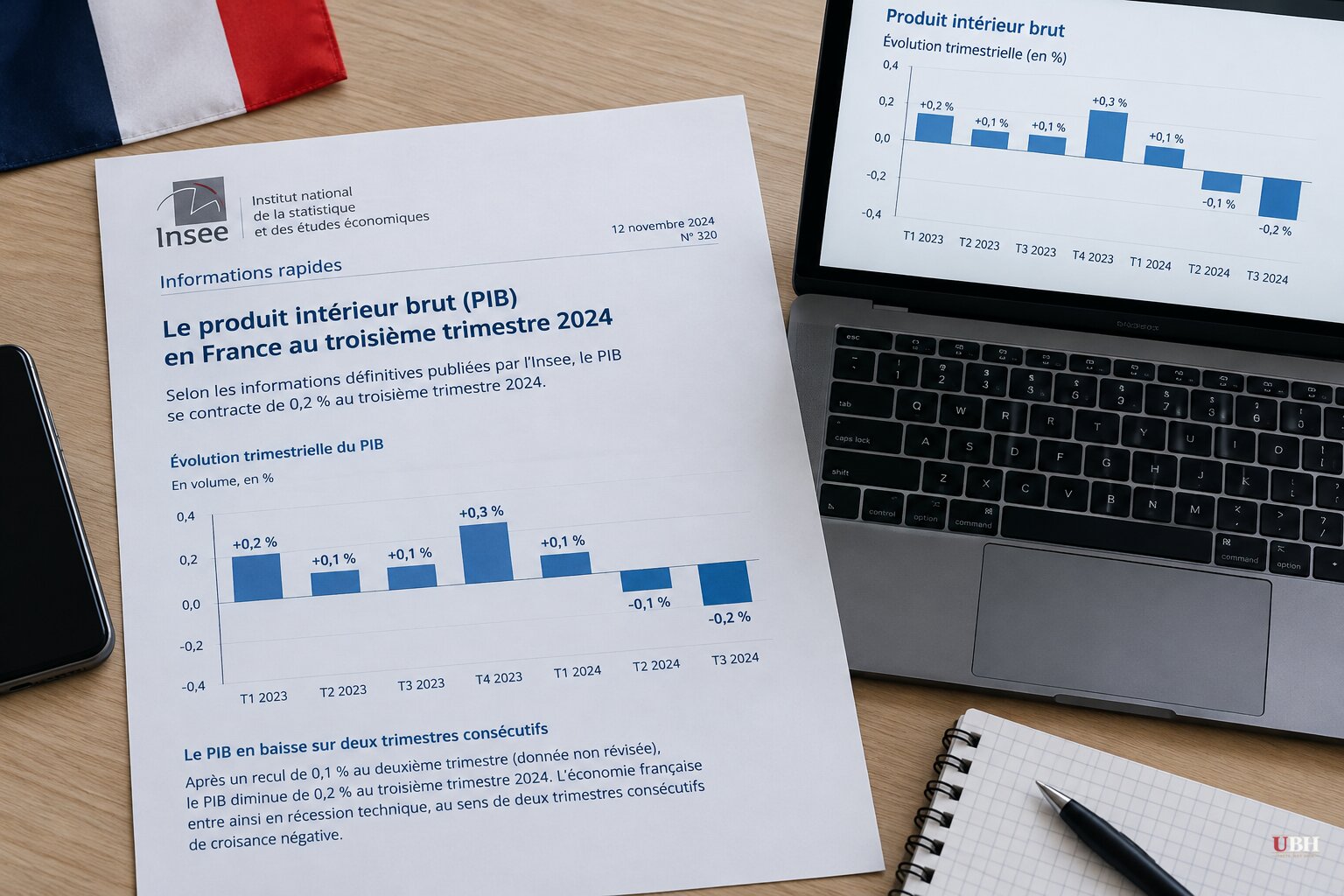
France's economy shrank 0.2% in the third quarter, according to final data INSEE published today, Nov. 27. The national statistics office had put the figure at a 0.1% decline in its Oct. 30 flash estimate.
The revision matters for a second reason. INSEE's unrounded numbers show GDP slipped 0.02% in the second quarter, a drop that rounds to 0.0% in the headline figure. Two straight quarters of contraction is the usual definition of a technical recession.
"We now have a very slight decline in GDP in the second quarter," said Marie Leclair, head of INSEE's national accounts department. "That doesn't really change the overall picture we are painting of the economy. But yes, we can say that we have a recession."
First-quarter GDP also fell 0.2%, so output has now shrunk three quarters running. GDP was €662.6 billion in the third quarter, down from €665.7 billion at the end of 2025. Compared with a year earlier, it is down 0.2%.
What dragged the economy down
Foreign trade was the main culprit. Exports fell 1.6% after rising 2.9% in the second quarter, while imports edged up 0.1%. Net trade subtracted 0.6 percentage points from growth.
Investment fell 0.9% after a 0.5% drop the previous quarter, with construction leading the decline. INSEE said the downward revision from the flash estimate reflected weaker construction investment and softer information and communication activity.
Household consumption rose 0.3%, a notch below the initial 0.4% estimate. Final domestic demand excluding inventories was flat and added nothing to growth.
Inventory rebuilding added 0.3 percentage points. Without that, ING economist Charlotte de Montpellier notes, the contraction would have been much deeper.
The 0.5% target is out of reach
The government has not changed its forecast of 0.5% growth for 2026. INSEE puts the growth already locked in for the year at just 0.1%. Leclair said hitting 0.5% would take 1.4% growth in the fourth quarter alone.
Official forecasters are well below that. INSEE had projected 0.4% for the year, the Bank of France now sees "around 0.3%," and ING has cut its 2026 forecast to 0.1%. The Bank of France said earlier this month that the economy should post "moderate" growth in the fourth quarter.
The government's defense comes from Finance Minister Roland Lescure. He blamed an energy shock, heatwaves and drought, and the electoral cycle. He said a return to normal energy output, an aerospace catch-up and a farm rebound in 2027 point to a recovery "in the coming quarters."
ING is less convinced. De Montpellier wrote that it is "very difficult to see domestic demand rebounding strongly enough" in the fourth quarter. Business and consumer confidence both deteriorated in October and November, she said, and a weakening labor market is keeping households cautious. Household spending on goods merely stagnated in October after a 0.9% decline in September. "This is not a recovery," she wrote.
A budget problem on top of a growth problem
Weaker output means weaker tax receipts at the moment Paris is trying to shrink its deficit. INSEE said the general government deficit rose to 5.6% of GDP in the third quarter from 5.3% in the second.
Public revenue rose just €1.0 billion in the quarter. Spending jumped €3.7 billion, driven by social benefits and a €1.2 billion rise in debt interest.
The government still forecasts a 2026 deficit of 5.4% of GDP, already raised from the 5% in the original budget. The High Council of Public Finances has said higher interest on inflation-linked bonds alone would push it to 5.5%.
The 2027 budget aims to bring the deficit to 5.0%. It rests on 1% growth next year, while ING forecasts 0.4%. The minority government is struggling to pass the budget through a deeply divided parliament, with a presidential election five months away.
"We must adopt a budget as soon as possible with a non-negotiable deficit target of 5%," Lescure said after the INSEE release. "It is imperative that we restore visibility for economic stakeholders."
One bit of relief: inflation slowed to 2.9% year on year in November. ING calls easing price pressure the only good news in the data.
INSEE will publish its first fourth-quarter GDP estimate on Jan. 29, 2027. That figure will show whether the 0.5% target was ever reachable or whether the 2027 budget is being built on a growth number the economy has not delivered.
Sources used for this briefing
6 links from 5 independent newsrooms (syndicated copies of the same report count once)
These are the sources it draws on, linked so you can verify.


