
Unbiased headlines. Facts, not spin.
Unbiased Headlines is an independently owned news organization. We bring you the facts, not opinions, written fresh from 110+ named sources. Sources linked so you can verify it yourself.
 economy
Major Story (7/10)
Taiwan Raises 2026 Growth Forecast to 13.28%, Fastest Pace Since 1978
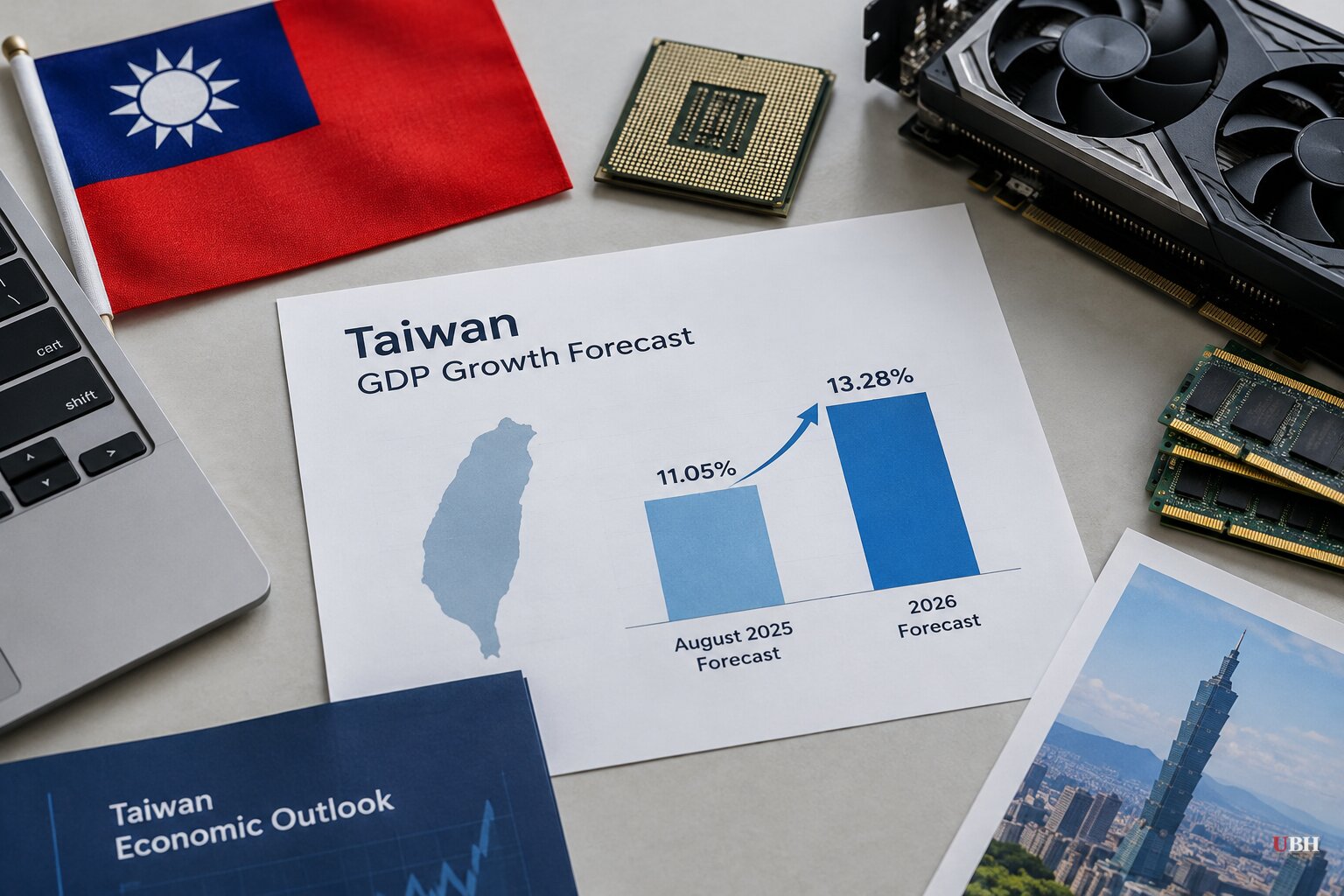
Taiwan's economy is on track for its strongest year in almost half a century. The Directorate General of Budget, Accounting and Statistics (DGBAS) said today, Nov. 27, that it now expects GDP to grow 13.28% in 2026.
That is up 2.23 percentage points from the agency's August forecast of 11.05%. If it holds, it would be the fastest growth since 1978, when the economy expanded 13.56%.
AI hardware is doing the heavy lifting
The driver is the global buildout of AI infrastructure. Taiwan is home to Taiwan Semiconductor Manufacturing Co., the world's largest contract chipmaker, which supplies chips for companies including Nvidia and Apple.
The quarterly numbers show the pace. Growth was 15.44% in the first quarter and 13.31% in the second. The third quarter came in at 14.39%, a hair above the preliminary 14.36%. DGBAS projects the fourth quarter at 10.42%, up 5.05 points from its previous estimate.
Trade accounts for most of it. Exports of goods and services are forecast to rise 23.96% in real terms this year. Merchandise exports are projected to hit a record $938.64 billion, up from about $640 billion last year, and to top $1.11 trillion in 2027. DGBAS put the dollar-value export gain for 2026 at 46.67%, versus its earlier 41.07%.
Private investment is forecast to climb 14.9%, up 3.32 points from the prior estimate, on AI infrastructure spending.
What it means per person
Nominal GDP this year is estimated at $1.0869 trillion. GDP per capita is projected at $46,767 in 2026 and $50,779 in 2027, which would be the first time Taiwan crosses the $50,000 mark.
DGBAS also raised its 2027 growth forecast to 6.51% from 6.04%.
Companies are posting better earnings and are increasingly willing to pay bonuses and raise wages, the agency said. Private consumption is forecast to grow 4.74%. That is 0.02 points lower than the previous estimate, which DGBAS attributed to recent volatility in the local stock market.
Consumer prices are projected to rise 2.07% this year and 1.96% next year. The 2026 figure sits just above the 2% threshold the central bank uses as its gauge.
The risks the government itself named
DGBAS did not hand out a clean bill of health. It listed possible tighter U.S. AI regulation, U.S. export controls, rising financing costs and uncertainty over U.S. tariff policy as threats to the outlook.
Tsai Yu-tai, who heads the agency's statistics operation, said DGBAS took a more conservative approach to export forecasts for the fourth quarter and next year. He pointed to uncertainty over the scope and timing of U.S. controls aimed at limiting China's access to advanced chips and to remote use of data centers, particularly in Southeast Asia.
The 2027 export growth forecast was trimmed slightly to 18.63% from 18.7%.
Economics Minister Kung Ming-hsin said on the 23rd that Taiwan's economic fundamentals are strong and that the order outlook through 2029 is bright.
Not everyone is that confident about the near term. Lu Cheng-tao, chief economist at President Capital Management, said current orders show no major problem. But he warned that purchasing momentum in the first half of next year "could very likely change," with a possible slowdown in demand from U.S. clients.
There is also a broader worry in markets about the scale of capital spending by major tech companies on AI and what it means for their earnings. Taiwan's export boom depends on those budgets staying large.
The 13.28% number is a forecast, not a final tally. The fourth quarter still has to be reported, and DGBAS has now revised its full-year estimate sharply upward, from 11.05% in August to 13.28%.
The open question for 2027 is whether Washington's export rules and U.S. customers' orders leave the 6.51% growth forecast and the $1.11 trillion export projection intact. Lu's first-half warning puts the test early in the year.
Sources used for this briefing
7 links from 7 independent newsrooms (syndicated copies of the same report count once)
These are the sources it draws on, linked so you can verify.


