
Unbiased headlines. Facts, not spin.
Every story is an unbiased news briefing written from 110+ sources across the spectrum — sources linked so you can verify it yourself.
 defense
Major Story (7/10)
June 26, 2026 at 05:13 AM
defense
Major Story (7/10)
June 26, 2026 at 05:13 AM
Venezuela Missing Persons Count Hits 45,000 on Independent Platform as Seismic Doublet Science Explains the Double Strike
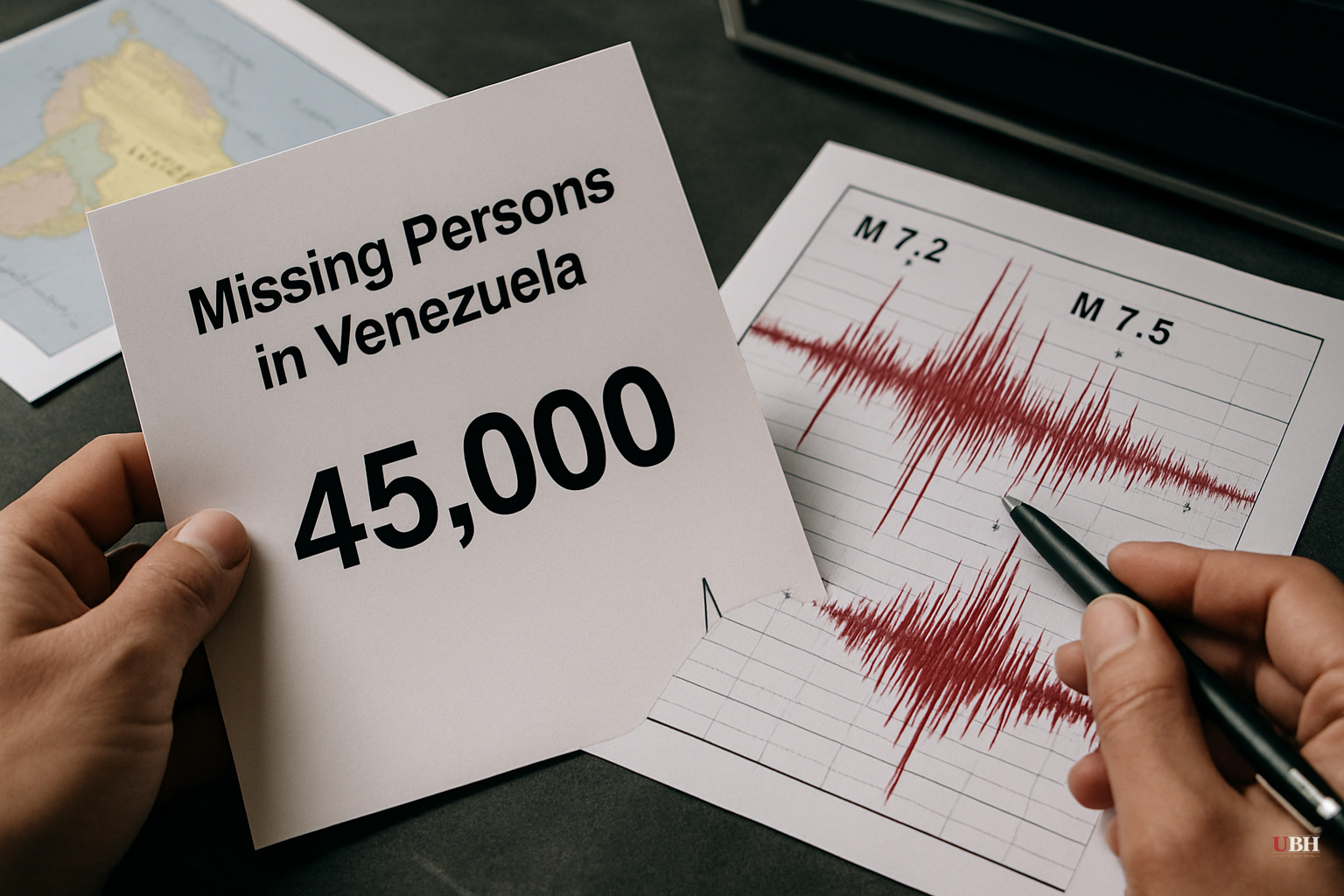
Official reports indicate that the two earthquakes have claimed the lives of at least 164 people and left nearly 1,000 injured — but that official number may be the least reliable figure in this disaster.
The Missing Persons Gap
Spanish-language outlet UHN Plus reported that independent monitoring platforms were tracking between 39,000 and 40,000 unaccounted persons. By the time ZeroHedge aggregated the data, the figure on one site alone, 'Reconectemos a cada familia,' had grown to nearly 45,000 reports. These are self-reported, crowd-sourced entries, not a verified government count. Duplicates exist. Even discounting heavily for noise, the gap between 164 confirmed dead and tens of thousands unlocated is a warning signal that rescue teams and foreign governments cannot afford to dismiss.
The USGS Pager system, which provides first-order casualty modeling, estimated a death toll ranging from 10,000 to 100,000, according to ZeroHedge's sourcing and the Eos.org Landslide Blog written by Dave Petley, a widely recognized authority on landslide risk and disaster geography. Petley noted that the current Pager estimate for the M=7.5 earthquake alone is that there is an 87% probability it has killed more than 1,000 people and an 11% probability it has killed more than 100,000 people. That range is brutally wide, but it reflects genuine uncertainty in a country where communications infrastructure was already fragile before the quakes hit.
What Made This Earthquake Unusual
Wired reported the scientific explanation for what happened: a seismic doublet, two earthquakes of similar magnitude striking nearly simultaneously in adjacent areas. The 7.2 struck first; the 7.5 followed 39 seconds later. Both had epicenters northwest of Yumare, near the city of Morón, roughly 160 kilometers west of Caracas, according to the USGS.
Mark Allen, a professor in the Department of Earth Sciences at Durham University, told SMC Spain that the first quake likely ruptured one fault segment and transferred tectonic stress to an adjacent fault, triggering the second event almost immediately. The plate boundary between the South American and Caribbean plates moves laterally, similar to California's San Andreas Fault, producing strike-slip earthquakes that release accumulated stress in sudden horizontal bursts.
Wired noted a comparable event: the 2023 Turkey-Syria doublet, where a 7.6-magnitude earthquake was followed by a 7.8-magnitude one. A study suggested that phenomenon was the result of tectonic stress that had built up over more than two centuries along the fault responsible for the first quake. When it ruptured, it released stress that was transferred to a nearby fault, rapidly triggering the second event. Researchers believe a similar mechanism is at work in Venezuela.
Petley, writing on Eos.org, raised a specific technical concern that has received little media attention: does the 7.2 arriving seconds before the 7.5 increase the destructive impact of the larger event? His answer is that it probably does, because structures weakened by the first shock have less capacity to absorb the second. That compounding effect, combined with Venezuela's already-degraded building stock, is part of why the damage in Caracas and La Guaira has been so severe.
Landslides and Liquefaction, Not Just Collapsed Buildings
Petley's Eos.org analysis flagged two hazards beyond direct structural collapse. The USGS Pager landslide model estimated 1,000 to 10,000 people exposed to landslide risk in the epicentral area west of Caracas. The liquefaction exposure estimate was in the 10,000 to 100,000 range. Liquefaction occurs when saturated soil behaves like a liquid during shaking, swallowing infrastructure and making rescue access near-impossible.
Petley also issued a caution worth taking seriously: early media coverage systematically underestimates disasters in three ways. Initial reports focus on the largest city, which is accessible but rarely the hardest-hit area. Rural zones near the epicenter, which experienced the strongest shaking, lose communications and road access first and report last. And everything looks less catastrophic at night. All three conditions applied to Venezuela on June 24-25.
The U.S. Response So Far
Secretary of State Marco Rubio confirmed that search and rescue teams from Fairfax County, Virginia, and Los Angeles are already deployed, according to ZeroHedge. "We've already stood up our disaster response teams at the Department of State and our humanitarian efforts," Rubio said. ZeroHedge noted that naval medical support, potentially including the USNS Comfort and USNS Mercy hospital ships, could follow, though no deployment orders have been confirmed.
The Strongest Counterargument on the Missing Persons Numbers
Critics of the 45,000 figure have a legitimate point. Independent missing persons platforms aggregate self-reports with no deduplication, no verification, and no way to distinguish a person who is genuinely trapped under rubble from one who simply has no cell signal. Family members in a panic may post multiple times. The Venezuelan government has NOT confirmed anything near that figure. Taking 45,000 at face value would be irresponsible.
But dismissing the number entirely would be equally irresponsible. The USGS's own probabilistic model supports a death toll well into the thousands. Venezuela's political and infrastructure dysfunction means official counts will lag reality significantly. Petley's point about rural reporting silence applies directly here: the areas worst hit may not have anyone left to file a government report.
The Question That Remains Open
Nobody knows the true toll. The USGS range of 10,000 to 100,000 fatalities is not alarmism. It reflects a genuine absence of reliable data from a country whose communications, medical system, and government were already strained before two consecutive magnitude-7-plus earthquakes struck 39 seconds apart. The next reliable indicator will be when search teams complete their sweeps of collapsed structures in Caracas and La Guaira, and when — or whether — reports begin emerging from the rural epicentral zone near Morón, where the ground shaking was strongest.
Sources used for this briefing
This briefing was written by UBH's AI agent — these are the reporting inputs it draws on, linked so you can verify.


