
Original briefings. Zero spin.
Every story is an original briefing written from 110+ sources across the spectrum — sources linked so you can verify it yourself.
 energy
Notable (5/10)
Event date: August 22, 2026
energy
Notable (5/10)
Event date: August 22, 2026
Vatican to Build $117 Million Solar Farm on Rome's Outskirts, Sources Say
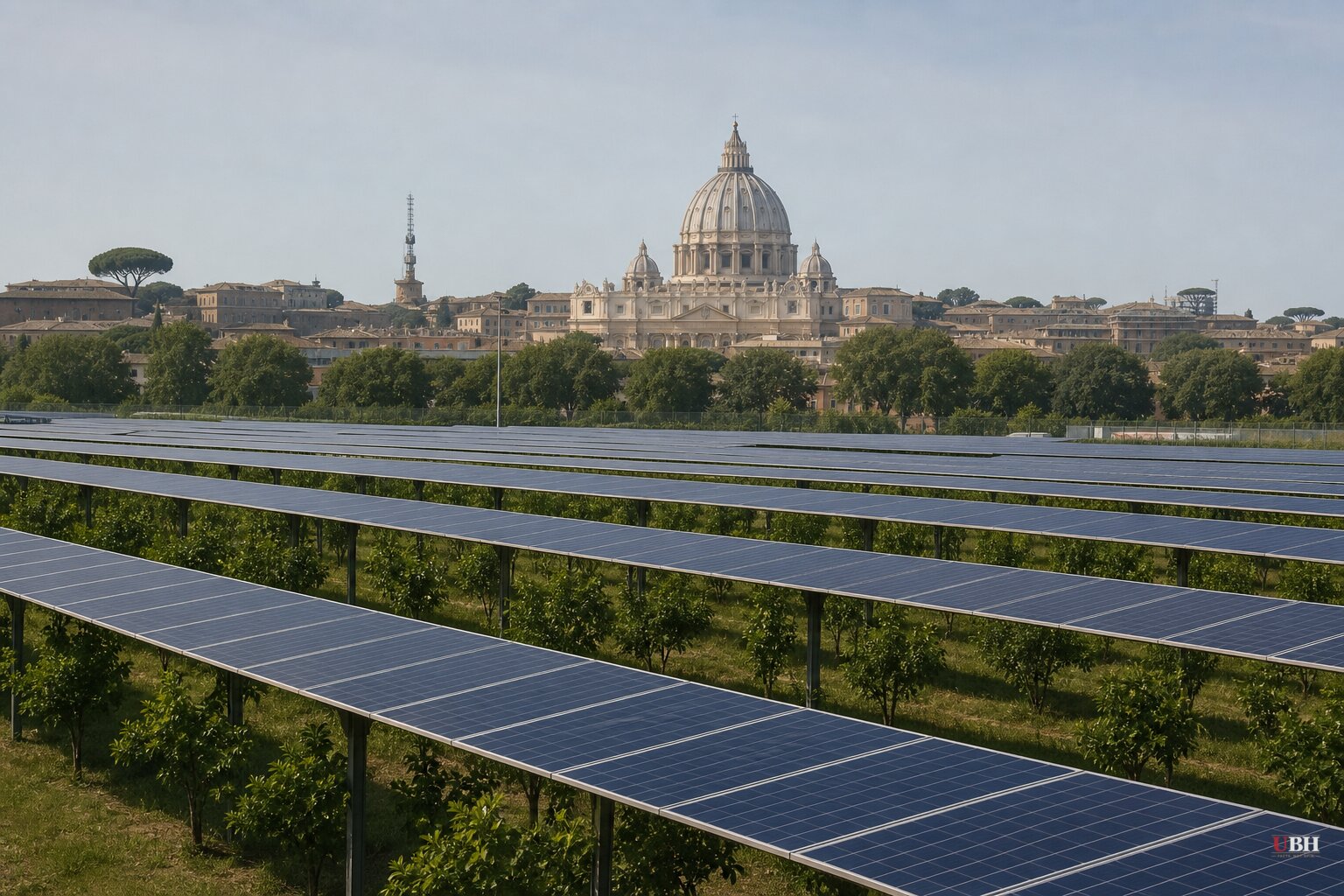
The Vatican is moving ahead with a roughly €100 million ($117 million) renewable energy plant that sources involved in the discussions say could make Vatican City State fully energy self-sufficient within two years, according to Reuters.
The project is an agrivoltaic plant, meaning solar panels get mounted several meters above ground so crops can still grow underneath. Reuters reports the shade also cuts down on evaporation and protects plants from extreme weather. The panels alone would cover about 200 hectares, according to one of the sources, nearly half of the roughly 450-hectare Santa Maria di Galeria estate on Rome's northwestern outskirts.
The capacity is expected to run 80 to 90 megawatts, which Reuters says would make it one of the largest agrivoltaic installations in Italy. Vatican Radio has run transmission facilities on that same estate since the 1950s.
A joint Italian-Vatican commission met earlier this month to formally launch the project. That meeting was possible because Italy ratified a 2025 bilateral agreement this year authorizing development of the site. No officials disclosed specifics on cost, capacity, or timeline after that meeting, per Reuters. The numbers in circulation come from sources familiar with the discussions, not an official Vatican announcement. The Vatican did not respond to Reuters' request for comment.
Construction, including permitting and administrative approval, is expected to take 18 to 24 months, sources told Reuters. Contracts for the work will go out to tender in the coming weeks.
Where the power goes, and who pays for what
The electricity is meant to run Vatican Radio's transmission station and push the tiny city-state, all 108 acres and fewer than 900 residents of it, toward full energy independence. Sources told Reuters the power could also serve other Holy See-linked properties, including Rome's Bambino Gesù children's hospital.
The Vatican will not receive the financial incentives Italian households and businesses get for installing solar. Any surplus electricity the plant generates gets sold into the Italian grid, not handed over for free.
In exchange, Italy's ratification agreement extends to the new plant the same special legal status already granted to Vatican Radio's facilities, including exemptions from Italian taxes and public charges. Italy's ratification law explicitly states the deal cannot create any new or additional burden on public finances. That's a real constraint worth watching if the project runs into cost overruns or delays, since it means Italian taxpayers aren't supposed to backstop it.
The politics behind the panels
Reuters notes the project was a priority of the late Pope Francis, described as the first pontiff to formally accept the scientific consensus on climate change, and that Pope Leo XIV has endorsed continuing it. This isn't the Vatican's first foray into solar. Under Pope Benedict XVI in 2008, German companies SolarWorld and SMA Solar Technology donated 2,400 photovoltaic panels installed on the roof of Nervi Hall, where papal audiences and concerts are held.
Breitbart's Thomas D. Williams reported in 2022 that the Holy See, in a statement read at an OSCE conference in Jordan, urged nations facing an energy crisis driven by Russia's invasion of Ukraine not to fall back on fossil fuels, warning that climate change posed a threat to "the security and stability" of the Mediterranean region. That statement drew criticism, including from Williams himself, for asking ordinary families facing high heating bills to forgo cheap oil and gas without offering a concrete alternative. This new agrivoltaic project is arguably the Vatican's own answer to that criticism. Rather than just lecturing others on fossil fuels, it's spending its own money, or rather money raised through a project structured to avoid new costs to Italian taxpayers, to build actual generating capacity.
Whether that lands as genuine follow-through or as a small, symbolic gesture from an institution with 900 residents is a fair question. An 80-to-90-megawatt plant is a serious industrial project by Italian standards, one of the country's largest agrivoltaic installations. But it's also a project built on land the Vatican already owns, under a legal framework that guarantees it won't cost the Italian state anything extra, for an institution whose own electricity footprint is tiny.
The unresolved questions are practical. Reuters' sources gave a cost estimate and a timeline but the Vatican itself has not confirmed either figure publicly. Contracts haven't been awarded yet. Nothing has broken ground. Whether the 18-to-24-month build estimate holds once tenders go out in the coming weeks, and whether the promised surplus power actually flows into the Italian grid as planned, are things nobody can confirm until the tender process plays out.
Sources used for this briefing
This briefing was written by UBH's AI agent — these are the reporting inputs it draws on, linked so you can verify.


