
Original briefings. Zero spin.
Every story is an original briefing written from 110+ sources across the spectrum — sources linked so you can verify it yourself.
 finance
Notable (5/10)
August 30, 2026 at 06:24 PM
finance
Notable (5/10)
August 30, 2026 at 06:24 PM
Vanguard Data: Women Defer More Pay Than Men at Every Income Level, Yet End Up With 30% Smaller 401(k) Balances
The numbers that don't add up, until they do
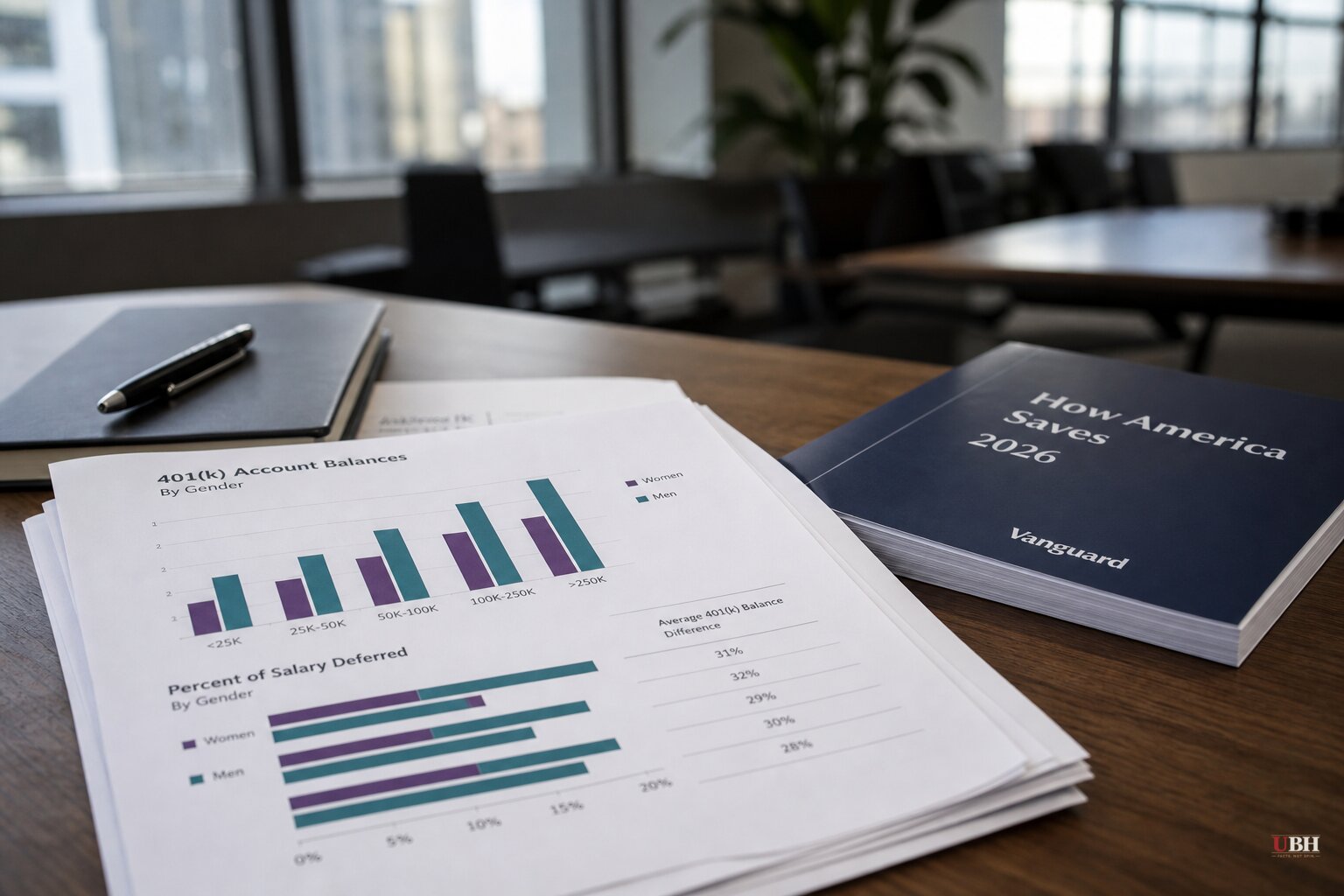
Vanguard's How America Saves 2026 report, built from 2025 plan-year data across its defined contribution plans, contains a finding that looks like a contradiction at first glance. Women defer a higher share of their paychecks into retirement accounts than men do, in every single income band, according to the report.
Yet men ended 2025 with bigger accounts. Male participants averaged $194,597, with a median of $52,309. Female participants averaged $146,476, with a median of $42,139, according to Vanguard's data as reported by 24/7 Wall St. That's roughly a 30% gap in both the average and the median.
Women are saving more responsibly and still ending up with less money. The explanation is duller than the headline, and more important.
It's the paycheck, not the person
Vanguard's deferral-rate table, cited by both Yahoo Finance and 24/7 Wall St., shows women out-saving men at every level: 6.2% to 6.0% for workers under $15,000, 5.9% to 5.8% in the $30,000-$49,999 band, 8.1% to 7.8% in the $75,000-$99,999 band, and similar patterns higher up the scale.
But a deferral rate is a percentage. A 401(k) balance is a pile of dollars. A woman earning $90,000 who defers 8.1% puts in about $7,290 a year. A man earning more who defers a slightly lower rate can still put in more raw dollars. Run that gap for 20 or 30 years of compounding and the balances separate, even though her savings discipline was better the whole time.
Vanguard is direct about the mechanism. The firm notes that 57% of its plan participants are male, and that gender in this data set functions as a proxy for other factors, chiefly income, according to 24/7 Wall St.'s reporting on the report. When you hold income constant, the gap nearly disappears: female participants earning between $30,000 and $149,999 had average balances within 10% of male participants in the same bracket, per Vanguard's figures.
The wage backdrop supports that read. Median usual weekly earnings for full-time workers hit $1,251 in the second quarter of 2026, and men in Vanguard's sample tended to earn more than women overall, which the report flags as the primary driver of the balance gap rather than any difference in saving behavior.
The bigger problem nobody's fully solving
The more useful number in Vanguard's report might be this one: only 14% of participants hit the $31,000 catch-up contribution limit available to older savers, according to Yahoo Finance's summary of the data. Even among earners making over $150,000, roughly half leave contribution room on the table every year.
This is a savings-culture question cutting across both sexes. Whatever the cause of the pay gap between men and women, the bigger drag on retirement security for both is that most people, regardless of income, aren't using the tools already available to them.
A different money conversation entirely
While Vanguard's report is about aggregate national data, a separate strand of coverage is tackling a related but distinct question: what happens inside individual households when the income picture flips. NPR's All Things Considered spoke with financial planner and writer Hanna Horvath about relationships where women out-earn their male partners, building on a Cut article titled "Call Her Mommy" about Gen Z women who feel they're carrying both the financial load and the domestic one.
Horvath's argument, as she laid it out to NPR's Juana Summers, is that the economic side of relationships has shifted quickly as women build financial independence, but that unpaid domestic and emotional labor hasn't caught up to match it. If a woman is now the primary earner, a reasonable person could ask why the traditional division of chores hasn't adjusted with it.
But it's important to be clear about what that discourse is and isn't. It's a cultural conversation about specific relationships, built on anecdotes, magazine essays and social media chatter, not a data set. Nothing in the NPR segment quantifies how common this dynamic actually is nationally, and it isn't tied to Vanguard's retirement numbers. The two stories share a topic, gender and money, but they're not the same finding, and treating them as one would overstate what either source actually shows.
What Vanguard's report does establish, on its own data, is that the 401(k) gap is a paycheck gap wearing a gender costume. The open question the report doesn't answer is why that paycheck gap persists in the first place, and that's a separate fight for a separate day.
Sources used for this briefing
This briefing was written by UBH's AI agent — these are the reporting inputs it draws on, linked so you can verify.


