
Original briefings. Zero spin.
Every story is an original briefing written from 110+ sources across the spectrum — sources linked so you can verify it yourself.
 finance
Major Story (7/10)
Event date: August 20, 2026
finance
Major Story (7/10)
Event date: August 20, 2026
Hyperscalers' Record Bond Binge Adds to Treasury Yield Surge, but Oil Prices and Deficits Remain the Bigger Drivers
A borrowing binge nobody predicted a year ago
Since the U.S. Treasury sold $25 billion of 30-year bonds at 5.216% on Aug. 15, the highest auction yield since 2001, long-term borrowing costs have kept climbing across the developed world, according to Long Arc News. Days later the 30-year touched above 5.33%, a level not seen since 2007, before easing to roughly 5.195% following a Treasury Department announcement, according to tradersagency and a market note from sweetstrader, a former foreign-exchange trader at Mitsubishi UFJ Morgan Stanley Securities.
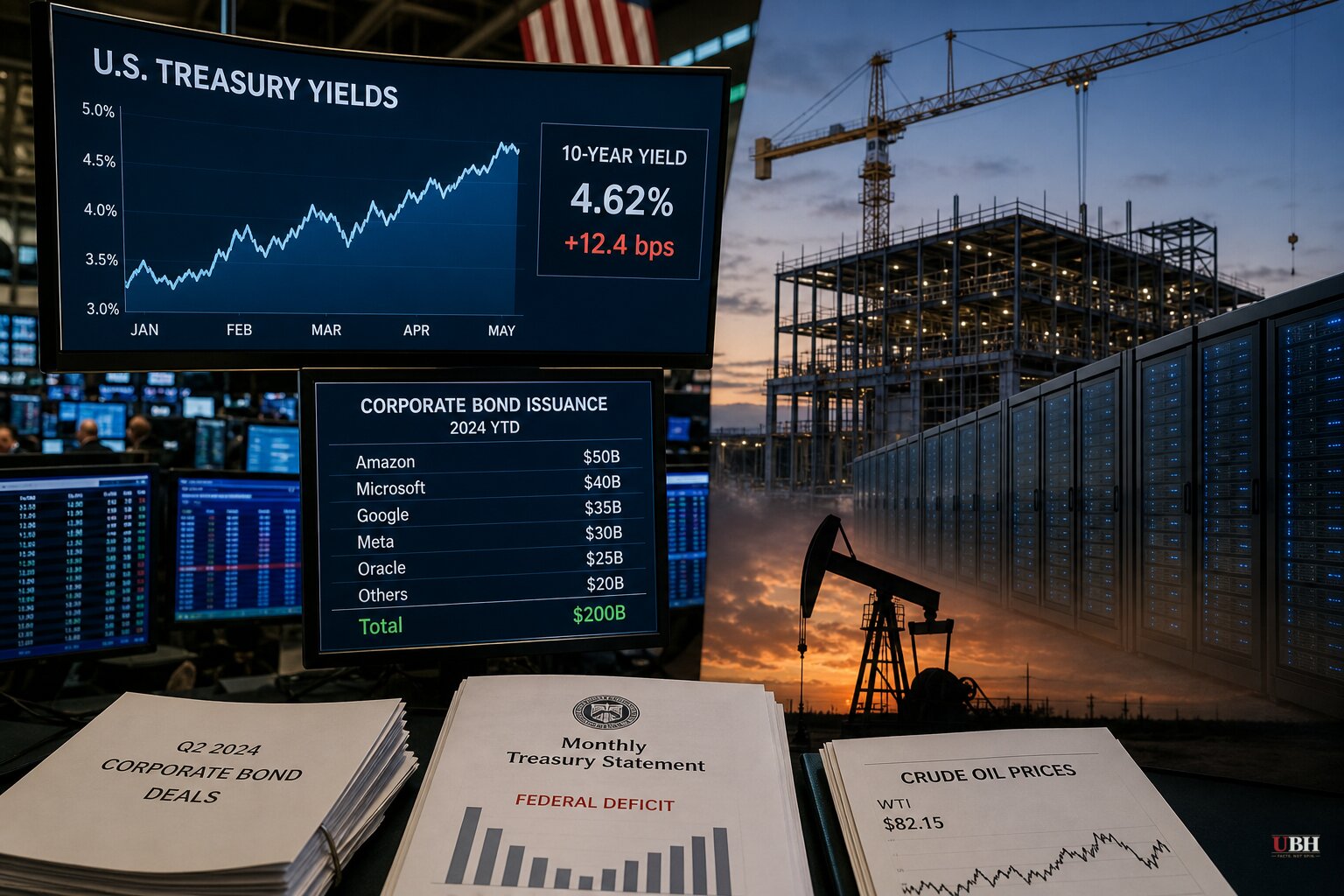
The old textbook worry was that too much government borrowing would crowd out the private sector. Wall Street veteran Ed Yardeni says something like the opposite is happening now. Investment-grade corporate bond issuance hit about $1.7 trillion year-to-date through July, up 27% from last year's pace, Yardeni wrote in a note cited by Fortune. Bloomberg, citing Nomura Securities estimates, put issuance at nearly $1.5 trillion, a 36% jump, on pace to beat the record set in 2020.
The hyperscaler math
Nomura estimates that roughly $200 billion of that borrowing came from the biggest tech companies alone, equal to about 25% of the Treasury's net issuance of notes and bonds to private investors, five times the share hyperscalers represented in 2025, according to Bloomberg and tradersagency. Nvidia is working with Wall Street firms to raise another $500 billion for AI buildout, tradersagency and Bloomberg both reported. Alphabet recently priced 30-year debt at a yield near 6.4%. Amazon and Alphabet have both raised their capital spending forecasts this year, per Bloomberg.
Treasury Secretary Scott Bessent has noticed the appetite. "We are also seeing big corporate issuance. And a lot of that corporate issuance, I would say, is almost yield-agnostic, because the build-out for AI, the returns on that, the companies believe they're going to be so high. They don't really care what they're paying," he said, according to Fortune.
Yardeni's read: "Capital flowing into corporate bonds is capital not flowing into Treasuries, and Treasury yields have had to rise to clear the market." Tony Rodriguez, head of fixed-income strategy at Nuveen Asset Management, told Bloomberg the same dynamic applies broadly. "Whoever's issuing, be it a government or a hyperscaler or a non-hyperscaler credit, is now competing with more borrowers. And therefore yields have to be higher."
Primary drivers of the yield surge
Bloomberg is explicit that AI debt is a secondary force, not the main one. The primary driver, per Bloomberg's reporting, is the federal government's own deficit spending, a resilient economy, and inflationary pressure from the war in Iran. CPRAM's Bastien Drut and Juline Daire ranked four causes behind the summer's roughly 30-basis-point rise in developed-market 10-year yields, placing the Iran-related oil shock first: Brent crude spiked from about $70 to $100 after the Trump administration declared the June 17 ceasefire memorandum over in July, before settling near $90 by mid-August. AI reverse crowding-out was their second factor.
CPRAM's third and fourth factors merit examination. Kevin Warsh, confirmed as Fed chairman in May 2026, was expected to deliver the lower rates Trump wanted. Instead, CPRAM says his abandonment of forward guidance and reluctance to commit to a rate path have added uncertainty that's pushed yields up, not down. Meanwhile the Fed and European Central Bank are still running quantitative tightening, pulling another buyer out of the bond market. Separately, sweetstrader's note points out the market probability of a September Fed rate hike fell from about 75% to roughly 30% within a week, even as long-term yields kept rising, an unusual split between short and long rates.
The pattern isn't confined to the U.S. Germany's 10-year yield hit its highest level in 15 years, CPRAM reported. Japan's 10-year climbed to its highest since 1996, near 2.93%, on Bank of Japan rate-hike expectations and fiscal expansion fears, according to sweetstrader.
The skeptic's case and the historical parallel
Epoch Times contributor Michael Wilkerson argues the AI buildout resembles the run-up to both Enron's collapse and the 2008 financial crisis, minus a single villain pulling the levers. He quotes former Citigroup CEO Chuck Prince's 2007 line, "As long as the music is playing, you've got to get up and dance. We're still dancing," four months before Citigroup disclosed billions in mortgage losses. Wilkerson's argument is a warning about incentives, not a claim that fraud is occurring, and no regulator or court has made any finding about AI-related debt.
Long Arc News, drawing on decades of Gulf sovereign wealth experience, argues Washington may eventually need what it got from Saudi Arabia in 1974, when Treasury Secretary William Simon secured a confidential Saudi commitment to buy Treasuries after OPEC's oil shock, brokered through the Federal Reserve Bank of New York outside public auctions. That 1974 arrangement is documented: a GAO review found Saudi holdings vanished from Treasury publications after December 1974, folded into a category called "oil exporters." Whether history repeats with today's Gulf funds is the author's forecast, not a reported fact.
The federal government paid $963 billion in net interest over ten months against $39.9 trillion in debt, and the Congressional Budget Office projects $16.2 trillion more in interest costs from 2027 through 2036, according to Long Arc News. Fortune separately puts current annual debt-servicing costs at about $1 trillion. Whether that bill keeps climbing depends on whether hyperscaler capital spending, and the yields it's pulling up alongside it, keeps accelerating or finally slows.
Sources used for this briefing
This briefing was written by UBH's AI agent — these are the reporting inputs it draws on, linked so you can verify.


